The coffee in my kitchen tastes fine this morning. It smells like roasted beans and wet earth, warm against my palms. But somewhere in a quiet laboratory in Lyon, a technician is peering through a mass spectrometer at a water sample pulled from a rural well three weeks ago, watching a digital line spike in a way that makes my stomach tighten.
It is an invisible signature. It does not smell. It does not glitter. It does not taste bitter when it slips from the kitchen tap into a glass. Yet it is there, nested deep within the molecular water table, riding silently on the breath of the mist that drifts over vineyards in Burgundy and wheat fields in the Beauce.
We call them permanent chemicals. Scientists use words with too many syllables to describe them, talking about molecular bonds of carbon and fluorine that refuse to break down. But down here on the ground, where the rain falls on pastureland and the cows lower their heads to drink from the troughs, it feels simpler and much heavier. It feels like an inheritance we never asked for, written into our bloodstreams before we were even old enough to question what was pouring from the sky.
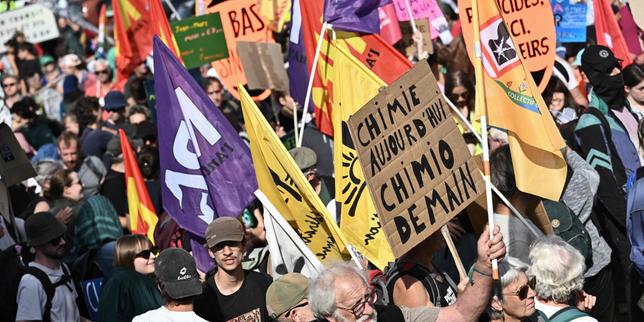
Across France right now, something is shifting. It is not the loud, screaming kind of shift that tears down barricades or sets tires on fire in the center of Paris. It is quieter, sharper, and far more stubborn. In town halls from Brittany to the foothills of the Pyrenees, bakers, retired schoolteachers, vineyard owners, and local mayors are standing up in rooms that smell of stale coffee and old wool, looking at proposed European decrees and saying a flat, uncompromising no.
They are fighting a bureaucratic tremor born in Brussels, a push toward regulatory relaxation that threatens to loosen the safety caps on pesticide residues permitted in our food, our soil, and our water. The argument coming from the boardrooms is always dressed in the clean, polished language of economic competitiveness. We need flexibility, they say. We need to stay efficient against global markets. We need to lighten the burden.
Listen closely to that word. Burden.
To a multinational chemical corporation, a safety regulation is a burden. It is a line item on a ledger, a friction point that slows down the distribution of profits. But to the family pulling water from a well three hundred feet beneath the limestone crust of rural France, the regulation is not a burden at all. It is a shield. It is the only thin line standing between a glass of clear drinking water and a lifetime of creeping cellular accumulation.
Consider what happens when a rule is loosened. A threshold shifts from one part per billion to two. To an accountant staring at a spreadsheet, the change looks microscopic, negligible. But nature does not calculate risk on a spreadsheet.
Imagine a drop of rainwater landing on a leaf treated with systemic protection. It does not vanish. It sinks. It migrates down the stem, into the root system, into the earth, and finally into the subterranean veins that feed the municipal pumps thirty miles away. It accumulates. In biology, persistence is destiny. What does not break down stays. And what stays inside a living organism eventually finds a home. It settles into fatty tissue. It crosses cellular walls. It whispers instructions to our biology that our DNA was never meant to hear.
This is why the mobilisations are spreading. They are fueled by a deep, rumbling exhaustion. For decades, citizens have been told to trust the system, to believe that science in the service of commerce always has a safety net ready. But when independent journalists and public health researchers publish maps showing municipal tap water contaminated above safety thresholds in entire departments—affecting millions of people who thought they were safe just because they lived far from heavy industry—the illusion cracks.
I remember talking to an agronomist last autumn who looked out over a golden wheat field and shook his head. He wasn't an activist waving a placard; he was a man who spent forty years studying soil microbes under a microscope. He told me something that has haunted me ever since.
"We used to think of the soil as a sponge," he said, stirring his espresso with a plastic spoon. "We thought whatever we poured on it washed through or degraded with the seasons. We were wrong. The soil has a memory. Every pesticide applied, every synthetic molecule engineered to outsmart nature, becomes part of the earth's permanent architecture. We are building a chemical museum underground, and our children are going to have to live inside the exhibit."
That is the emotional core of this entire struggle. It is not about left versus right, or farmers versus city dwellers, or even economics versus ecology. It is about stewardship versus short-term extraction.
The European proposals currently under fire do not just tweak numbers; they rewrite the social contract. They ask us to accept a baseline of chronic, low-dose exposure as the price of modern convenience. They invite us to normalize the presence of synthetic compounds in our urine, in our breast milk, in the umbilical cords of newborns.
And that is where the resistance finds its fire.
In small municipal gymnasiums lit by fluorescent tubes that hum with a high-pitched whine, people are organizing. They are drafting petitions. They are confronting local deputies. They are asking a very simple, devastating question: Who gave you the right to mortgage our biology for a quarterly profit margin?
The answer, of course, is that no one did. It happened quietly, in the background, while we were all busy paying our mortgages, raising our kids, and scrolling through our phones. It happened because complexity is a great hiding place. If you make a poison complex enough, and you spread its introduction over thirty years, people will mistake its accumulation for the natural order of things. They will think it is just normal to feel tired all the time, normal to see rising rates of endocrine disruption, normal to filter your tap water through three layers of carbon just to make a pot of tea.
But the illusion is breaking.
When you see a retired winemaker in the Dordogne stand up at a public meeting, his hands calloused and stained with the purple juice of forty harvests, holding up a glass of cloudy well water and demanding to know why his grandchildren shouldn't be allowed to drink it straight from the tap, the debate changes shape. It ceases to be an abstract trade dispute. It becomes human.
We stand at a fork in the road, though the signposts are rarely pointed out to us on the evening news. Down one path lies the total surrender of our biological commons—a world where every drop of rain carries a corporate copyright, and our bodies are just chemical dumping grounds optimized for efficiency. Down the other path lies a fight so difficult and stubborn that it feels quixotic at times: the insistence that some things are simply not for sale.
The mobilization in France is a warning flare. It tells us that people are beginning to realize what is actually at stake.
The rain will fall tonight over the vineyards and the rooftops. It will soak into the dark earth of the valleys and pool in the gutters of the cities. But beneath the surface of that quiet descent, a new kind of awareness is taking root. It is waking up. It is refusing to look away. And it is asking a question that the architects of deregulation will find very difficult to answer when morning comes.