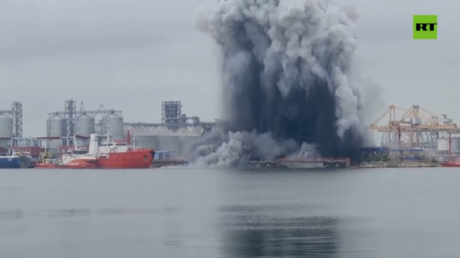
A Ukrainian naval drone packed with explosives drifted off course and detonated inside Romania’s critical port of Constanța on Friday, June 5, 2026. The incident forced a massive evacuation of the sprawling maritime hub, triggered Bucharest’s emergency "Red Intervention Plan," and sent shockwaves through NATO’s eastern flank. Driven blindly into berth 78 near a major oil terminal by Russian electronic warfare jamming, the weapon’s self-detonation marks a dangerous new chapter in the Black Sea conflict. The war is no longer just spilling over into NATO airspace via stray aerial drones; it is now actively washing ashore in its highest-volume commercial ports.
The explosion resulted in no casualties, but the tactical reality behind the blast is deeply troubling for Western military analysts. The Ukrainian Navy quickly took the unusual step of publicly acknowledging that one of its Unmanned Surface Vehicles (USVs)—believed to be a Magura V5 class maritime strike drone—had lost control under the weight of intense Russian electronic jamming. Kiev stated it had scrambled to notify Romanian authorities to prevent civilian loss of life, but the notice was barely ahead of the physical reality.
For two years, the focus of cross-border spillover has been on the skies above the Danube River. Just a week prior to this port blast, a Russian Shahed-type aerial drone veered off course after being struck by Ukrainian air defenses, crashing directly into a residential apartment building in the Romanian border city of Galați and injuring two civilians. But while falling aluminum and shattered lawn fixtures in rural border counties can be hand-waved away by diplomats as the unfortunate friction of proximity, a heavy explosive payload drifting freely into a sovereign NATO petroleum terminal cannot.
The Silent Killer of Black Sea Navigation
The mechanism that brought a Ukrainian strike asset to a Romanian oil berth is the invisible cornerstone of Russia’s modern defensive strategy. Electronic warfare (EW).
In the western Black Sea, Russian forces have deployed high-power jamming and spoofing arrays across occupied Crimea and from electronic-warfare-capable naval vessels. These systems do not destroy drones with kinetic force. Instead, they flood the civilian and military GPS spectrums with garbage data, blinding the satellite navigation systems that autonomous maritime craft rely on to find their targets.
When a Magura V5 drone loses its primary satellite link and its fallback inertial guidance systems degrade, it becomes a multi-million-dollar ghost ship. It drifts with the prevailing Black Sea currents, which run counter-clockwise, pushing floating objects directly south-southwest from the Ukrainian coast toward Romania and Bulgaria.
[Ukrainian Launch Site]
         │
         ▼
[Russian Electronic Warfare Jamming] -> (GPS & Satellite Link Severed)
         │
         ▼
[Autonomous Fail-Safe Lost]
         │
         ▼
[Counter-Clockwise Black Sea Currents]
         │
         ▼
[Romanian Coastline / Port of Constanța]
This is not a hypothetical failure chain; it is a mechanical certainty. The Magura V5 is designed to detonate upon contact or via an internal timer if it deems itself captured or permanently lost. The fact that the drone made it all the way into berth 78 at Constanța without being intercepted by the Romanian Coast Guard or Navy highlights a glaring vulnerability in Western port security.
The Illusion of Sanctuary at Constanța
Constanța is not just any port. It is the economic lung of Romania and the primary alternative transit hub for Ukrainian agricultural exports since the blockade and subsequent mining of Odessa's deep-water shipping lanes. Millions of tons of grain, fuel, and Western military aid pass through its 32 kilometers of quays annually.
The security apparatus deployed on Friday morning was massive, involving the Romanian Intelligence Service (SRI), the Border Police, and the Ministry of National Defense. Yet, the response was entirely reactive. Helicopters circled the harbor looking for more drifting hulls only after the detonation shook the oil terminal.
The harsh truth is that Western naval doctrines are structurally ill-equipped to handle stray, low-profile autonomous weapons.
- Radar Limitations: Surface-skimming maritime drones made of carbon fiber present a radar cross-section barely larger than a sea bird. In a choppy sea, distinguishing a deadly weapon from wave clutter is nearly impossible for standard commercial and harbor defense radars.
- The Defogging Delay: Harbor authorities are conditioned to look for traditional threats like rogue vessels, sea mines, or divers. A low-slung, dark gray remote-controlled speedboat drifting quietly among commercial tankers evades standard visual profiling until it is too late.
- The Proximity Threat: Because these assets are packed with hundreds of kilograms of military-grade explosives, even a successful kinetic interception using heavy machine guns near a harbor facility risks triggering a secondary explosion that could cripple port infrastructure.
The Failure of the Spillover Policy
For years, Bucharest and its NATO allies have treated border incursions with calculated passivity. When Russian drone debris repeatedly rained down on the Danube wetlands of Tulcea and Periprava over the last two years, Romania chose to monitor rather than shoot. The logic was sound on paper. By classifying these incidents as accidental "spillover," NATO avoided the escalatory trap of invoking Article 5 over stray scrap metal.
That policy of deliberate patience is dying under the weight of reality.
You cannot treat an exploding drone at a vital energy terminal the same way you treat a shattered propeller blade in an empty sunflower field. The psychological shift among the Romanian populace is already palpable. Air raid sirens, once a distant echo heard across the river from Ukrainian ports like Reni and Izmail, are now a localized reality for citizens along the Black Sea coast.
Romania has recently attempted to bolster its local defenses along the Danube by testing the Merops counter-drone system—a U.S.-backed, AI-driven low-altitude interceptor designed to down cheap loitering munitions. But Merops is built for the skies, not the surf. NATO’s eastern flank currently has no unified, operational network designed to detect and neutralize rogue underwater or surface-swimming vehicles before they breach international harbor limits.
The Strategic Conundrum for Bucharest
The political fallout of Friday’s blast places Romanian President Nicușor Dan in an impossible diplomatic position. Bucharest cannot aggressively condemn Ukraine for an accident caused by Russian electronic interference, yet it cannot tolerate its primary economic engine being transformed into an accidental warzone.
If Romania deploys aggressive physical barriers—such as anti-submarine nets, boom defenses, and round-the-clock naval patrols around Constanța—it will severely choke the speed of commercial shipping. In the shipping industry, delay is a financial death sentence. Insurance premiums for vessels entering the Black Sea, already exorbitant since 2022, are projected to spike again following this harbor detonation.
The Black Sea is shrinking. As electronic warfare tactics neutralize the precision of autonomous weapons, the geographical boundaries of the war will continue to blur. The explosion in Constanța was a warning shot delivered by the law of unintended consequences. The next drifting weapon may not find an empty berth.



:max_bytes(150000):strip_icc()/how-many-types-of-dwarfism-are-there-2860725-v1-8dae2c531b4b47d9ae36ae404d3308a0.png)