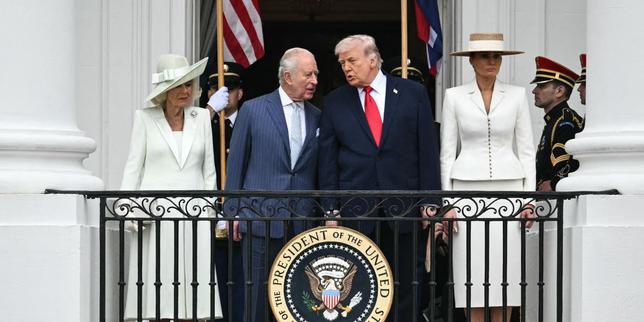
The operational efficacy of a political system is measured by its capacity to absorb shocks without compromising its core structural integrity. When examining the contrasting archetypes of the British Constitutional Monarchy and the American Executive Presidency—specifically through the behavioral lenses of King Charles III and Donald Trump—the primary differentiator is the decoupling of symbolic authority from functional power. The British model functions as a high-inertia stabilizer, while the American model, particularly under populist leadership, operates as a high-velocity feedback loop.
The Architecture of Neutrality vs The Mandate of Agitation
The British Crown serves as a "Constitutional Heat Sink." Its primary function is to draw the heat of national identity and historical continuity away from the friction-heavy machinery of daily governance. This creates a firewall between the personhood of the sovereign and the policy of the state. King Charles III operates within a rigid framework of "tripartite rights": the right to be consulted, the right to encourage, and the right to warn. These are non-executive functions that prioritize long-term institutional preservation over short-term political wins.
In contrast, the American Executive Presidency consolidates symbolic, military, and administrative power into a single individual. When an incumbent like Donald Trump occupies this role, the office undergoes a process of "Personalization of Power." The presidency stops being an abstract node in a system of checks and balances and becomes an extension of the incumbent’s brand. This consolidation removes the buffer between the state and the individual, meaning every rhetorical fluctuation by the President translates directly into market volatility or diplomatic friction.
The Mechanism of Continuity The King’s Strategic Silence
The effectiveness of King Charles III as a democratic stabilizer relies on the "Opaque Mandate." By maintaining a public vacuum on specific legislative debates, the King allows the democratic process (Parliament) to function as the primary site of conflict. This is not passive; it is a deliberate structural strategy.
- Conflict Deflection: By remaining apolitical, the monarch ensures that the Head of State remains a viable unifying figure for 100% of the population, regardless of which party holds the majority.
- The Durability of Precedent: Charles III’s transition from an activist Prince of Wales to a restrained Monarch demonstrates the "Institutional Gravity" of the Crown. The office reshapes the man to fit the requirement of stability.
Donald Trump’s methodology is the inverse. His strategy relies on "Friction-as-Leverage." Instead of deflecting conflict to other branches of government, he centers the conflict within his own persona. This maximizes short-term mobilization among a base but creates a "Systemic Stress Test" for every other institution, from the Department of Justice to the electoral college. Where the King uses silence to protect the office, Trump uses volume to expand it.
Quantification of Influence Soft Power vs Hard Executive Orders
We can measure the divergence between these two styles by looking at their respective "Influence Vectors."
- The Monarch’s Vector (Influence without Authority): Charles III utilizes soft power—convening global leaders on climate or urban planning without the power to tax or legislate. This creates a "Consent-Based Leadership" model. It is durable because it does not rely on coercion.
- The President’s Vector (Authority with Contested Influence): Trump utilizes hard power—executive orders, vetoes, and appointments. While this produces immediate results, it creates "Elastic Policy." Because the policy is tied to the individual’s mandate rather than broad institutional consensus, it is often snapped back or reversed by the next administration or the judiciary.
The cost of the King’s model is a lack of direct agency; the cost of the Trump model is a lack of permanence.
The Resilience Function Assessing Systemic Risk
The fundamental question of political strategy is: What happens when the leader fails?
The British system handles leader failure through a "Decoupled Replacement." If a Prime Minister fails, the Head of State (the King) remains, providing a psychological and legal anchor while a new executive is selected. The system does not require a total reboot.
In the American system, as demonstrated during the Trump administration and the subsequent transition periods, the failure or perceived illegitimacy of the President threatens the entire stack of governance. Because the President is the state in the eyes of the public, a crisis of the person becomes a crisis of the constitution.
The Paradox of Democratic Legitimacy
A common critique suggests that a hereditary monarch is inherently undemocratic compared to an elected president. However, a structural analysis suggests a different conclusion: The Monarch protects democracy by "Occupying the Space." By holding the highest symbolic office through birth rather than ambition, the King prevents any political actor from achieving total symbolic dominance.
Donald Trump’s career represents an attempt to occupy that same symbolic space through the ballot box. This creates a "Monopolistic Executive," where the leader claims to be the sole true representative of "the people." This claim bypasses traditional democratic intermediaries like the press, the courts, and the legislature.
- The King’s Legitimacy is derived from History (Passive).
- Trump’s Legitimacy is derived from Performance (Active).
Performance-based legitimacy requires constant escalation to maintain its potency. This leads to a "Volatility Trap," where the leader must create increasingly disruptive events to prove their relevance and mandate.
The Cost of Institutional Erosion
Every time a leader bypasses a norm, they incur an "Institutional Debt." King Charles III is currently in a phase of "Debt Repayment"—reaffirming traditional protocols to stabilize the UK after the dual shocks of Brexit and the passing of Queen Elizabeth II. His strategy is one of "Minimalist Intervention."
Donald Trump’s strategy is "High-Leverage Disruption." By challenging the validity of elections, the impartiality of the judiciary, and the necessity of traditional alliances, he gains immediate tactical flexibility. However, the long-term interest on this debt is a decline in "Social Capital." When the citizens of a state no longer trust the neutral operation of its institutions, the cost of governance increases exponentially through litigation, protest, and civil unrest.
Strategic Forecast for Executive Models
The global trend is currently oscillating between these two poles. We are seeing a rise in "Aspirational Trumpism" in various republics—leaders who seek to consolidate symbolic and executive power to bypass "stagnant" institutions. Simultaneously, there is a renewed valuation of "The Charles Method"—the use of non-partisan, high-status figures to act as national moderators.
For a system to survive the next fifty years of technological and social acceleration, it must adopt the "Modular Resilience" found in the UK model. This does not require a King, but it does require a separation of the "Chief Celebrant" (the symbolic leader) from the "Chief Executive" (the policy leader).
The American presidency is currently "Overloaded." It asks a single human being to be a commander-in-chief, a chief legislator, a head of a political party, and a national comforter. This is a "Single Point of Failure" design.
To mitigate the risks identified in the Trump era, the strategic play is the "Functional Partitioning" of the executive branch. This involves strengthening the civil service (the "Deep State" in populist parlance, but more accurately the "Permanent Administration") and re-empowering legislative committees to act as autonomous power centers. This mimics the stability of the Constitutional Monarchy by ensuring that the "Ship of State" maintains its heading regardless of who is currently at the helm. The goal is to move from a system of "Personalized Volatility" to one of "Distributed Stability."