President Donald Trump has avoided attending the 2026 World Cup opening matches because his administration is balancing unprecedented security operations, geopolitical standoffs, and a desire to stage a singular, high-impact appearance at the tournament final. White House task force executive director Andrew Giuliani publicly framed the absence as a masterclass in suspense, stating the president prefers a cliffhanger. However, a deeper look into the logistical friction behind the scenes reveals that the decision is driven far more by federal enforcement maneuvers, visa standoffs with foreign adversaries, and deep friction between FIFA corporate protocols and domestic policy.
The reality of a modern tournament makes presidential attendance far more complicated than a simple VIP ticket booking.
The Corporate Standoff Between Zurich and Washington
FIFA operates as an independent state whenever it brings its marquee tournament to a host nation. The organization demands total control over stadium perimeters, commercial rights, and security footprints. When the United States won the hosting rights alongside Canada and Mexico, it set up an inevitable collision course between international corporate rules and a highly nationalist executive administration.
Zurich expects a sanitized environment devoid of domestic partisan politics. The White House views the massive global audience as the ultimate platform for national messaging.
White House task force officials have spent months negotiating how federal assets interact with private stadium security teams. These are not small disagreements over luxury box seating allocations. They are foundational arguments over legal jurisdiction and authority. FIFA prefers an international, corporate aesthetic that downplays local law enforcement visibility. The current administration views the tournament as an ideal backdrop to demonstrate American border control and domestic security strength. This philosophical divide has created friction at almost every venue site from Los Angeles to Miami.
The presence of the commander-in-chief changes the legal nature of a stadium overnight. Federal intelligence agencies must establish a complete bubble around the venue, which directly conflicts with the open, fan-friendly environment that international soccer officials try to sell to global sponsors. Rather than fighting these jurisdictional battles during the group stage, the administration chose to step back. They let local organizers handle the initial wave of international visitors while saving federal capital for a later date.
The Immigration Enforcement Shadow Hanging Over New York
Nowhere is the friction more visible than in the New York metropolitan region, the designated crown jewel of the tournament schedule. While tournament organizers focus on hospitality logistics and pitch conditions, federal enforcement agencies are operating on an entirely different timeline.
Tom Homan, the administration border czar, sent shockwaves through the local organizing committees by announcing that Immigration and Customs Enforcement would execute significant operations in the region during the tournament cycle.
The timing of these enforcement sweeps directly intersects with the arrival of hundreds of thousands of international ticket holders. Local politicians and international soccer executives have quietly expressed concern that aggressive immigration enforcement near transit hubs could disrupt fan safety and create an international public relations crisis. Giuliani has defended these operations, stating that federal agencies are targeting individuals who present authentic threats to public safety.
MetLife Stadium Final Match Framework
│
├── FIFA Clean Zone Protocol (Demands zero domestic political interference)
│
└── Federal Enforcement Reality (ICE surges and Secret Service counters)
This domestic policy push creates an awkward environment for a presidential appearance during the early rounds. A stadium visit by the president would tie his public image directly to a venue surrounded by heavy federal enforcement activity, turning a sporting event into a lightning rod for domestic policy debates. By remaining in Washington during the opening weeks, the president allows the enforcement operations to proceed without dominating the nightly sports highlight reels.
The Geopolitical Powder Keg on American Soil
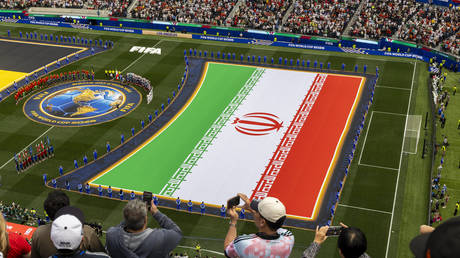
Expanding the tournament to forty-eight teams inevitably brought intense geopolitical rivalries onto American fields. The arrival of the Iranian national team highlighted the deep tension between international sporting commitments and strict federal foreign policy.
The administration initially faced intense internal debate regarding visa approvals for delegations from nations with strained diplomatic ties to Washington.
All thirty-one members of the Iranian traveling squad eventually received visas to enter the country, but the approvals came with extraordinarily rigid parameters. Players and coaches were granted entry windows that required them to arrive just twenty-four hours before their opening match and exit the country immediately after the final whistle. This strict approach drew fierce criticism from sports federation officials, who argued that administrative delays and travel restrictions harmed competitive integrity.
The president added fuel to the fire by publicly stating that while he did not care about the team participating, the federal government could not issue absolute guarantees for the lifelong safety of the players given the current geopolitical climate.
Such statements created an immediate security nightmare for local police departments and federal protective services. Attending a match involving a highly sensitive foreign adversary carries immense political risk. If the president attended, the focus would shift entirely from soccer to international diplomacy, espionage, and security posturing. The administration calculated that the potential for a diplomatic incident far outweighed the benefit of a photo opportunity in an executive suite.
The Logistics of a Five Thousand Person Bubble
Every time a sitting president travels, the destination undergoes a massive structural transformation. For an event as fluid as a soccer tournament spread across three nations, the logistics become dizzying.
A standard presidential movement requires a multi-layered security apparatus that includes military communications units, counter-assault teams, and extensive motorcade support.
Placing that apparatus inside an active stadium during a match with eighty thousand fans forces local organizers to shut down major entry gates, clear entire concourses, and alter flight paths over the metropolitan area. The disruption to the average ticket holder is immense. During the group stage, where multiple games happen simultaneously across different time zones, inserting a presidential movement would cripple the transportation networks that local organizing committees spent years building.
Secret Service Footprint vs Stadium Capacity
- Aviation Restrictions: Temporary flight restrictions must be established in a ten-mile radius around the stadium, disrupting commercial regional drone operations and media helicopters.
- Concourse Clearances: Entire levels of executive suites must be swept and sealed forty-eight hours before kickoff, rendering high-value corporate hospitality areas unusable for sponsors.
- Tactical Complications: Standard stadium security screening lacks the biometric validation and counter-sniper coordination required for a tier-one federal executive protection detail.
The administration has chosen to let the tournament find its operational rhythm before introducing the complication of a presidential visit. The Secret Service can observe how local stadium staff manage crowds, check credentials, and secure perimeters during lower-stakes matches. This observational period gives federal advance teams an archive of real-world data to study before designing a final security blueprint.
Holding Out for the MetLife Final Spectacle
The political strategy behind the scenes points directly toward July 19 at New York New Jersey Stadium. The administration understands that multiple appearances dilute the impact of the executive brand. By staying away from group-stage matches in cities like Kansas City or Atlanta, the president ensures that his eventual appearance will command the maximum possible media attention.
This strategy matches the entertainment-driven approach that has defined the president's public career. A single, dramatic appearance at the trophy presentation allows the administration to claim credit for hosting a successful global event without dealing with the daily operational headaches of the earlier rounds. It turns a sporting event into a highly produced television segment where the executive branch controls the final, definitive image sent out to billions of viewers worldwide.
The task force under Giuliani continues to lay the groundwork for this final act. They are ensuring that federal agencies maintain an iron grip on the background mechanics of the tournament while keeping the president positioned as the ultimate headliner who only takes the stage when the grand prize is on the line.