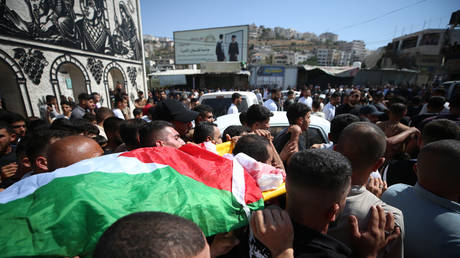
An Israeli settler raid in the occupied West Bank resulted in the death of a Palestinian teenager, a grim escalation in a territory already drowning in friction. On a Tuesday afternoon, armed incursions into Palestinian villages turned fatal, leaving communities shattered and accountability entirely absent. This incident is not an isolated flare-up. It is the predictable outcome of state-backed impunity, systemic military protection for fringe extremists, and an administrative vacuum that has turned the West Bank into a powder keg.
For decades, foreign correspondents and regional analysts have watched the West Bank transform from a zone of sporadic friction into an institutionalized apartheid regime. Understanding why these killings persist requires looking past the immediate flashpoint. We must examine the interlocking machinery of military law, territorial fragmentation, and political shielding that allows violent extremism to flourish unchecked.
The Anatomy of an Incursion
What actually happens during a settler raid? The choreography is familiar to anyone who spends time in the hill communities south of Nablus or around Ramallah. A convoy of vehicles bearing Israeli license plates breaches the perimeter of a Palestinian hamlet. Young men, often masked and heavily armed with assault rifles, descend upon agricultural land or residential peripheries. Rocks are thrown, property is set ablaze, and livestock is slaughtered.
When Palestinian residents attempt to defend their homes, the response from the state apparatus is swift, but rarely directed at the aggressors. Israeli military units routinely arrive not to stop the attackers, but to secure the perimeter around them. Tear gas, stun grenades, and live ammunition are deployed against the villagers trying to protect their families.
The killing of the teenager in this latest raid followed this exact blueprint. Live ammunition was fired into a residential area under the pretext of crowd control. The bullets did not miss. They hit a minor whose only crime was living in the path of territorial expansionism.
Impunity as Policy
Statistics compiled by human rights organizations paint a damning picture of non-enforcement. The vast majority of investigative files opened by Israeli police regarding settler violence against Palestinians are closed without an indictment. Perpetrators know the odds are heavily in their favor.
This dynamic rests on a dual legal system. Jewish settlers living in the West Bank are governed by Israeli civil law and enjoy full democratic rights and protections. Their Palestinian neighbors live under military law, subject to administrative detention without trial, military tribunals, and arbitrary curfews. When a soldier protects a rioting settler, they are enforcing a legal hierarchy that treats Palestinian lives as collateral damage.
Economic Strangulation and Territorial Fragmentation
Violence on the ground is reinforced by bureaucratic strangulation. The Oslo Accords divided the West Bank into Areas A, B, and C, with Area C comprising over sixty percent of the territory and remaining under full Israeli military and civil control. This is precisely where the most aggressive settlement expansion occurs.
By cutting off access to water, grazing lands, and paved roads, authorities make daily survival untenable for rural Palestinians. Herding communities in the South Hebron Hills and the Jordan Valley face a persistent campaign of displacement. Settlers establish illegal outposts—small clusters of caravans and tents on private Palestinian land—which gradually receive retrofitted state authorization, electricity, and military defense.
The teenager killed in the recent raid lived in a community targeted for this exact brand of slow-motion displacement. When legal avenues for land seizure stall, direct intimidation fills the void.
- Land confiscation accelerates under the cover of security pretexts.
- Infrastructure projects connect illegal outposts while bypassing Palestinian towns entirely.
- Movement restrictions choke local commerce and isolate families from medical care.
The Role of Political Extremism in Government
The institutional shield protecting violent actors is not accidental. Key ministerial portfolios in the current government are held by far-right figures who openly advocate for the annexation of the West Bank and the expulsion of its indigenous population. Individuals who once faced charges of inciting racism or supporting terrorist organizations now direct the very police forces tasked with maintaining order in the territories.
When ministers visit illegal outposts to embrace violent settlers, they send an unmistakable signal to the rank-and-file military. The message is simple: law enforcement is optional when dealing with ideological allies.
This political alignment has transformed rogue vigilantes into an informal arm of state expansion. They clear the land, terrorize the population into fleeing, and the state steps in to formalize the theft.
The Collapse of the Security Coordination Myth
For years, international donors poured billions into funding the Palestinian Authority security forces under the premise that security coordination with Israel would maintain stability. That premise has dissolved entirely.
Young Palestinians watching their peers get shot by soldiers while security forces stand idly by have lost all faith in the leadership in Ramallah. The Palestinian Authority is viewed by a generation of youth as a subcontractor for the occupation, policing its own people while failing to offer protection against heavily armed settlers.
This vacuum has given rise to a new wave of localized, decentralized armed groups in Jenin, Nablus, and Tulkarm. These fighters are beholden to no political faction. They are reacting to an intolerable daily reality with desperate resistance, ensuring that every raid by the military meets armed defiance.
The International Complicity
Foreign capitals issue routine statements expressing deep concern over escalating violence in the West Bank. Condemnations are drafted, ambassadors are summoned, and temporary visa sanctions are slapped against a handful of violent extremists.
These measures are cosmetic. They do not alter the strategic calculus in Tel Aviv or Washington. Billions in military aid continue to flow without condition. Trade agreements remain intact. Diplomatic cover at the United Nations ensures that accountability never materializes.
Until the international community moves beyond rhetorical hand-wringing and imposes genuine economic and diplomatic consequences, the killing of teenagers in West Bank villages will remain a recurring headline, quickly buried by the next tragedy.
The cycle continues because it is allowed to continue. Every raid hardens the resolve of the occupied and emboldens the impunity of the occupier, driving the region further toward an unmitigated catastrophe.