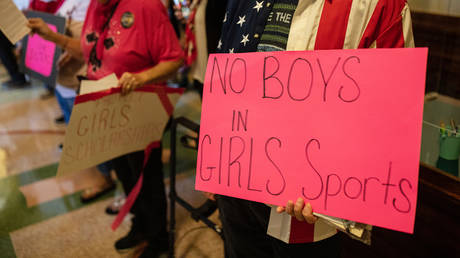
The federal government cannot directly force Democratic states to ban transgender athletes from women’s sports, but it is using a financial vice grip to achieve the exact same result. Following the Supreme Court’s June 2026 ruling in West Virginia v. B.P.J., which affirmed that state-level athletic bans are constitutional, the legal battlefield has shifted from local legislatures to federal funding channels. While progressive governors promise their states will remain safe havens for transgender youth, a coordinated wave of federal lawsuits, administrative penalties, and funding threats from Washington is quietly giving school districts a brutal choice between matching federal policy or facing total bankruptcy.
The illusion of state sovereignty in high school and collegiate sports shattered on the final day of the Supreme Court's term. In a 6-3 decision, the conservative majority ruled that separating athletic teams by biological sex does not offend the Equal Protection Clause or Title IX. Justice Brett Kavanaugh noted that states are the appropriate entities to assess these athletic lines. What the court left unsaid, however, is that federal agency enforcement can make those local choices irrelevant. Meanwhile, you can explore similar stories here: The Illusion of the Indo-Pacific Axis Why India and Indonesia Are Strategic Strangers.
The Financial Chokehold on Local School Districts
For decades, public education has relied heavily on the carrot-and-stick mechanism of federal funding. Under Executive Order 14201, signed early last year, the White House directed the Department of Education to strip federal funds from any educational institution that allows transgender women to compete on girls' teams. This is not an abstract threat.
The mechanism relies on Title IX compliance reviews. When a local school board in a state like California or Minnesota permits a transgender athlete to play, the federal government triggers an investigation. The Department of Education then issues a finding of non-compliance, giving the district a brief window to alter its policy or lose all federal funding. For major urban school districts, federal dollars represent up to fifteen percent of their total operational budget. Losing that money means laying off teachers, canceling programs, and closing school doors. To see the full picture, check out the excellent article by NPR.
Faced with this reality, local superintendents are refusing to become martyrs for state policy. Internal memos from school boards across New York and Washington reveal a growing panic among compliance officers. State laws might protect gender identity, but state laws do not replace missing federal lunch program funds or special education grants.
The Multi Pronged Legal Assault on Blue States
Conservative advocacy groups are not waiting for federal agencies to do all the heavy lifting. Organizations like Defending Education and Female Athletes United have launched a wave of secondary litigation targeting progressive strongholds. These lawsuits utilize the Supreme Court’s recent definitions of biological sex to sue individual school districts in federal court, circumventing state-level protections entirely.
The strategy works by identifying cisgender female athletes who have finished behind transgender competitors in state tournaments. By filing federal lawsuits under the newly interpreted Title IX framework, these litigants demand the erasure of athletic records and the redistribution of college scholarships.
Federal Pressure Points on Democratic States:
1. Executive Order 14201 Compliance Reviews
2. Department of Justice Civil Rights Lawsuits
3. Private Title IX Litigation Against School Boards
4. Grand Jury Subpoenas for Healthcare Records
The Department of Justice has already filed formal lawsuits against Maine, California, and Minnesota. These actions argue that by maintaining trans-inclusive sports policies, state athletic associations are systematically discriminating against cisgender women under federal law. When federal law and state law collide, the Supremacy Clause of the United States Constitution dictates that federal authority wins. Progressive attorneys general are finding their traditional states-rights arguments inverted, forced to defend local policies against an aggressive federal apparatus.
The Escalation into Medical Privacy
The fight has moved beyond the locker room and into the hospital records room. A federal grand jury in Fort Worth, Texas, recently issued subpoenas to major healthcare systems in New York City, demanding the identities and medical histories of youth treated for gender dysphoria. This escalation points to a larger, more coordinated strategy to track and enforce biological definitions of sex at birth.
Civil rights attorneys argue these subpoenas represent a terrifying overreach of federal power. The objective is to compile a federal registry of individuals who have transitioned, making it impossible for athletes to quietly participate under state-level self-identification policies. By targeting the medical pipeline, federal prosecutors can identify non-compliant institutions and athletes before they ever step onto a competitive field.
Democratic governors have responded with executive orders forbidding state agencies from cooperating with out-of-state subpoenas. Minnesota Governor Tim Walz asserted that his state would remain a welcoming environment, but state agencies cannot prevent a federal grand jury from enforcing a subpoena against a private hospital system that operates across state lines. The jurisdiction of the federal government overrides state-level shield laws.
Public Opinion Shifts the Political Calculations
The legal strategy is succeeding because it aligns with a massive shift in public sentiment. Recent polling indicates that nearly eighty percent of Americans now support restricting sports categories strictly to sex assigned at birth. This consensus crosses traditional partisan lines, leaving Democratic politicians in a vulnerable position.
Suburban voters who typically lean progressive on environmental or economic issues have shown deep resistance to trans-inclusive policies in competitive youth sports. This electoral vulnerability has caused a quiet fracturing within the Democratic coalition. While some lawmakers demand total resistance to federal mandates, others are privately urging state athletic associations to compromise before the issue destroys their chances in the upcoming midterm elections.
The administrative burden of fighting these battles is already taking a toll. School districts are spending hundreds of thousands of dollars in legal defense fees to fight federal enforcement actions. That money comes directly out of operational classrooms, creating friction with parents who care more about basic education than national culture wars.
The Collateral Damage of Biological Verification
To enforce a absolute ban based on biological sex, schools must implement verification procedures. This is the messy reality that proponents of federal bans rarely discuss in public. In states that have already enacted bans, implementing these rules has required invasive administrative tracking.
Some state policies allow parents or rival schools to challenge an athlete’s sex, forcing young women to produce birth certificates, genetic testing results, or medical examinations to prove their eligibility. This process does not just impact transgender athletes. Cisgender girls who excel in sports or possess physical traits that deviate from traditional feminine archetypes are increasingly facing intrusive challenges from disgruntled opponents.
State vs. Federal Authority Conflict Matrix:
┌──────────────────────────────┬──────────────────────────────┐
│ Progressive State Protections│ Federal Enforcement Tactics  │
├──────────────────────────────┼──────────────────────────────┤
│ Gender identity shield laws  │ Grand jury medical subpoenas │
│ Trans-inclusive sports rules │ Title IX funding revocations │
│ State civil rights statutes  │ Supremacy Clause litigation  │
└──────────────────────────────┴──────────────────────────────┘
The administrative burden of managing these challenges creates an environment of suspicion. Rather than creating a fair playing field, it turns high school sports into a bureaucratic surveillance state where every high-performing female athlete is subject to scrutiny.
The End of the Two Tiered System
For the past several years, America operated under a two-tiered athletic system. Red states banned transgender women from female sports, while blue states permitted their participation under varying degrees of hormone-regulation requirements. The Supreme Court's ruling and the federal government's funding threats are making this dual reality impossible to maintain.
National athletic governing bodies like the NCAA and various high school athletic federations cannot operate under fifty different sets of rules. The NCAA changed its policy last year to limit women's collegiate competitions exclusively to athletes assigned female at birth, citing the impossible logistics of managing conflicting state laws and federal funding risks. When national organizations standardize their rules to align with federal mandates, individual states lose their ability to chart an independent course.
A state can pass all the inclusive legislation it wants, but if its universities are barred from participating in national championships, those policies will collapse under their own weight. College athletes looking for professional futures will avoid schools in states that are locked out of the national athletic ecosystem.
The Bankruptcy Strategy Succeeds
The federal campaign to eliminate transgender athletes from women’s sports in Democratic states does not require a sweeping act of Congress or a specific constitutional amendment. It requires only the steady, unyielding application of administrative pressure. By systematically choking off education funding, launching targeted federal lawsuits against vulnerable school boards, and forcing national athletic organizations to standardize their rules, the federal government is achieving its goals through bureaucratic attrition.
Progressive states are discovering that their statutory protections are nothing more than paper shields against the financial power of the federal purse. The question is no longer whether America will ban transgender athletes in Democratic states. The question is how long those states can afford to pretend they have a choice.