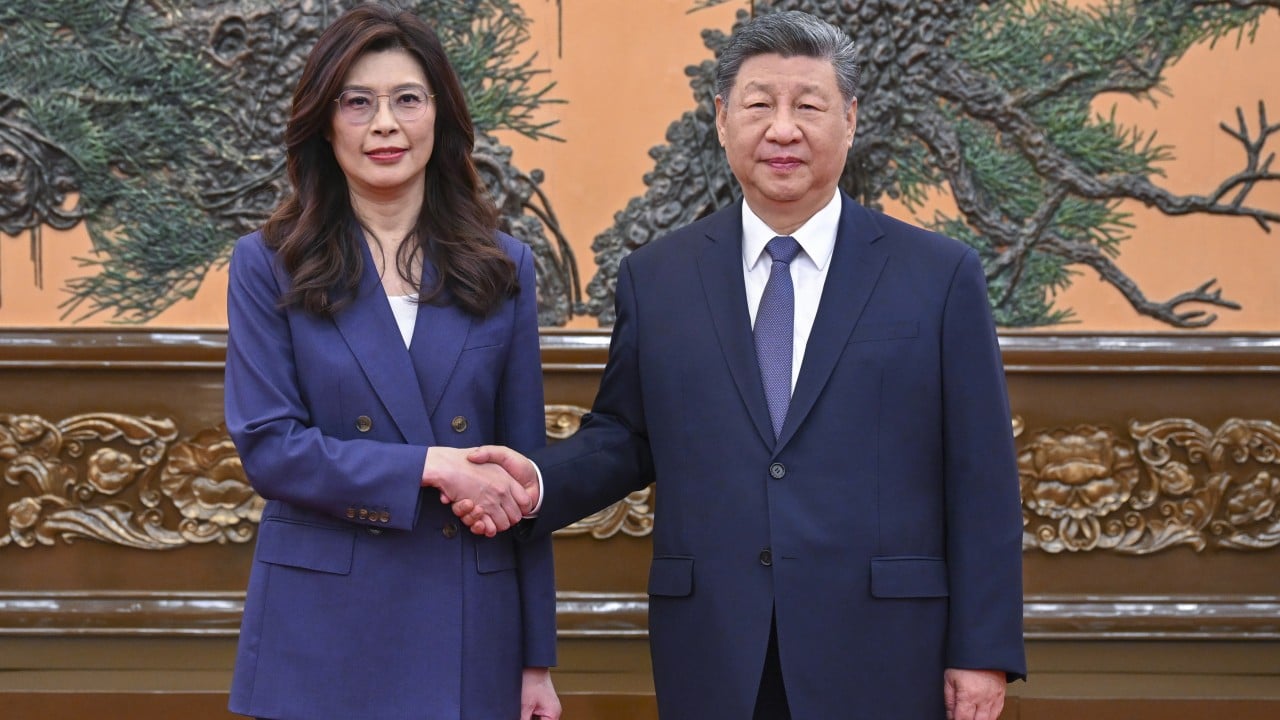
Kuomintang Chairwoman Cheng Li-wun arrived in the United States this week with an audacious objective to convince Washington that her opposition party is the ultimate guarantor of peace in the Taiwan Strait. To achieve this, she must overcome profound skepticism from American policymakers who are alarmed by the party's recent actions, which include slashing Taiwan's defense spending and pursuing high-profile engagements with Beijing. The Kuomintang, or KMT, is facing a credibility deficit in Washington, where its strategy of balancing ties between the United States and China is increasingly viewed not as a diplomatic masterclass, but as a severe security vulnerability.
Cheng's fifteen-day tour, which includes high-stakes stopovers in Washington and Boston, is designed as a damage-control mission. Just two months ago, she stood in Beijing shaking hands with Chinese President Xi Jinping, marking the first such meeting for a KMT leader in a decade. Weeks later, her party used its legislative majority in Taipei to block a proposed forty-billion-dollar defense package, ultimately forcing a budget cut of nearly one-third. Now, Cheng is attempting to rebrand these controversial moves as responsible statecraft, arguing that the KMT is preventing Washington from being dragged into an avoidable war. Learn more on a related subject: this related article.
The strategy hinges on an appeal to the current administration. Cheng has publicly expressed a strong willingness to meet with U.S. President Donald Trump, a move that would break decades of diplomatic protocol. Her broader pitch relies on persuading American lawmakers and think-tank analysts that the Republic of China Constitution is fundamentally a "one China" document. In her view, this legal framework offers a unique mechanism for cross-strait reconciliation while preserving Taiwan's democratic status quo.
The Double Standard on Defense
American officials are highly skeptical of Cheng's arguments. For years, Washington has urged Taiwan to adopt an asymmetric warfare strategy, which requires substantial investments in drones, anti-ship missiles, and resilient command-to-control systems. When the KMT gutted the government’s defense bill, it undermined those exact capabilities. Additional analysis by Reuters highlights comparable views on the subject.
KMT leadership defends the budget cuts by claiming they are exercising fiscal oversight and targeting administrative inefficiency. Yet the political reality is far more complicated. By blocking critical weapons acquisitions, the opposition party signals to Beijing that Taiwan lacks the political will to sustain a prolonged defense strategy. This approach directly conflicts with Washington's deterrence policy, which depends on Taipei demonstrating an unwavering commitment to self-defense.
American lawmakers across the political spectrum view these budget cuts as a profound contradiction. The KMT cannot reasonably demand ironclad security guarantees from the United States while simultaneously defunding its own military infrastructure. This dynamic transforms Cheng's visit from a standard diplomatic outreach mission into an intense interrogation regarding the party's core loyalties.
The Myth of Creative Ambiguity
Cheng's diplomatic platform is built on reviving a modified version of the 1992 Consensus, which she frames as a necessary constitutional anchor. This concept relies on the idea of creative ambiguity, where both sides of the strait acknowledge there is only "one China" but agree to disagree on what that means in practice. For decades, this formula allowed the KMT to facilitate trade agreements and ease military tensions with the mainland.
That ambiguity has largely collapsed. Beijing has systematically redefined the framework, leaving no room for Taipei's interpretation and explicitly linking it to a mandatory path toward unification. Consequently, what the KMT presents to Washington as a pragmatic peace tool is viewed by American national security experts as a dangerous concession to Chinese coercion.
The ruling Democratic Progressive Party has seized on this vulnerability, accusing the KMT of promoting a policy that compromises Taiwan's sovereignty. Cheng has countered by claiming the ruling party has hijacked the constitution and is pushing a dangerous independence narrative that risks triggering a conflict. This intense domestic political warfare has now spilled directly into the halls of Congress.
Washington's Realignment and the Trump Factor
The geopolitical landscape Cheng is trying to navigate has shifted dramatically. Washington is no longer interested in maintaining an ambiguous status quo that allows Beijing to expand its regional influence unchecked. The current American administration views the cross-strait issue through the lens of intense strategic competition, meaning any perceived accommodation of Beijing's interests is treated with suspicion.
Cheng's push for a meeting with President Trump is a calculated gamble designed to bypass traditional diplomatic channels. She is betting that her message of avoiding an expensive, destabilizing war will resonate with an administration focused on reducing foreign commitments. However, this strategy overlooks a fundamental reality: the administration's policy toward China is driven by a desire to maintain absolute American deterrence in the Pacific, an objective that is incompatible with a Taiwanese leadership that seeks to scale back its own military readiness.
Instead of securing deep trust, Cheng faces a coordinated pushback from American officials. The American Institute in Taiwan has already noted that international observers are questioning whether the KMT is fundamentally altering its geopolitical orientation. Rather than projecting strength, the KMT's current posture makes it look increasingly isolated.
The High Cost of the Middle Ground
The central flaw in the KMT's diplomatic strategy is the belief that Taiwan can continue to operate as a neutral buffer between two competing superpowers. As Washington accelerates its economic and technological decoupling from China, the space for a middle-ground position is rapidly disappearing.
Taiwan's critical role in the global semiconductor supply chain means its security architecture cannot be separated from international economic stability. By attempting to placate Beijing to secure short-term peace, the KMT risks alienating the international partners required to guarantee Taiwan's long-term survival.
Cheng's mission to Washington is exposing the profound limits of traditional cross-strait diplomacy. The KMT can no longer rely on outdated diplomatic formulas to assure the United States of its reliability as an ally. If the opposition party fails to offer a credible, fully funded defense strategy during this tour, it will confirm Washington's worst fears: that Taiwan's largest opposition party has become the weakest link in the island's defense strategy.