On Tuesday, July 14, 2026, Supreme Court Justices Elena Kagan and Amy Coney Barrett will step out of their marble sanctuary to testify before a House Appropriations subcommittee, marking a rare and tense moment of congressional scrutiny. This is the first time sitting justices have testified since 2019. They are not there to discuss constitutional law, but to ask for $228 million—including $14.6 million to drastically beef up their personal protection details—highlighting a judicial security crisis fueled by unprecedented polarization and public rage.
This high-profile defense of the Supreme Court budget is more than a routine appropriations request. It is a stark admission that the highest court in the land is operating under virtual siege. For decades, the justices relied on a quiet consensus of institutional respect as their primary shield. Today, that shield is completely gone. In its place is a requested fleet of new security agents, off-site residential monitoring hubs, and a rapidly inflating security apparatus designed to protect public figures who have become targets of deep political anger.
A Historic Breach of Judicial Isolation
The appearance of Barrett and Kagan on Capitol Hill represents a major break from modern judicial tradition. Historically, the Supreme Court has guarded its independence with extreme jealousy, keeping congressmen at arm's length and rarely submitting to public questioning. The last time justices testified on budget matters was seven years ago, when Kagan appeared alongside Justice Samuel Alito. Before that, such appearances were infrequent duties left to a rotating cast of administrators or the occasional justice willing to endure the political theater of a congressional hearing.
By sending a prominent liberal and a prominent conservative to testify together, the court is trying to present a unified front. The message is clear: personal safety has no political party.
Yet, the timing of this public plea is politically charged. The hearing takes place only weeks after the conservative-majority court wrapped up a historic and deeply controversial term. Recent rulings have stripped authority from federal regulatory bodies and expanded presidential immunity, drawing intense public fire and personal criticism of the justices. The court is asking for millions of dollars from the very branch of government where many lawmakers have spent the last several months arguing that the judiciary has overreached its constitutional bounds and needs to be reined in.
The Brutal Math of the Supreme Court Security Budget
To understand the scale of the threat, one has to look at the cold numbers behind the judiciary's fiscal year budget request. The court is asking for a total of $228 million, representing a 10% increase over the previous year.
The line items reveal exactly where the anxieties lie:
- $14.6 million is earmarked exclusively for personal protection details. This funding would add six protective agents to the detail of every single justice, a massive expansion designed to cover them and their immediate families around the clock.
- $2 million is set aside to build and staff an off-site residential security post. This facility is designed to improve physical security at the justices' private homes, speeding up emergency response times and integrating local police departments with Supreme Court security.
- The budget also calls for hiring 25 additional full-time officers for the Supreme Court's own police force, a dedicated unit that has seen its duties balloon from guarding a single building to managing complex threat environments across multiple states.
This is not a theoretical threat. The U.S. Marshals Service, which bears the responsibility of protecting the broader federal judiciary, has reported a sharp upward trajectory in serious threats. During the fiscal year ending in September, the service tracked hundreds of direct threats against judges nationwide. Incidents classified by authorities as being of "significant concern" have jumped dramatically.
For the nine justices, the danger has repeatedly knocked on their front doors. In May, Justice Barrett was targeted in a swatting incident—a highly dangerous hoax where a fake emergency call was used to draw heavily armed police to her home. Last year, a bomb threat targeted her sister's home in South Carolina. These events follow the terrifying 2022 arrest of an armed man near Justice Brett Kavanaugh’s home, who confessed to planning an assassination following the leak of the draft decision overturning abortion rights.
A High Stakes Transaction with Capitol Hill
While the physical dangers facing the justices are undeniable, their request for more funding puts them in a vulnerable position. They are entering a legislative arena where many lawmakers are looking for leverage to force changes on the court.
For years, congressional Democrats have tried to impose a binding ethics code on the Supreme Court, pointing to controversies over undisclosed luxury travel, political activities of judicial spouses, and opaque recusal practices. Up to this point, the court has resisted formal external oversight, adopting its own non-binding code of conduct that critics call toothless.
When Barrett and Kagan take their seats at the witness table, they will face lawmakers who see the budget as their only real lever of power over an otherwise unchecked branch of government. It is highly likely that representatives will use the security funding request to demand concessions. Lawmakers may demand greater transparency regarding internal leak investigations, stricter enforcement of financial disclosures, or concrete steps toward an independent ethics watchdog.
This creates a tense, transactional dynamic. The justices are asking Congress to write checks to protect them from a hostile public, while Congress is pointing out that the public’s hostility is partly driven by the court's own perceived lack of accountability.
The Architecture of a Modern Judicial Fortress
The physical security of a Supreme Court justice was once a relatively straightforward matter. They walked the streets of Washington, rode public transit, and dined at local restaurants with minimal protection. Justice Clarence Thomas has spoken publicly about how much harder it has become to live a normal life outside the courtroom, noting that the heightened security risks have essentially ended the era when a justice could be a regular member of the community.
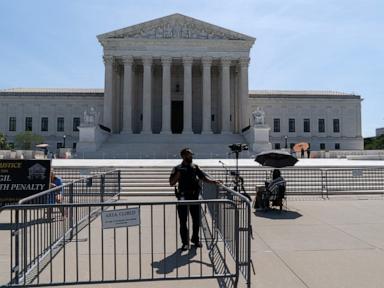
Today, the justices are surrounded by a permanent security bubble. The transformation of the Supreme Court building itself tells the story. What was once an open temple of justice, where tourists could freely walk up the iconic marble steps, has become a heavily fortified compound. High steel fencing, concrete barriers, and armed checkpoints now keep the public at a distance.
The security request aims to extend this fortress model to the justices' private lives. The $2 million off-site residential security post is designed to act as a centralized nerve center, monitoring the perimeter of the justices' homes and coordinating with local law enforcement. This level of protection mirrors the security footprint of cabinet secretaries or military commanders.
But physical barriers cannot solve the underlying problem. The security crisis is a direct symptom of a deeper institutional crisis. When a court loses its public legitimacy, it must make up for that loss with physical force. The more the court is seen as a political body rather than a legal arbiter, the more its members are treated like politicians—complete with the protests, threats, and hostility that characterize modern American politics.
The Price of Polarizing Power
This security spiral is the natural result of an imperial judiciary that has taken on some of the country’s most volatile political battles. By issuing sweeping rulings that dismantle decades of legal precedent on abortion, gun control, administrative power, and executive immunity, the court has placed itself directly in the crosshairs of cultural and political warfare.
The justices cannot have it both ways. They cannot issue highly consequential, politically disruptive rulings while expecting to retain the quiet, uncontested respect that shielded their predecessors. Power comes with a price, and in twenty-first-century America, that price is paid in bodyguards, swatting threats, and high-tensile steel fences.
As Barrett and Kagan defend their budget, they will likely argue that protecting the justices is vital to protecting the rule of law. If a judge can be intimidated or terrorized into changing a vote, the entire legal system collapses. This is a powerful and correct argument. No public servant should have to fear for their life or the safety of their family because of the decisions they make on the bench.
But Congress must also ask a harder question: can $228 million really buy safety for an institution that is actively losing the trust of the nation? Security details and residential monitoring stations can protect the physical bodies of the nine justices, but they cannot restore the moral authority of the court. The fortress on First Street is growing stronger, but the foundation of public trust upon which it stands continues to wash away.


