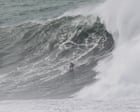
Every few years, atmospheric anomalies in the equatorial Pacific trigger a chain reaction that sends sixty-foot walls of water slamming into California, Hawaii, and Mexico. Super El Niño swells are not just bigger waves. They are violent, high-period energy transfers generated by a southward-shifted subtropical jet stream, drawing hundreds of elite big wave surfers to outer reefs while exposing massive gaps in coastal safety, sponsorships, and environmental infrastructure.
Most surf media treats these events like an action-movie premiere. Cameras roll at Mavericks, Jaws, and Cortes Bank, capturing glassy faces and death-defying drops. That coverage misses the real story. Behind the viral clips lies a high-stakes collision of meteorology, commercial desperation, and physical risk that leaves both athletes and coastal municipalities scrambling to survive the winter.
The Atmospheric Engine Behind the Swell
To understand why big wave surfers drop everything when a Super El Niño forms, you have to look at the ocean's thermostat. During a standard year, trade winds push warm surface water toward Asia, allowing cold water to upwell along the Americas. During an extreme El Niño event, those trade winds collapse. Warm water pools across the central and eastern Pacific, fundamentally altering global weather patterns.
This thermal shift supercharges the subtropical jet stream. Instead of steering winter storms toward the Pacific Northwest and Alaska, the jet stream dips south and accelerates across the open ocean.
The result is fetch. Fetch is the uninterrupted distance over which wind blows across open water in a single direction. In a Super El Niño winter, low-pressure systems develop hurricane-force winds across thousands of miles of open Pacific. These storms do not just create local chop; they organize chaotic wind energy into long-period groundswells.
When a swell reaches a period of twenty seconds or more—meaning twenty seconds pass between the arrival of one wave crest and the next—its energy extends hundreds of feet beneath the surface. As that deep-water energy hits abrupt underwater topography, like the submerged reef at Mavericks near Half Moon Bay or the shallow shelf at Peʻahi on Maui, the wave decelerates violently. The bottom drags while the top keeps moving at thirty miles per hour. The ocean pitches forward, transforming a deep-water pulse into a thick, hollow mountain of water.
The Economics of Chasing Ghosts
For a professional big wave surfer, a Super El Niño winter is a career-defining window. It is also a financial sinkhole.
Unlike conventional professional surfing, which operates on a predictable schedule of stadium-style contests in manageable surf, big wave riding is entirely reactive. Athletes must monitor weather buoys, satellite wind charts, and barometric pressure drops around the clock. When a purple blob appears on the swell models, the clock starts ticking.
Consider a hypothetical scenario common during these winters. A storm forms off Japan on a Tuesday, projecting a massive swell to hit Northern California by Friday morning. A surfer based in Oahu has less than forty-eight hours to book last-minute commercial flights, pay hundreds of dollars in oversized baggage fees for ten-foot surfboards, arrange local housing, and secure a jet ski rescue partner.
The costs easily exceed five thousand dollars for a single forty-eight-hour swell window.
- Equipment Overhead: Big wave boards—known as guns—cost upwards of fifteen hundred dollars each and snap easily under the lip of a fifty-foot wave. A serious charger needs a quiver of at least four boards per trip.
- Safety Logistics: Riding waves over forty feet without personal watercraft assistance is widely considered reckless. Hiring a dedicated jet ski driver for a six-hour session costs between eight hundred and fifteen hundred dollars, factoring in fuel, maintenance, and specialized sleds.
- Travel Volatility: Last-minute flights to hubs like San Francisco or Kahului during peak winter swells routinely triple in price, eating directly into shrinking sponsorship budgets.
The surf industry has contracted sharply over the past decade. Traditional apparel brands that once funded massive expedition budgets have been bought out by private equity firms or liquidated entirely. Today, only a tiny fraction of big wave surfers earn a living wage from sponsorships. Most work construction, commercial fishing, or fire department shifts between swells, burning through personal savings to chase a single ride that might earn them a digital magazine cover and zero prize money.
The Hidden Dangers of El Niño Bathymetry
The popular narrative suggests that bigger swells simply mean better waves. Veterans of the North Pacific know the opposite is often true. Super El Niño winters bring relentless, back-to-back storms that destroy the very conditions surfers travel thousands of miles to find.
Clean, rideable giant surf requires a specific sequence: a massive storm far out at sea, followed by high pressure and light offshore winds along the coast. During an extreme El Niño, the storm track sits directly over the coastline. The same atmospheric river events that generate sixty-foot swells also bring torrential rain, gale-force onshore winds, and toxic urban runoff.
When millions of gallons of rainwater flush through storm drains into the ocean, coastal waters become a hazardous soup of agricultural chemicals, raw sewage, and floating debris. Surfers paddling out at breaks near urban centers like San Francisco's Ocean Beach or Los Angeles's outer reefs risk severe staph infections, sinus damage, and collisions with submerged tree trunks washed out from flooded river mouths.
Furthermore, extreme swells alter the ocean floor. Bathymetry—the underwater equivalent of topography—dictates how a wave breaks. A single catastrophic swell can strip millions of tons of sand from coastal beaches and deposit it onto outer reefs, ruin well-known sandbars, or shift deep-water channels that rescue drivers rely on for safe passage.
What worked at a break in November might be a death trap by January. Channels close out. Escapes vanish. A surfer who miscalculates the shifting currents during a twenty-five-second period swell faces the dreaded "two-wave hold-down," where a rider is pinned beneath the surface by the first wave and immediately hammered by the second before reaching air.
The Crowding Crisis at Outer Reefs
Twenty years ago, a massive El Niño swell at a break like Todos Santos off Baja California or Cortes Bank—a submerged seamount one hundred miles off the coast of San Diego—attracted maybe a dozen specialists. The barrier to entry was physical endurance and deep local knowledge.
Today, those same lineups look like rush-hour traffic.
The proliferation of inflatable vests, jet ski assist teams, and hyper-accurate forecasting apps has democratized access to giant waves. You no longer need to spend ten years learning how to read cloud formations or survive brutal paddle-outs to sit in the lineup at a world-class big wave spot. Anyone with enough money to hire a water patrol team can get towed into position.
This influx creates severe friction and genuine danger in the water. Big wave etiquette relies on strict spatial awareness and mutual trust. When fifty surfers and twenty jet skis occupy a takeoff zone the size of a football field, human error becomes inevitable.
- Collision Risks: A jet ski driver rushing to rescue a downed surfer can easily lose sight of another rider dropping down a sixty-foot face in the glare of the morning sun.
- Priority Breakdowns: In giant surf, there is rarely a clean rotation. When a rogue set—a group of waves significantly larger than the rest—appears on the horizon, panic sets in. Surfers scramble frantically toward deeper water, abandoning boards that become high-velocity projectiles in the whitewater.
- Rescue Fatigue: Local water safety teams, often composed of unpaid volunteers or underfunded municipal lifeguards, face impossible workloads. During peak El Niño swells, rescue crews spend eight consecutive hours navigating fifteen-foot shorebreak and freezing temperatures to pull exhausted surfers from impact zones.
Municipalities are starting to push back. Harbor districts in California and county officials in Hawaii have repeatedly debated strict permitting systems, jet ski bans, and mandatory safety certifications for big wave events. While the surf community largely resists government regulation, the sheer volume of close calls during extreme weather winters makes heavy-handed intervention increasingly likely.
The Physiology of High-Consequence Surfing
Surviving a Super El Niño swell requires more than courage; it demands specific physiological adaptations that few athletes fully master.
When a surfer wipes out on a fifty-foot wave, the hydrostatic pressure deep underwater spikes instantly. The turbulence of the whitewater does not just push the body down; it twists limbs violently, dislocating shoulders and tearing knee ligaments before the rider even realizes they have fallen.
To survive this, modern big wave surfers train like free divers and combat athletes. Apnea training—learning to tolerate high levels of carbon dioxide in the bloodstream—is now standard practice. When panic sets in underwater, heart rates spike, burning through precious oxygen reserves in seconds. Surfers spend months practicing breath-holds while performing rigorous physical tasks, training their nervous systems to remain completely calm while being violently tumbled in pitch-black water.
Equipment has evolved alongside the training, though not without controversy. Inflatable life vests, equipped with CO2 cartridges that pull a surfer to the surface at the tug of a cord, have undeniably saved lives. Yet many veteran watermen argue the vests create a false sense of security.
Relying on an inflation cord encourages surfers to take reckless risks in waves beyond their true skill level. Worse, if a vest inflates prematurely while a surfer is still trapped inside the barrel of a massive wave, the sudden buoyancy pins them directly into the churning lip, subjecting them to a violent, washing-machine beating at the surface rather than allowing them to dive safely beneath the energy.
Coastal Erosion and the Vanishing Breaks
There is a grim irony at the heart of the Super El Niño surf rush. The very storms that deliver the waves of a lifetime are systematically destroying the coastlines that make those waves possible.
During the extreme El Niño winters of 1982–83, 1997–98, and 2015–16, the Pacific coastline suffered billions of dollars in infrastructure damage. Cliffside roads collapsed into the sea, piers were torn from their pilings, and historic beaches vanished overnight.
When coastal cities respond to this erosion, they rarely prioritize wave quality. Municipalities routinely deploy emergency seawalls, rock revetments, and massive sand-dredging projects to protect beachfront real estate and coastal highways.
These hard-armoring techniques alter the natural flow of sediment along the coast. Wave refraction—the bending of wave energy as it approaches shallow water—depends entirely on natural contours of sand and rock. When concrete seawalls reflect incoming wave energy back out to sea, they create chaotic backwash that ruins surf breaks permanently. Several legendary California point breaks have been degraded or completely destroyed by coastal armoring projects initiated after severe El Niño storms.
The big wave community finds itself caught in a paradox. Athletes celebrate the arrival of extreme atmospheric events for the adrenaline and media exposure they generate, even as those same meteorological extremes accelerate the degradation of the coastal ecosystems they depend on.
The Reality Beyond the Lens
The images that emerge from a Super El Niño winter are undeniably spectacular. A lone human figure arcing down a glistening, vertical wall of Pacific water represents a rare collision of athletic mastery and raw planetary force.
Yet treating these swells merely as a sporting spectacle ignores the profound instability driving them. Warming ocean temperatures and volatile atmospheric rivers are reshaping the Pacific basin at an accelerating pace. For the surfers paddling into the dark, freezing lineups of outer reefs, the margin for error has never been thinner, the financial rewards have never been smaller, and the ocean beneath their boards has never been more unpredictable.