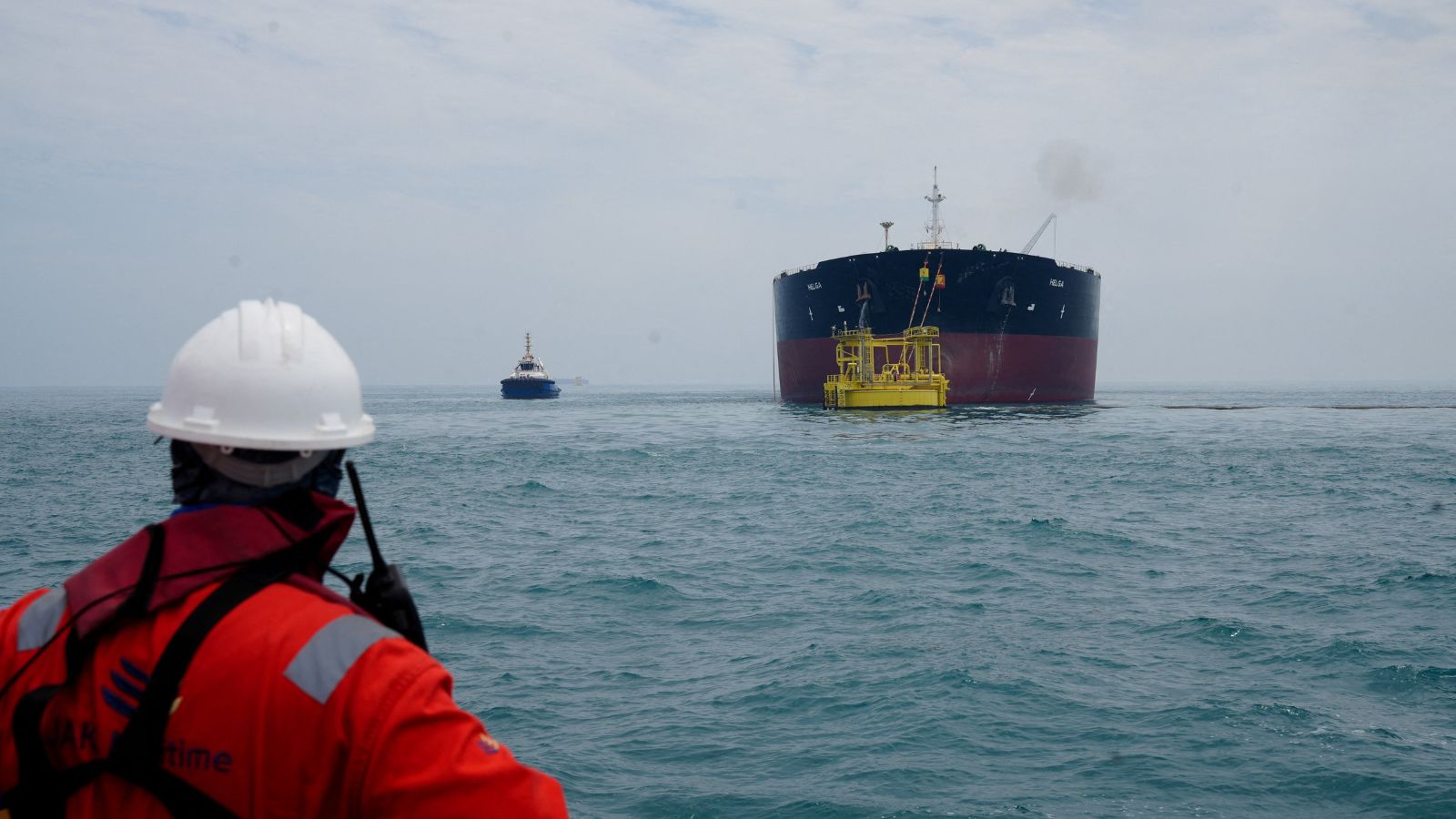
Iranian state television broadcasted a dramatic frame grab showing a foreign-flagged container ship hard aground in the shallow waters of the Strait of Hormuz. Tehran immediately blamed the United States for the maritime disaster, claiming the vessel veered off course by following a US-suggested alternate route rather than the Islamic Revolutionary Guard Corps mandated Route of Authority. This narrative was constructed to demonstrate absolute Iranian control over the world's most critical energy chokepoint during sensitive peace negotiations in Doha. However, independent satellite imagery and transponder tracking data quickly destroyed this official story, revealing that the grounded ship was actually an illicit vessel belonging to Iran's own sanctioned shadow fleet.
The incident marks a chaotic escalation in a conflict that has disrupted global maritime trade since early 2026. By tracking the physical reality of the vessel, maritime intelligence firms have exposed an intricate web of registry manipulation, sanctions evasion, and a massive propaganda miscalculation by Tehran.
The Doha Diplomatic Backdrop and the Route of Authority
As the vessel sat trapped in the silt, high-level diplomatic delegations were meeting in Qatar. US Mideast envoy Steve Witkoff and Jared Kushner were conducting indirect talks with Iran’s top negotiator, Kazem Gharibabadi, attempting to broker a permanent end to the hostilities that erupted earlier this year. A major point of contention in these negotiations involves who governs the narrow strait through which a fifth of the world’s oil and liquefied natural gas flows.
An interim 60-day agreement allowed merchant ships to pass through the region without paying transit fees. Tehran upended this arrangement by insisting that all commercial vessels must follow specific channels dictated by the Islamic Revolutionary Guard Corps Navy, known as the Route of Authority. The Iranian state claimed that any deviation from these lines would result in irreparable incidents.
When the container ship ran aground, Tehran saw a perfect geopolitical opportunity. State-run news anchors claimed the grounding proved that alternative routes proposed by the United States and Oman were inherently unsafe. They warned international shipping lines that ignoring Iranian naval instructions would lead to financial and structural ruin. The narrative was designed to force Western negotiators to concede control of the waterway to Iran.
What the Tracking Data Actually Reveals
The official Iranian story disintegrated within hours of the announcement. Marine intelligence analysts from TankerTrackers used high-resolution satellite imagery, historical hull profiles, and Automatic Identification System logs to verify the identity of the stranded vessel. The data revealed that the ship was a container vessel named Arista.
The ship was not a helpless Western merchant vessel misled by American coordinates. It was a known actor in the international maritime black market. The tracking logs demonstrated that the Arista had been operating with a deactivated transponder for significant portions of its journey, a practice known as dark sailing that is frequently utilized to conceal illegal cargo pickups and transfers.
The spatial data confirmed that the Arista did not hit the shoal because of a Western navigation plot. The vessel was maneuvering through a familiar coastal area frequently utilized by smugglers attempting to bypass international naval patrols. The grounding was a classic case of human navigational error or mechanical failure during an illicit transit, entirely unrelated to any official shipping lanes recommended by the United States.
The Shell Game of Flags of Convenience
To understand how a vessel under Iranian control ended up being framed as an example of Western failure, one must look at the structural mechanics of the shadow fleet. The Arista was flying the flag of Comoros, a small East African island nation. This flag did not reflect the true ownership or operational control of the vessel.
Just last year, the exact same ship was registered under a Panamanian flag and operated under the name Gauja. Maritime records indicate that the vessel underwent a sudden, mid-contract registry shift. This tactic is a hallmark of maritime smuggling networks. When a corporate entity or a specific flag becomes heavily monitored by international regulators, operators quickly register the hull in a different jurisdiction to create a fresh paper trail.
- The Vessel: Arista
- Former Identity: Gauja (Panama-flagged)
- Current Flag: Comoros (False registry)
- Sanctions Status: Listed by the US Office of Foreign Assets Control
The United States Department of the Treasury had already identified this specific hull. The Arista was placed on the Office of Foreign Assets Control sanctions list because it was part of an expansive logistics network generating tens of billions of dollars for the Iranian ruling establishment. The network specializes in moving petroleum products and illicit cargo to fund regional proxy groups and state military budgets.
By claiming that a sanctioned asset from its own smuggling network was a victim of Western interference, Tehran attempted a complex psychological operation. The maneuver backfired because modern open-source intelligence can track a ship's unique physical characteristics regardless of what name is painted on the bow or what flag flies from the mast.
The Dangerous Reality of the Chokepoint
The grounding of the Arista occurred at a time of extreme vulnerability for international merchant shipping. Following an Iranian attack on a Taiwanese-operated container ship in the Omani side of the waterway, total daily transits through the strait plummeted. The United Nations shipping agency was forced to pause a voluntary evacuation scheme that was designed to assist thousands of stranded seafarers.
Despite the high risks, the economic gravity of the Persian Gulf keeps drawing hulls into the region. On the day of the grounding, over forty commercial vessels still transited the strait. Some supertankers entered the area to load Iranian oil under the cover of darkness, while others braved the international lanes to transport Qatari crude. The presence of the grounded Arista added a severe physical obstacle to an already congested and highly militarized environment.
The Islamic Revolutionary Guard Corps Navy has used the physical presence of the stranded Arista to reinforce its patrols. Gunboats have been stationed around the shoal, ostensibly to provide salvage assistance but effectively creating an ad-hoc military checkpoint in international waters. This aggressive posturing directly threatens the fragile progress being made by mediators in Doha.
Propaganda Versus Open Source Intelligence
State media corporations can no longer control the narrative of maritime incidents. In previous decades, a government could claim that a foreign ship ran aground due to Western negligence, and the international community would have to wait weeks for independent verification. Today, the democratization of orbital data and transponder tracking allows analysts to reconstruct an accident in real time.
The failure of the Iranian narrative demonstrates the limitations of traditional state propaganda in a digitized world. The Arista was tracked from its previous ports, its structural anomalies were cross-referenced with global databases, and its financial ties to Tehran were exposed before the mud on its hull could dry. This creates a severe diplomatic problem for Iranian negotiators in Qatar, who are now forced to explain why their state media is using a sanctioned Iranian smuggling vessel as a rhetorical weapon against the United States.
The situation in the Strait of Hormuz remains highly volatile as salvage crews attempt to stabilize the Arista without spilling its cargo into the fragile marine ecosystem. Shipping companies are currently ignoring the political rhetoric from Tehran, relying instead on private security escorts and independent satellite routing to navigate the dangerous waters. Shippers realize that the true danger in the strait is not an alternate navigation route, but rather the unpredictable actions of a state willing to sacrifice its own shadow fleet vessels for a temporary tactical advantage on the global stage.