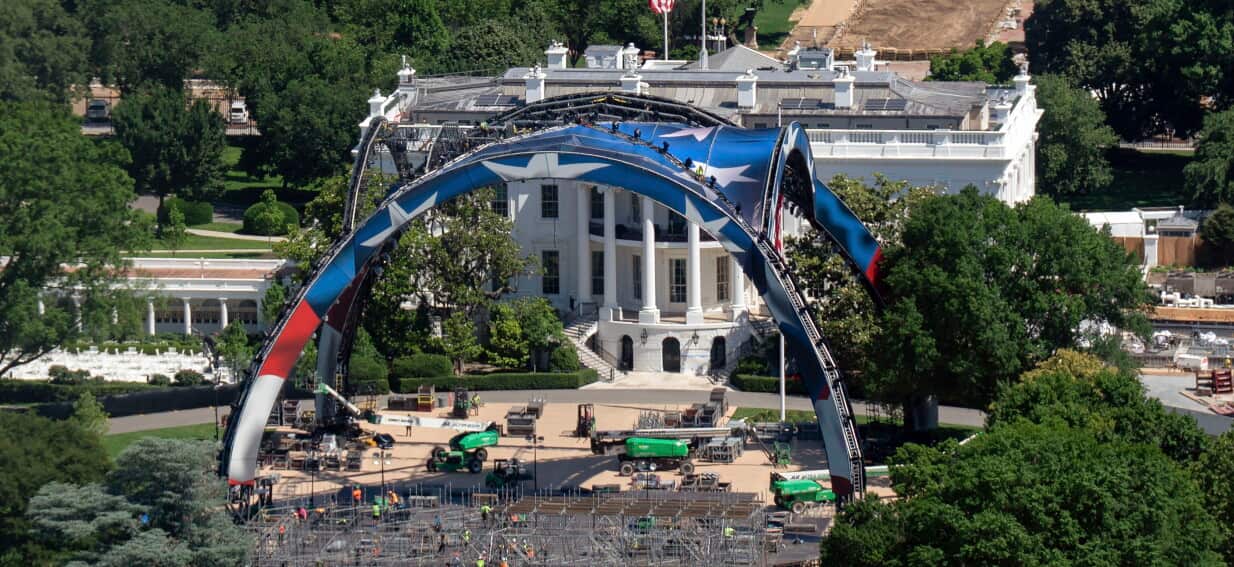
The Great American State Fair was supposed to be a bipartisan masterstroke, a 16-day spectacle on the National Mall to kick off the nation’s 250th anniversary. Instead, it collapsed into a high-stakes cultural boycott within 48 hours of its lineup announcement, forcing President Donald Trump to declare he will headline the event himself with an "AMERICA IS BACK" rally. The rapid exodus of heritage acts like Martina McBride, the Commodores, and Morris Day highlights a deeper structural failure. It reveals how the official, congressionally mandated U.S. Semiquincentennial was quietly bypassed by a parallel, private fundraising vehicle designed to grant corporate donors direct access to the executive branch.
When Freedom 250 rolled out its initial musical roster, the fallout was instantaneous. Legacy artists who believed they had signed up for a wholesome, nonpartisan celebration of American history woke up to find their names plastered on promotional materials for an entity heavily tied to the Trump administration.
The Illusion of a Bipartisan Birthday
In 2016, Congress established the U.S. Semiquincentennial Commission, known publicly as America250. It was built to be a strictly nonpartisan body, balanced between both major parties, tasked with planning a unified national celebration for July 4, 2026. However, bureaucracy moves slowly, and the official commission spent years bogged down in internal friction and shifting leadership.
Seeing an operational vacuum, the Trump administration launched Freedom 250, officially titled the White House Task Force on Celebrating America’s 250th Birthday. Led by Keith Krach, a former Under Secretary of State from Trump's first term, Freedom 250 marketed itself as a nimble nonprofit capable of delivering "the most spectacular birthday party the world has ever seen."
The administrative sleight of hand worked well until the entertainment bookings went public.
Musicians operate on brand preservation. For legacy acts whose touring revenue relies on broad, politically diverse audiences, being perceived as an endorsement for a specific political figure is a commercial liability.
Country star Martina McBride noted she was explicitly assured the Great American State Fair was a nonpartisan event celebrating all 50 states. Once the political nature of the backing organization became clear, she pulled out.
Rapper Young MC went further, describing the booking process as a "bait-and-switch," stating his team was never informed of the administration's direct involvement.
Cash for Access Under the Cover of Patriotism
The artists' panic was not merely a reaction to a brand name. A deeper investigation into the structural framework of Freedom 250 reveals a sophisticated corporate access pipeline operating under the guise of civic pride.
While the congressional America250 entity relies heavily on federal appropriations and highly regulated sponsorships, Freedom 250 was built as a private 501(c)(3) funding vehicle. This structure allows the organization to bypass standard federal procurement rules and transparency mandates.
Corporate entities and wealthy donors discovered that a seven-figure contribution to Freedom 250 yielded substantial returns.
- The Seven-Figure Tier: Donors contributing $1 million or more secured invitations to private receptions hosted directly by the president.
- The Policy Pipeline: This structure allowed executives with pending regulatory business before the administration to purchase high-level access through tax-deductible donations.
- The VIP Treatment: Corporate sponsors were promised prominent branding across the National Mall during the 16-day festival, effectively privatizing public land during a national milestone.
This access pipeline explains why the administration fought so aggressively to control the narrative of the 250th anniversary. It was never just a party. It was a massive, unregulated fundraising apparatus.
The Infrastructure of a Solo Pivot
The withdrawal of Poison frontman Bret Michaels, who cited safety concerns and a toxic atmosphere, effectively ended any remaining hope of salvaging a conventional music festival. Faced with empty stages from June 25 to July 10, the administration resorted to its most familiar playbook: turning a civic crisis into a political rally.
On Truth Social, Trump dismissed the departing acts as "overpriced singers" and "Third Rate 'Artists,'" suggesting the solution was to replace the state fair model entirely. His proposed "AMERICA IS BACK" rally shifts the financial and logistical burden away from an entertainment spectacle and onto the standard campaign apparatus.
Executing a multi-week state fair requires complex coordination with the National Park Service, extensive staging, and diverse crowd management. A singular, high-intensity political rally simplifies the logistics. It replaces a complex cultural program with a familiar, repeatable security and production blueprint.
A few acts remain on the bill. Hip-hop artist Vanilla Ice and Fab Morvan, performing under the Milli Vanilli name, have confirmed their attendance. Their presence highlights the fragmented nature of the remaining lineup.
The administration’s pivot confirms a long-suspected reality. The 250th anniversary of the United States will not be a singular moment of national unity, but a deeply polarized reflection of its current political reality. By transforming a hollowed-out music festival into a signature executive rally, the administration has ensured that the opening salvos of the American Semiquincentennial will be defined not by historical reflection, but by a direct show of political strength.


