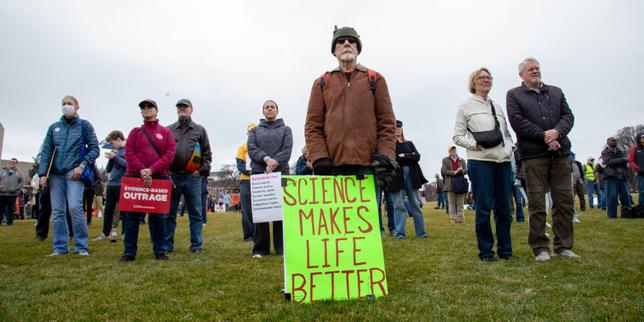
The bureaucratic plumbing of international scientific research is quietly being dismantled, and the fallout will stall medical and technological breakthroughs for a generation. While mainstream reporting has treated the "Stand Up for Science" movement as a standard academic protest against budget cuts, the reality is far more dangerous. The core of the crisis is not just a lack of funding. It is an aggressive, systemic rewrite of how federal grant money is distributed, monitored, and clawed back, shifting power from peer-review panels to political appointees.
A proposed regulation by the U.S. Office of Management and Budget (OMB) titled "Regulation for Federal Financial Assistance" has pushed the scientific community to a breaking point, drawing nearly 100,000 public comments ahead of its July deadline. By allowing agencies to terminate active grants at any moment if they deviate from shifting "federal priorities," the policy turns multi-year scientific endeavors into volatile political gambles. Learn more on a connected issue: this related article.
The Death of the Multi Year Research Project
The fundamental misunderstanding of scientific research by policymakers is the assumption that discovery operates on a corporate quarterly cycle. It does not.
Large-scale clinical trials, climate modeling, and deep-tech engineering require predictable, multi-year commitments. Under the traditional framework, once a grant survived the grueling gauntlet of peer review, the funding was secure provided milestones were met. This insulation allowed researchers to pursue high-risk, high-reward inquiries without looking over their shoulders. Additional journalism by NBC News highlights related views on this issue.
The new regulatory mechanism strips this stability away. By expanding the definition of agency discretion, a project studying oncology treatments or pediatric diseases can have its funding severed mid-stream if a new political director deems the research inconsistent with a revised agenda.
According to internal analyses circulated by activist groups like Stand Up for Science, over half of active federally funded clinical trials are structurally vulnerable under these rules. The vulnerability stems heavily from clauses targeting international collaboration and specific, newly restricted terminology in grant applications.
The Chilling Effect of Semantic Censorship
Funding allocation is increasingly tied to compliance with strict semantic guidelines. Grant proposals containing terms linked to systemic inequities, specific climate phenomena, or diverse demographic profiles are being systematically flagged.
This is not a superficial culture war; it is a structural chokehold on funding. When researchers are forced to sanitize their language to pass a political vetting process, the integrity of the underlying hypothesis is compromised before the work even begins.
The Weaponization of Fraud and Civil Litigation
Perhaps the most overlooked element of the current regulatory shift is the alteration of how fraud is defined and prosecuted within the university ecosystem.
Historically, the False Claims Act was deployed against bad actors who deliberately falsified data, overbilled federal agencies, or diverted research funds for personal gain. The new guidance expands the scope of what constitutes an award violation to include vague compliance metrics and even the personal speech of the grantees.
+-----------------------------------+-----------------------------------+
| Traditional Grant Enforcement      | New Proposed OMB Framework        |
+-----------------------------------+-----------------------------------+
| Focus on financial fraud and data | Broadened to include ideological  |
| fabrication.                      | and semantic non-compliance.      |
+-----------------------------------+-----------------------------------+
| Peer-review panels evaluate       | Political appointees hold final   |
| scientific merit and methodology. | termination and approval power.   |
+-----------------------------------+-----------------------------------+
| Low litigation risk for compliant | High risk of private civil suits  |
| institutional researchers.        | based on loose infraction rules.  |
+-----------------------------------+-----------------------------------+
By lowering the threshold for what constitutes a violation, the policy invites a wave of third-party civil litigation against universities and independent labs. Academic institutions are risk-averse by design. Faced with the threat of prolonged legal battles over ambiguous compliance terms, university legal counsels will inevitably block researchers from pursuing controversial or politically sensitive avenues of inquiry.
The Global Brain Drain and the European Pivot
Science is a global commodity, and researchers are highly mobile. The immediate consequence of the American regulatory squeeze is a rapid shifting of intellectual capital toward more stable ecosystems.
European institutions are already capitalizing on this instability. Backed by the 95.5 billion euro framework of the Horizon Europe program, ministers and university presidents across the continent are actively recruiting displaced American scientists. The promise of long-term autonomy and protection from political whim is a powerful incentive.
But the European refuge is not a perfect solution. Moving an entire laboratory, along with specialized equipment and specialized post-doctoral staff, takes years.
Many critical projects cannot survive the transit. When a lab closes down due to an abrupt funding termination, the specialized cell lines die, the longitudinal data sequences are interrupted, and the institutional knowledge scatters. You cannot simply plug a half-finished $5 million clinical trial into a new university across the Atlantic and expect it to resume seamlessly.
The Fragility of Scientific Infrastructure
The enduring lesson of the current crisis is the sheer fragility of the systems we assume are permanent. For decades, the global scientific apparatus operated on the assumption that while funding levels might fluctuate based on economic realities, the underlying architecture of peer review and academic freedom was sacrosanct.
That illusion has evaporated. When political appointees are given the unilateral authority to override expert consensus, the entire foundation of evidence-based policymaking erodes.
The immediate task for the scientific community is no longer just advocating for larger budgets. The real battle lies in erecting legal and structural firewalls around the grant-making process itself, ensuring that once scientific merit is established, political agendas cannot claw it back.