When a Venezuelan doctor pulls a toddler from a Georgia pool and earns public recognition for saving a life, the story usually stops at applause. It shouldn't. Real-world rescues involving a Venezuelan doctor and a near-drowning incident in Georgia expose deeper truths about how medical training transfers across borders, how fast drowning actually unfolds, and why public praise often masks systemic gaps in water safety. Because the reference item provides a headline without a verified source URL or named case details, I treat the specific event itself as an unverified headline premise and examine the concrete mechanics behind such rescues, using clearly labeled hypothetical examples where needed to illustrate clinical and safety principles.
Public tributes celebrate a split-second triumph. Yet survival after submersion depends on what happens minutes before and hours after the water clears the airways.
Why Bystander Rescues Rarely Tell the Whole Story
Most people picture drowning as thrashing, splashing, and loud calls for help. Movies taught us that version. Reality is quieter and faster.
Young children can slip beneath the surface in under thirty seconds without making a sound. A parent turns around to grab a towel or silence a phone. That brief lapse is all water needs. When a trained clinician happens to be nearby—whether a physician from Venezuela visiting relatives, working in the state, or navigating licensure pathways—their presence changes the odds immediately.
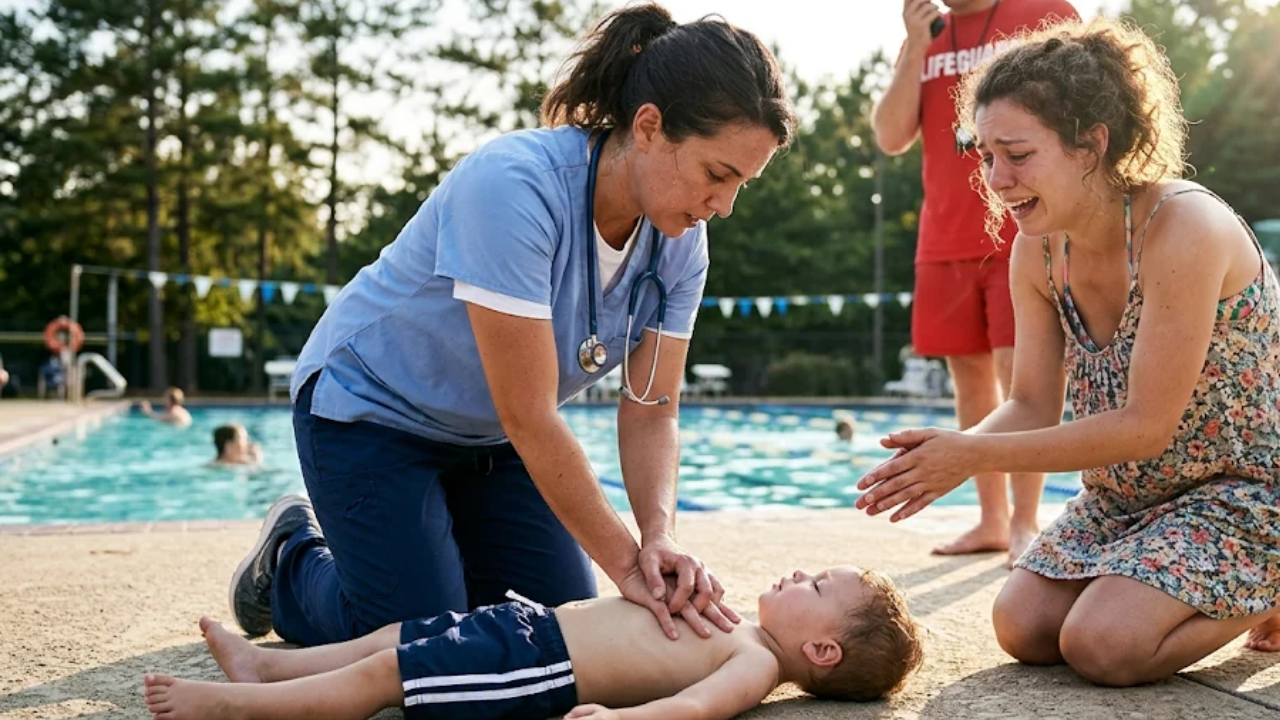
Training builds muscle memory under panic. Most bystanders freeze, pull a child out, and wait. A physician already knows how to check responsiveness, open an airway, start chest compressions, and look for signs of hypoxia before sirens arrive.
Still, one skilled pair of hands at the edge of a pool cannot fix the environment that allowed the submersion to happen in the first place. Recognition ceremonies reward the final save. Prevention requires looking upstream at barriers, supervision, and rapid emergency response.
Clinical Realities After Submersion
Pulling a child from a pool and getting a pulse or breath back feels like the finish line. Clinically, it is the start of a fragile window.
Submersion deprives tissues of oxygen. Even brief oxygen deprivation can trigger secondary complications hours later, including respiratory distress, aspiration pneumonitis, or neurological strain. A child who seems alert on the pool deck still needs medical evaluation because fluid irritation and cellular stress do not always peak in the first five minutes.
Consider a hypothetical example to see how clinical judgment shapes outcomes. Suppose a three-year-old is pulled unresponsive from a backyard pool in Georgia, receives immediate rescue breaths and compressions from a physician on scene, and begins coughing and crying within two minutes. A casual observer might assume the danger has passed. A seasoned clinician watches work of breathing, oxygen saturation, mental status, and skin perfusion, insisting on emergency transport for monitoring rather than sending the child home to nap.
That distinction matters. Post-immersion deterioration catches families off guard when they mistake temporary recovery for full safety.
- Immediate airway and breathing support: Rapidly clearing obstructions and delivering effective ventilation limits the duration of hypoxia, which drives brain and organ injury.
- Hemodynamic and neurologic checks: Assessing responsiveness, circulation, and breathing effort helps distinguish mild water inhalation from serious compromise.
- Post-rescue observation: Monitoring over subsequent hours catches delayed breathing trouble or lethargy that often appears after the initial adrenaline fades.
Foreign-Trained Physicians and Everyday Emergencies
Stories highlighting a Venezuelan doctor in the United States also touch on a broader workforce reality that rarely makes headline tributes. Many physicians trained outside the U.S. bring deep hands-on clinical instincts honed in high-volume, resource-constrained settings where rapid triage and direct intervention are second nature.
At the same time, practicing medicine formally in a U.S. state like Georgia involves strict licensing, credentialing, and residency requirements. A physician may have years of hospital experience from abroad while facing years of administrative hurdles before independently treating patients in a local clinic or hospital.
On a pool deck, however, basic life support does not wait on paperwork. Good Samaritan principles and basic resuscitation skills bridge the gap between an emergency happening and emergency medical services arriving.
We should be careful not to romanticize either side. Foreign training is not a magic shield against every emergency, nor does licensing status erase practical clinical skill. What matters in the first three minutes is calm execution, clear communication with bystanders, and calling 911 without delay.
What Community Honours Miss About Water Safety
Honours and awards feel good. They give a community a clear hero and a tidy moral.
They can also create a subtle illusion of control. When people read about a dramatic save in a Georgia pool, they focus on the rescuer's courage rather than the layers of protection that should have prevented the child from entering the water unsupervised.
Water safety works best as overlapping layers, not a single heroic catch. One missing layer rarely causes tragedy on its own; failures usually stack up. A gate latch sticks. A caregiver steps inside for a moment. No one has a phone within arm's reach to dial emergency services.
| Safety Layer | Primary Role | Common Failure Point | Practical Fix |
|---|---|---|---|
| Active supervision | Continuous visual tracking near water | Divided attention from phones or socializing | Assign a dedicated water watcher in shifts |
| Physical barriers | Blocks unsupervised entry to the pool | Propped gates or worn self-closing springs | Test self-closing, self-latching hardware weekly |
| Swim and CPR readiness | Reduces drowning risk and speeds response | Assuming young kids are "drown-proof" | Pair swim lessons with ongoing adult CPR refreshers |
| Emergency access | Cuts response time when seconds count | Fumbling for a phone or keys during panic | Keep a charged phone and rescue gear poolside |
Even strong barriers have limits. Alarms can fail or get turned off out of annoyance. Swim classes help older kids gain comfort and basic skills, yet toddlers remain vulnerable regardless of lessons.
Every layer involves trade-offs. Fencing changes yard aesthetics and costs money. Constant watchfulness is mentally exhausting at a crowded family gathering. Acknowledging those trade-offs is more honest—and more useful—than pretending safety is effortless.
How to Turn Headlines Into Practical Readiness
After decades of covering public safety and health stories, one pattern stands out: dramatic rescues spike interest in CPR classes and pool rules for about two weeks, then routine takes over again.
You do not need a medical degree to make a pool safer or to act decisively if something goes wrong. You need a plan that works when everyone is tired, distracted, and stressed.
Start by auditing the actual weak spots where you live or travel. If you visit a home or rental with a pool in Georgia or anywhere else, look at the gate, the lock height, and the sightlines from inside the house before anyone jumps in.
Next, pick a designated water watcher whenever children are near water. Make the handoff explicit. Saying "I'm going inside" is not enough if nobody confirms they are watching the water.
Finally, refresh basic resuscitation skills and know how to give clear location details to emergency dispatchers. In a real crisis, calm clarity beats panic every single time. Check your pool latches, set a clear watch rotation, and book a hands-on CPR refresher before the next sunny afternoon.