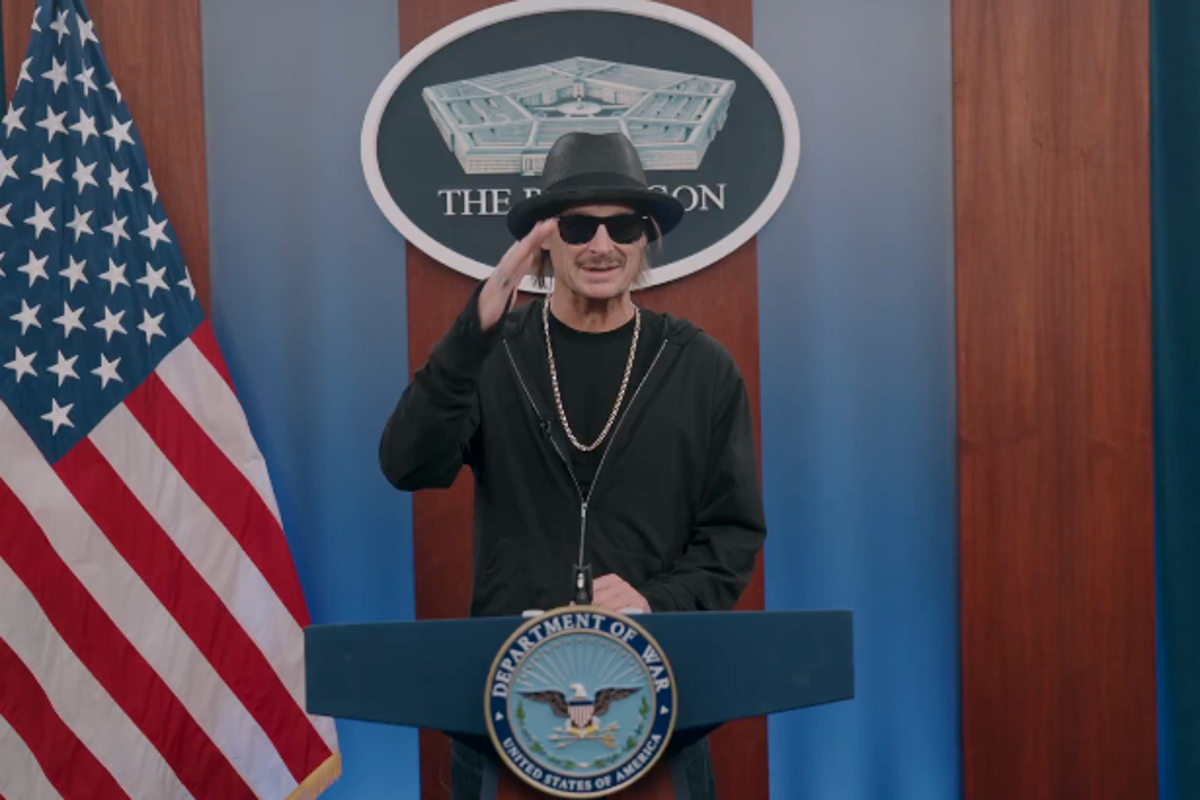
The United States Department of Defense marked Memorial Day by releasing an official video recorded inside the Pentagon briefing room featuring Robert James Ritchie, the musician known as Kid Rock, standing behind the government podium in sunglasses and a hoodie.
The appearance was not a rogue stunt. It was a planned, taxpayer-supported media event authorized by Defense Secretary Pete Hegseth and defended by Pentagon spokesperson Sean Parnell. The video, intended to honor fallen service members, concluded with Ritchie telling the public to "keep on Kid Rocking in the free world." While packaged as a tribute to the troops, the performance marks a historic shift in how the American military command uses state resources, blurring the line between national remembrance, partisan culture wars, and commercial entertainment marketing.
The Infrastructure of a Pentagon Promo Tour
The Memorial Day message was the culmination of a weeks-long relationship between the rock musician and the highest levels of military leadership. Public flight tracking data and defense department statements reveal that the video was filmed during an official visit where Ritchie was granted VIP access to military hardware and personnel.
On a Monday morning, Ritchie’s private jet traveled from Nashville to Fort Belvoir, Virginia. Waiting for him were four AH-64 Apache attack helicopters and two UH-60 Black Hawks, which had been flown in over the weekend from Fort Campbell, Kentucky. Fort Belvoir does not typically host Apache units, meaning the aircraft were repositioned specifically for this sequence of events.
Ritchie and Defense Secretary Hegseth boarded separate Apache gunships for what was described by defense officials as a flight to support "Freedom 250," a White House-led community relations initiative celebrating America's upcoming 250th anniversary. The helicopters, which cost roughly $7,000 per hour to operate, flew a ten-minute loop over the base with the civilian passengers occupying the gunner seats.
Parnell later confirmed that the itinerary was designed for Ritchie to film promotional material for his commercial Freedom 250 tour and to participate in "troop touches" with service members. The Pentagon defended the use of the $100 million attack helicopters by stating that the flights doubled as pilot training and that the musician had pledged 1,000 free concert tickets for veterans at each tour stop.
Command Interventions and Flight Rules
The official visit to the Pentagon followed a prior controversy involving the same military hardware. Weeks earlier, a formation of Army Apache helicopters conducted a low-altitude flyby over Ritchie's private estate in Whites Creek, Tennessee, a property modeled after the White House. The aircraft also flew over a localized political protest in Nashville the same day.
The unauthorized flyby triggered an immediate internal Army investigation. The flight crews involved were suspended from flight duties pending a safety and protocol review. However, Defense Secretary Hegseth personally intervened, overriding standard military command structures to lift the suspensions and halt the investigation entirely, announcing publicly that there would be "no punishment."
By bringing Ritchie into the Pentagon briefing room weeks later, the defense leadership signaled a deliberate rejection of traditional non-partisan boundaries. Historically, the Pentagon podium is reserved for uniform leadership, career intelligence officials, and civilian defense spokespeople delivering strategic updates. Utilizing the space for a hooded celebrity delivering a branded slogan represents a fundamental departure from established protocol.
The Economics of Political Aesthetics
The alignment between the Department of Defense and the musician comes at a critical financial moment for the performer. Days before his Pentagon visit, Ritchie posted a video tour of his office via social media, openly requesting ticket purchases for his upcoming tour and claiming that his ticket sales were suffering because his views were being "suppressed" by algorithmic gatekeepers.
The commercial reality is distinct. His multi-city festival tour had previously faced low engagement, forcing organizers to slash ticket prices and adjust lineups. By securement of Pentagon backdrops, Apache helicopter footage, and high-profile endorsements from the Secretary of Defense, the commercial venture gained millions of dollars in free, high-impact marketing content under the guise of state-sanctioned patriotism.
This cross-pollination of state power and commercial branding sets a difficult precedent. When tax-funded military assets are used to generate content for a commercial venture, the institution compromises its neutrality. Critics, including California Governor Gavin Newsom, questioned the fiscal propriety of using frontline combat aircraft for celebrity promotion, highlighting the friction between working-class military families and high-level celebrity access.
The Erosion of Non-Partisan Military Tradition
The core issue of the Pentagon’s Memorial Day strategy is not the identity of the celebrity, but the systemic politicization of an institution that relies on public trust across the entire political spectrum. Memorial Day has historically functioned as a somber, unified day of mourning for the hundreds of thousands of Americans who died in uniform.
Transforming the commemoration into a high-energy, partisan cultural statement alienates a significant portion of the population. It reduces a sacred national tradition into a content-generation engine for a specific political faction. Senior military officials have long warned that when the armed forces become entangled in domestic cultural disputes, recruitment, retention, and public institutional trust suffer.
The defense department’s defense of the event—citing the donation of concert tickets—fails to address the systemic cost. The transactional nature of the arrangement implies that corporate patriotism can purchase access to state assets. If a defense secretary can halt safety investigations and deploy attack helicopters to assist a personal friend with a concert promo, the internal discipline of the military chain of command is eroded.
The image of a rock star standing at the nation's command podium, wearing sunglasses inside the Pentagon while telling the public to keep on rocking, will remain the defining image of this era's defense leadership. It is an image that showcases an institution less focused on strategic readiness and more invested in the production of political spectacle. The long-term consequences of this shift will be felt not in the charts of ticket sales, but in the institutional integrity of the American military.