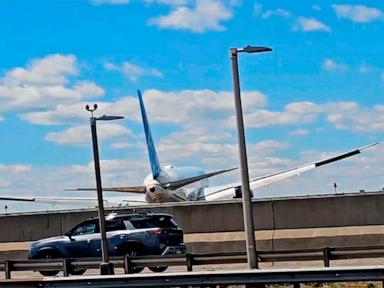
A commercial flight crew landing a widebody jetliner should never be surprised by a light pole. Yet, on May 3, 2026, the crew of United Airlines Flight 169 found themselves inches from disaster when their Boeing 767 clipped an airport light pole just before touching down at Newark Liberty International Airport. The impact sent metal debris tearing into a tractor-trailer on the adjacent New Jersey Turnpike, shattering its windshield and puncturing its hull.
A preliminary report from the National Transportation Safety Board (NTSB) reveals a deeply unsettling sequence in the cockpit. The first officer explicitly noticed the danger, warning the captain, "You are still slow and a little low." By the time both pilots realized exactly how critically low they were, they were already out of time to abort the landing.
While mainstream coverage focused heavily on the dramatic imagery of a highway truck being struck by falling debris, the real story lies in the cockpit dynamics and systemic pressures that led to this near-miss. The incident exposes a toxic combination of rapid-fire runway reassignments, severe wind conditions, and a controversial pilot technique that defied standard safety practices.
The Chaos of Three Runway Changes
Flight crews arriving from long transatlantic routes—in this case, Venice, Italy—anticipate a stable, predictable arrival pattern. They calculate landing distances, approach speeds, and flap configurations based on specific runway geometry.
Air traffic controllers at Newark completely upended that preparation. As the Boeing 767 approached the busy airspace, air traffic control changed the aircraft's designated runway three separate times in rapid succession.
The crew was ultimately routed to Runway 29. This is Newark’s shortest runway, measuring just 6,726 feet. For a massive Boeing 767 carrying more than 200 passengers, landing on a strip this short leaves almost zero margin for error.
"They were told to prepare for three different runway landings as they approached the airport, but were given little time to do so," the NTSB noted, highlighting a clear breakdown in arrival flow management.
While the captain told investigators he was not overly concerned about the late changes, the scramble to reprogram the flight management computer and recalculate approach parameters inevitably spiked the crew's cognitive workload. Aviation safety experts point out that late runway changes frequently break a crew’s focus, setting the stage for unstable approaches.
The Shallow Approach Trap
When confronting high winds and a short runway, standard operating procedures dictate a precise glide path. On the afternoon of the incident, controllers warned the crew that winds were gusting up to 31 mph, causing moderate turbulence.
Data and expert analysis suggest the captain attempted to manage these brutal conditions by flying an intentionally shallow, flat approach to the runway. This path took the heavy jet far below the established safe flight path long before it cleared the airport boundary fences.
Aviation experts have roundly criticized this decision. If a pilot cannot maintain the standard flight path due to wind or turbulence, the rule is to abandon the approach or steepen the descent angle to clear obstacles—never to drag the aircraft in low and flat. By flattening out the approach over the New Jersey Turnpike, the aircraft was flying through airspace that should have been a mandatory buffer zone.
During the final turn into the headwind, the aircraft briefly "got fast," according to the pilot's statements to investigators. To compensate, the captain pulled the power levers back. This aggressive correction, combined with a sudden drop in wind speed, caused the heavy jet to lose airspeed rapidly and sink far faster than anticipated.
Total Breakdown of Cockpit Communication
The most damning revelation in the NTSB report involves the first officer's failed attempts to trigger a go-around. Modern airline cockpits rely heavily on Crew Resource Management, a system designed to give junior officers the authority to voice safety objections and halt a dangerous landing.
| Timeframe | First Officer's Observation | Action Taken |
|---|---|---|
| Approaching 500 feet | "Airspeed slow" | Verbal warning |
| Descent past 500 feet | "You are still slow and a little low" | Verbal warning |
| Seconds before impact | Realized critical obstacle hazard | No time to execute go-around |
The first officer saw the airspeed decay. He saw the altitude drop. Yet, his warnings were descriptive rather than assertive. Instead of calling out the definitive, mandatory phrase "Go around," which requires the flying pilot to immediately abort the landing and climb, the first officer relied on passive observations.
The captain looked outside, noticed they were low, but assumed they were simply crossing the runway threshold. A moment later, the crew felt a mild jolt and heard a loud thump. They had cleared the turnpike traffic by mere feet, their fuselage sustaining substantial structural damage from the light pole.
This communication gap highlights a lingering flaw in commercial aviation. When a captain is struggling with a highly unstable aircraft in severe wind, a first officer cannot afford to use soft, advisory language. They must take decisive action to force a go-around.
The Threat Beyond the Airfield Perimeter
This incident exposes a severe blind spot regarding airport infrastructure placement and public safety. For decades, drivers on the New Jersey Turnpike have watched commercial jets pass incredibly close overhead.
The initial public narrative from local law enforcement claimed the plane’s landing gear had physically struck a bakery truck. The NTSB report corrected this, proving that it was heavy metal debris sheared from the light pole that smashed into the passing vehicle.
This distinction provides little comfort. Had the aircraft been flying just three feet lower, a major catastrophe would have unfolded across multiple lanes of a packed interstate highway. The fact that a commercial widebody jet could legally or physically operate low enough to clip light poles right next to a major public roadway demands a re-evaluation of obstacle clearance zones.
Aviation regulators must look beyond the physical borders of the airfield. When airports utilize short, alternative runways during severe weather, the margins for surrounding civilian infrastructure shrink dramatically. If the infrastructure cannot be moved, the operational limits for incoming aircraft must be permanently adjusted.