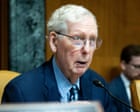
The official statements coming out of the office of Senator Mitch McConnell follow a well-worn Washington script. They describe a routine trajectory of steady improvement, expressing gratitude for the public support and maintaining that the 84-year-old lawmaker remains actively engaged in Senate business from his hospital bed.
The reality outside that hospital room tells a completely different story.
McConnell has been hospitalized since June 14, following a severe medical emergency at his Washington home that required advanced life support and immediate chest compressions. For over three weeks, the Capitol has operated under a cloud of deliberate obfuscation regarding the actual physical state of the man who served as the longest-serving Senate leader in American history.
This is not a standard recovery. It is an institutional crisis hidden behind the fortress of congressional privacy. With the Senate scheduled to reconvene, the prolonged absence of the senior senator from Kentucky threatens to paralyze an already fragile legislative machine and upend the Republican strategy ahead of critical midterm elections.
The Anatomy of a Covered Emergency
The public timeline began with a terse announcement on mid-June stating that McConnell had been admitted to an area hospital and was receiving excellent care. No diagnosis was offered. No context was given.
Emergency medical services dispatch records paint a far more terrifying picture. At 8:36 a.m. on June 14, a 911 call was placed from McConnell’s private residence. The dispatch logs, which surfaced through independent media verifications, detailed an unconscious individual. Within six minutes of the initial call, first responders on the scene confirmed that CPR was actively in progress. Moments later, the emergency was explicitly reclassified by dispatchers as a cardiac arrest.
While his staff maintains that he is merely recovering, the deployment of a specialized advanced life support unit indicates a life-threatening event occurred that morning.
A standard cardiac arrest event involves profound neurological and physical stressors. Yet, the official narrative has decoupled itself from these medical realities. Instead, the public receives carefully sanitized weekly dispatches. One statement announced he would not vote for a week. Another asserted he was working closely with aides on Kentucky and Senate matters.
The total absence of specific clinical updates has allowed wild speculation to fill the vacuum. Rumors have ricocheted across social platforms, ranging from unverified claims of neurological death to premature announcements of his passing. His office has occasionally broken its silence only to bat down the most extreme internet fabrications, yet they persistently refuse to answer basic questions about whether the senator can speak, walk, or when he might return to the Senate floor.
This wall of silence is an intentional strategy. Washington has long tolerated a culture where aging statesmen treat their medical charts as classified state secrets.
The Arithmetic of an Empty Seat
McConnell stepped down from his leadership position last year, handing the Republican reins to Senator John Thune. He is currently serving out the final months of a term that concludes this January, having already announced he would not seek reelection. Because of this, casual observers might assume his current absence is a sentimental sideshow rather than a structural threat.
That assumption is wrong.
The current Senate composition leaves Republicans with a razor-thin majority. Every single vote matters. Without McConnell in his seat, the Republican majority functionally shrinks to a 52-47 margin. While that still provides a technical edge, it leaves the party highly vulnerable to any internal dissent or additional unexpected absences.
The immediate friction point is the Senate Appropriations Committee.
The committee is currently tasked with hammering out spending bills for the 2027 fiscal year. It is a brutal, hyper-partisan process that is already running significantly behind schedule due to deep ideological divides over defense spending allocations. McConnell is a member of this committee. His absence has stripped the Republican side of its numerical advantage on the panel, leaving the committee split perfectly down the middle between Democrats and Republicans.
The mathematical consequence of this tie is gridlock.
Without McConnell's physical presence to break deadlocks, the committee cannot advance controversial spending bills to the full Senate floor. Republican leadership already had to scuttle planned markups in late June because they simply did not have the numbers to win a committee vote. This stall tactic cannot last forever. If the appropriations process remains frozen through the summer, the federal government faces the prospect of a high-stakes funding showdown or a messy omnibus spending package right as voters head to the polls.
A Legacy of Physical Defiance
To understand why McConnell and his inner circle refuse to yield to this latest health crisis, one must understand the senator’s lifelong history of physical endurance and defiance. He is a man who built an entire career on outlasting his enemies.
As a toddler in Alabama, McConnell contracted polio. The disease threatened to paralyze his left leg permanently. His mother enforced a rigorous, exhausting regimen of physical therapy and strict rest that eventually allowed him to walk without a visible brace. He has spoken openly about this childhood battle, framing it as the foundational crucible that forged his political identity.
But the long-term effects of post-polio syndrome, combined with advanced age, have exacted a heavy toll in recent years.
The signs of deterioration have been accumulating in plain sight for nearly a decade. In 2019, he suffered a fractured shoulder after tripping at his home in Kentucky. In March 2023, a severe fall at a Washington hotel resulted in a concussion and a fractured rib, sidelining him from the Senate floor for several weeks.
When he returned from that 2023 concussion, the physical degradation became impossible to hide.
Twice during televised press conferences that summer, McConnell abruptly stopped speaking. He froze at the podium, his gaze locked into a vacant stare while his colleagues stepped forward to gently guide him away from the microphones. The Capitol physician later attributed these terrifying episodes to lightheadedness and dehydration resulting from his concussion recovery, but independent medical experts watching the footage widely suspected transient ischemic attacks or seizure activity.
The falls kept happening. He sprained his wrist after tripping outside a Senate Republican lunch in late 2024. By early 2026, he was frequently relying on a wheelchair to traverse the long, marble corridors of the Capitol complex. Just months before this current hospitalization, he spent over a week in a medical facility being treated for severe flu-like symptoms.
Every single time, the playbook remained identical. Minimal disclosure. Quick dismissals. An immediate insistence that he was fully capable of executing the duties of his office.
The Silent Campaign Finance Victory
Even as he sits in a hospital room, the political machinery McConnell spent decades constructing continues to reshape American governance.
A stark example occurred during his current hospitalization. The Supreme Court handed down its ruling in National Republican Senatorial Committee v. Federal Election Commission. The decision dismantled long-standing federal limits on coordinated spending between political parties and their candidates.
For any other politician, this would be a moment for a triumphant press release or a victory lap on the Sunday talk shows. For McConnell, dismantling campaign finance restrictions has been his signature ideological crusade for forty years. He has consistently argued that money in politics is a form of protected free speech, repeatedly backing legal challenges designed to gut post-Watergate transparency laws.
Yet, from McConnell’s team, there was absolute silence. No statement was issued to mark the culmination of his life’s work.
This silence speaks volumes. It underscores the severity of the current crisis. When a politician who has weaponized the press and the legal system for half a century cannot or will not comment on his greatest judicial victory, the fiction of a senator who is merely working from his bed becomes impossible to maintain.
The Price of Permanent Power
The crisis surrounding McConnell’s hospitalization exposes a deeper, systemic rot within the American legislative branch. The U.S. Senate has transformed into a gerontocracy where power is closely tied to seniority, encouraging aging politicians to cling to their seats long after their physical capacities have waned.
The Senate cannot easily function when its members are incapacitated, yet the rules provide almost no mechanism to compel transparency or temporary replacement.
We are left with a dangerous status quo. A senior lawmaker suffers a cardiac arrest at home, requires bystander CPR, and vanishes into a medical facility for nearly a month. The public, his constituents in Kentucky, and his colleagues in the chamber are expected to accept vague, handwritten press releases as proof of his ongoing fitness for office.
John Thune and other top Republicans continue to insist that they have spoken to McConnell and that he sounds eager to return. But phone calls with political allies do not equal the grinding, physical reality of casting votes, debating policy, and breaking committee deadlocks in a divided Congress.
The Senate will return from its recess next week. The roll will be called. If McConnell’s seat remains empty without a clear, honest explanation of his medical status, the fiction of his recovery will dissolve entirely, forcing a confrontation over who actually wields power when a titan of the Senate can no longer stand on the floor.