Donald Trump thought he could walk into Madison Square Garden and claim a piece of New York sports history. Instead, the first sitting president to ever attend an NBA Finals game walked straight into a wall of sound that had nothing to do with executive privilege. When his face appeared on the Jumbotron midway through the national anthem on Monday night, a capacity crowd of 19,812 drowned out Avery Wilson’s rendition of "The Star-Spangled Banner" with a deafening, sustained chorus of boos. The hostility was predictable, but the raw fury behind it was rooted in something much deeper than partisan politics. Trump did not just miscalculate the political leanings of a modern basketball arena; he hijacked the most anticipated evening in New York sports history and transformed it into a logistical prison.
For a fan base that has waited 53 years for a championship, Game 3 was supposed to be a coronation. The Knicks came home from San Antonio holding a 2-0 series lead, riding a historic 13-game playoff winning streak, and sitting just two victories away from their first Larry O'Brien Trophy since 1973. Ticket prices in the nosebleeds had reached astronomical levels, with desperate fans shelling out $5,000 just to enter the building.
What they found instead was a midtown Manhattan completely paralyzed by the mechanics of a presidential visit.
The Fortress on Seventh Avenue
The Secret Service and the New York Police Department threw a ring of steel around the world's most famous arena that disrupted life for blocks in every direction. A 10-foot perimeter fence went up overnight, cutting off West 30th to West 35th Streets between Sixth and Eighth Avenues.
Tens of thousands of working New Yorkers exiting Penn Station found themselves trapped in a labyrinth of silver barricades and black steel fences. Commuters trying to reach subway platforms were redirected into bottlenecks by confused police officers who frequently gave conflicting directions. Delivery workers carrying food orders to nearby restaurants stared blankly at security checkpoints, unable to cross the street to complete their jobs.
The most painful blow to the local fan culture was the sudden, last-minute cancellation of the outdoor watch party. Throughout the earlier rounds of the playoffs, thousands of ticketless fans had gathered on the asphalt outside the Garden, creating a raucous, communal epicenter of basketball fever. On Monday, that space was replaced by metal detectors, heavily armed tactical teams, and canine units. While city officials hastily scrambled to offer alternative viewing locations at Bryant Park and Central Park's Wollman Rink, the authentic soul of the Garden's playoff run was effectively snuffed out before tip-off to accommodate a single VIP.
Inside the arena, the operational friction was just as severe. Arena staff grumbled loudly as they stood in TSA-style lines for hours just to report for their shifts. Credentialed journalists, accustomed to moving freely through the bowels of the building, were subjected to aggressive screening procedures and barred entirely from entering the team locker rooms before the game. The team issued an advisory urging fans to arrive four hours early just to clear the magnetometers.
A Protected View From the Executive Suite
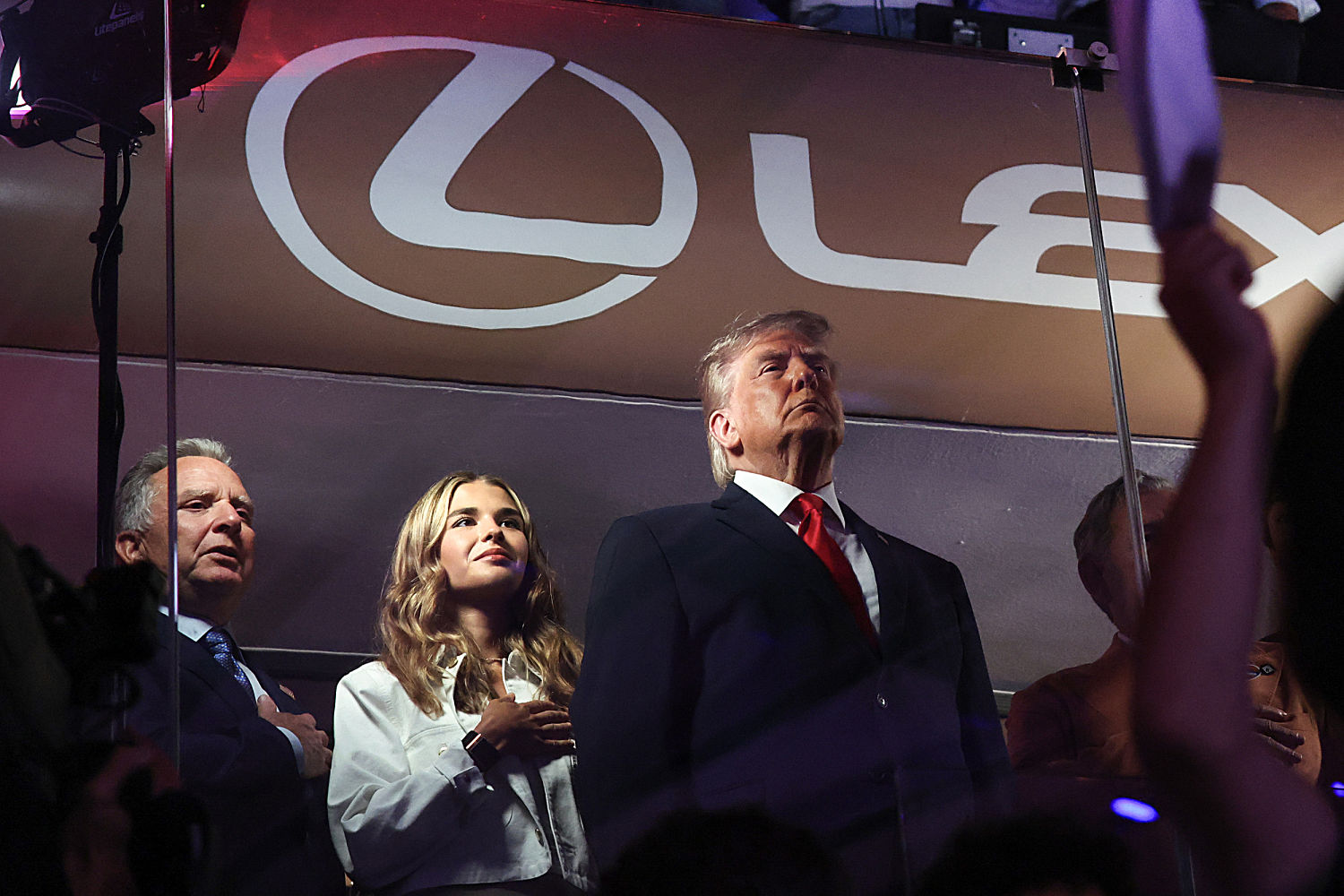
While ordinary fans spent their afternoon sweating behind barricades, Trump arrived in style. His Marine One helicopter touched down near Wall Street before a heavily armored motorcade whisked him up Manhattan. He entered the building under tight guard and took his place in the owner's box above center court, flanked by Knicks owner James Dolan, Interior Secretary Doug Burgum, and Transportation Secretary Sean Duffy.
The physical configuration of the arena spoke volumes about the tension inherent in the visit. The owner's suite was the only enclosure in the entire stadium retrofitted with security glass. Secret Service personnel completely commandeered the neighboring luxury suites on both sides, displacing high-paying corporate clients to ensure a sterile zone around the president.
Trump spent the first quarter chatting with Dolan, a longtime billionaire donor and personal friend who extended the invitation last week. Later, NBA Commissioner Adam Silver joined the box, navigating the delicate optics of a league that has historically clashed with Trump’s rhetoric. At one point, the president was spotted drinking a classic Coke, a minor rebellion in a stadium where Madison Square Garden’s exclusive pouring rights contract strictly dictates that only Pepsi products are sold to the public.
When the Jumbotron fixed its lens on him during the anthem, Trump held a military salute for eight seconds, smiling through a barrage of jeers that easily eclipsed the boos directed at the San Antonio Spurs during player introductions. The hostile reception only abated when the video board quickly cut away to show Knicks star Jalen Brunson, instantly flipping the arena's collective scream from pure rage to unbridled adulation.
The Cost of the Distraction
Sports franchises like to pretend their environments are hermetically sealed, but the reality is that energy bleeds from the concourses onto the hardwood. The electric, unified home-court advantage that had carried the Knicks through an unblemished postseason run felt fractured, replaced by a tense, hyper-policed anxiety.
On the floor, the visual contrast was stark. While Trump appeared to nod off into a brief nap in the upper tiers during the second half, French phenom Victor Wembanyama was putting on a clinic down below. The Spurs capitalized on the strange, unsettled energy of the building, erasing a seven-point halftime deficit to execute a clinical 115-111 victory. The loss snapped the Knicks' 13-game postseason winning streak and forced a reality check for a city that believed a championship was a foregone conclusion.
The political theater of the night also highlighted a massive disconnect within the building. Sitting elsewhere in the arena was New York City Mayor Zohran Mamdani, a democratic socialist who famously bought a $1,000 standing-room-only ticket out of his own pocket to support the team. Hours before the game, Mamdani had tried to downplay the looming political circus on a local radio station, noting that wanting the Knicks to win was one of the few things he and Trump actually agreed on.
But out on the concourse, fans weren't in a mood for bipartisan compromise. The general consensus among the blue-seat diehards from the Bronx and Queens was that the evening had been cheapened. For decades, the Garden has been a secular cathedral where New Yorkers from every socioeconomic background could escape the grinding realities of the city. By turning Game 3 into a political staging ground, Dolan and Trump stripped away that escapism, reminding everyone in attendance exactly who owns the suites and who gets stuck behind the fences.
The Knicks still lead the series 2-1, and Game 4 on Wednesday night promises a return to normal operational chaos without the presidential baggage. Trump is not expected to return to Manhattan for the remainder of the series. As the motorcade rolled away from the Garden and the metal barricades were loaded back into the beds of flatbed trucks, the neighborhood finally began to breathe again, leaving New York sports fans to count the literal and figurative cost of an evening where the game itself became second fiddle to an ego.