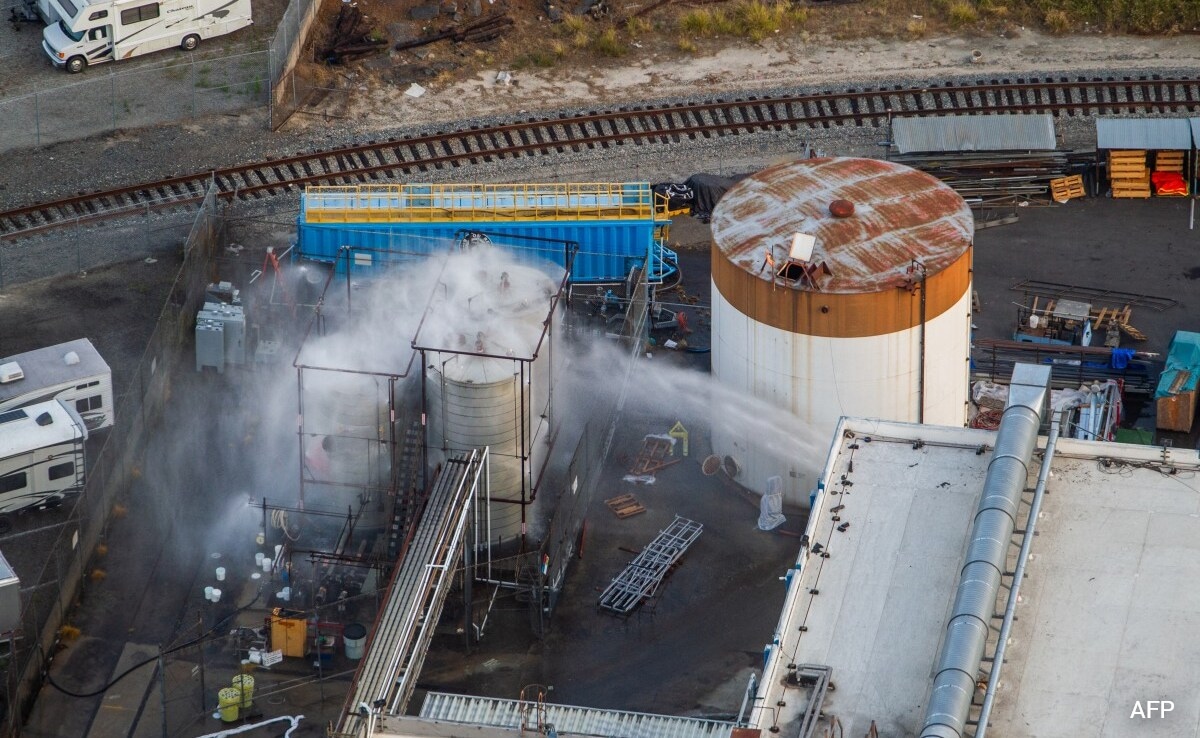
A failing valve, a rising pressure gauge, and suddenly an entire region is in the crosshairs of a major chemical disaster. When a toxic chemical tank threatened a catastrophic explosion recently, emergency officials had no choice but to order the immediate evacuation of 50,000 residents. The incident forced communities into makeshift shelters and ground local commerce to a halt. While local authorities managed to stabilize the site before a worst-case detonation occurred, the near-miss exposes a much larger, systemic vulnerability in global supply chains. We are living on the edge of aging industrial infrastructure, where regulatory gaps and urban encroachment turn routine chemical storage into ticking time bombs.
This was not an isolated stroke of bad luck. It was the predictable consequence of a system that prioritizes just-in-time logistics over deep-layered safety redundancies.
The Anatomy of a Near Miss
Chemical manufacturing and storage rely on a delicate balance of thermodynamics and mechanical engineering. When a storage tank holding volatile compounds fails, it usually begins with a breakdown in temperature control or stabilization additives. Many industrial chemicals require constant cooling or the introduction of inhibitors to prevent them from polymerizing—a chemical reaction that generates its own heat.
Once a runaway reaction begins, the liquid inside the tank boils, generating immense pressure. If the safety relief valves cannot vent the gas fast enough, the structural integrity of the steel tank compromises. This leads to a Boiling Liquid Expanding Vapor Explosion, or BLEVE.
The destructive power of a BLEVE is immense. The instant the tank ruptures, the sudden drop in pressure causes the remaining superheated liquid to vaporize violently, expanding to thousands of times its original volume. If the chemical is flammable or toxic, the resulting fireball and vapor cloud can devastate everything within a multi-mile radius. In this recent crisis, the sheer volume of the threatened tank meant that a breach would have leveled the industrial park and showered the surrounding residential zones with lethal concentrations of toxic gas.
Emergency crews faced a harrowing math problem. They had to pump thousands of gallons of water per minute onto the outer shell of the tank to keep it cool, knowing that if the temperature crossed a critical threshold, the water would be completely useless. It was a race against a clock no one could see.
The Blind Spots in Industrial Zoning
The necessity of evacuating 50,000 people highlights a structural flaw in how modern cities grow. Decades ago, heavy industrial facilities were built far outside municipal boundaries. Land was cheap, and the buffer zones between hazardous materials and human populations were measured in miles.
That buffer has vanished. As housing costs skyrocket and urban populations swell, residential developers push deeper into former industrial corridors. Local zoning boards, eager for property tax revenue, routinely approve high-density residential developments right next to chemical plants, refineries, and rail yards.
Consider the logistical nightmare of moving 50,000 people on short notice. Roads clog instantly. Emergency alert systems fail to reach everyone. Vulnerable populations, such as hospital patients and the elderly in care facilities, cannot simply pack into a car and drive away. The fact that an evacuation of this scale was required proves that our zoning laws have failed to protect public safety. We are allowing the invisible hand of real estate development to dictate our vulnerability to industrial disasters.
The Mirage of Self Regulation
The chemical industry frequently points to its internal safety protocols and voluntary compliance programs as proof that stricter government oversight is unnecessary. They argue that market forces and the threat of litigation are enough to keep operations safe.
That argument ignores the reality of corporate finance. In times of economic volatility, maintenance budgets are often the first to be trimmed. Deferring a routine inspection or delaying the replacement of a questionable seal saves money this quarter. The risk is kicked down the road, to be dealt with by future management teams or absorbed by the surrounding community.
Insurance companies are supposed to act as a backstop, demanding high safety standards in exchange for coverage. However, the complexity of modern industrial processes means that insurers often rely on self-reported data or superficial audits. By the time an inspector catches a critical flaw, the facility may have been operating in a high-risk state for years.
The Vulnerability of the Supply Chain
This crisis also shines a light on the dangerous lack of transparency regarding what is traveling through, and sitting in, our communities. Every day, thousands of railcars and trucks loaded with hazardous materials traverse the country. They park in railyards, sit at distribution centers, and wait outside manufacturing hubs.
Many local fire departments are dangerously under-equipped to handle a specialized chemical emergency. They lack the training, the protective gear, and the specific neutralizing agents required to combat a runaway chemical reaction. When an incident occurs, local first responders are often forced to wait for proprietary corporate response teams to fly in, losing precious hours while the danger escalates.
We need a fundamental shift in how we manage industrial risk. Relying on luck and the heroic efforts of emergency workers is not a sustainable strategy.
Fixing this requires concrete, enforceable changes to how we regulate hazardous materials. First, we must mandate strict, non-negotiable physical buffer zones between high-hazard facilities and residential areas, completely independent of local zoning pressures. Second, we need real-time, publicly accessible tracking of bulk toxic chemical storage, giving communities and local fire departments exact knowledge of the risks over the fence. Finally, federal regulators must implement mandatory, independent third-party structural audits for any vessel holding highly volatile compounds, eliminating the conflict of interest inherent in corporate self-policing. Until these measures become standard practice, the next mass evacuation is not a matter of if, but when.