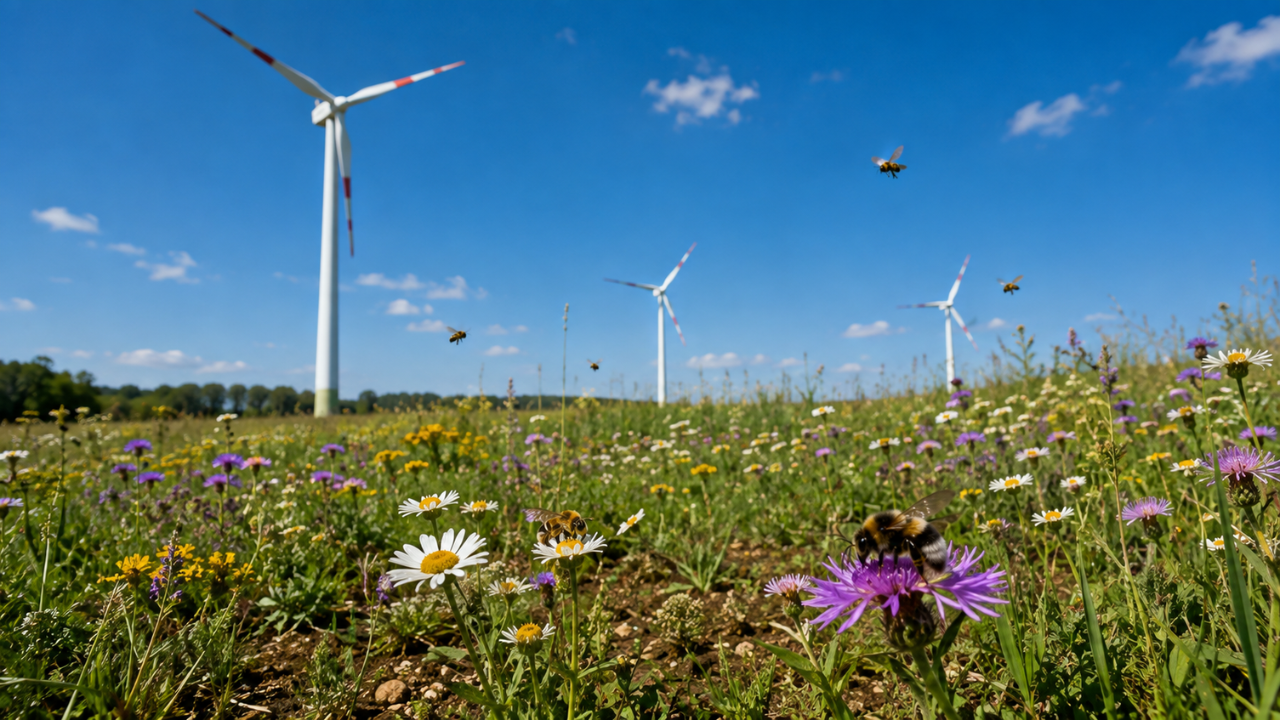
Industrial infrastructure rarely gets mistaken for a wildlife sanctuary. Steel towers, concrete pads, and access roads usually spell disruption for local ecosystems. Yet, a quiet ecological transformation is unfolding across the agricultural plains of western Poland. Beneath towering wind turbines, the gravel margins and unmanaged margins of service squares have inadvertently become prime real estate for wild bees.
This phenomenon challenges standard assumptions about energy projects and land use. For years, environmental impact assessments focused heavily on the immediate risks these massive blades pose to birds and bats. They routinely overlooked what happens directly at ground level. In homogenous agricultural districts dominated by intensive grain farming and heavy pesticide use, the small patches of ground surrounding turbine bases are emerging as unexpected ecological safe havens.
The Mechanics of an Accidental Habitat
Ecological field studies examining wind farms near towns like Gołańcz reveal a striking disparity between industrial footprints and the surrounding crop fields. While commercial fields are heavily sprayed and stripped of native flora, the gravel service squares—roughly twenty by thirty meters of sparsely vegetated soil maintained primarily for maintenance vehicles—attract remarkable numbers of ground-nesting bees.
Wild bees do not require pristine wilderness to thrive. They require specific structural conditions. Many solitary, ground-nesting species actively search for bare or semi-bare soil exposed to sunlight, free from the thick, choking root mats found in dense grasslands. The gravel margins, subjected to light foot traffic and minimal management, provide ideal drainage and thermal conditions for burrowing.
At the same time, segetal weeds—wild flowering plants that have been systematically eradicated from modern agricultural tracts—find a foothold in these neglected micro-habitats. These plants supply a steady source of nectar and pollen. Species richness and diversity indices for weeds around turbine bases frequently outpace both adjacent crop fields and plots specifically set aside for conservation.
Beyond the Corporate Greenwash
Skeptics are right to question whether energy operators should receive conservation credit for pouring gravel. Industrial construction fragments habitats and alters local hydrology. To frame wind farms as intentional conservation projects would misrepresent their primary industrial purpose.
However, distinguishing between corporate intent and physical reality matters. The data shows that these sites function as independent biological communities rather than mere spillover zones from nearby grasslands. Bee diversity and abundance metrics recorded around turbine towers frequently match or exceed those of dedicated semi-natural reserves.
This creates a complex policy puzzle. Traditional environmental assessments treat land under industrial footprints as a total write-off. When developers calculate biodiversity offsets, they rarely factor in the spontaneous reconciliation that occurs when human hands simply walk away from a patch of gravel for twenty years.
Rethinking Industrial Land Management
The implications extend far beyond a single wind farm in Poland. Energy transition blueprints across Europe and North America demand vast tracts of land. As developers face mounting scrutiny over land utilization, the management protocols applied to the ground beneath renewable energy infrastructure deserve a complete overhaul.
Minor adjustments could dramatically amplify these incidental benefits. For instance, operators could completely ban herbicide use within a designated perimeter around turbine towers. Intentionally seeding native, regionally appropriate forbs that bloom sequentially across the spring and summer would transform sterile gravel into high-output forage corridors.
The primary barrier is institutional habit. Facility operators prize neatness. Crews prefer sterile gravel pads free of vegetation that might obscure equipment or create fire hazards during dry months. Over-tidying remains the default setting of industrial asset management.
Allowing nature to reclaim the margins requires a cultural shift within the energy sector. It means accepting a certain level of unruliness around multi-million-dollar machinery. Yet, as rural landscapes face relentless ecological homogenization, the unpaved margins of renewable energy sites offer a rare opportunity to stitch fractured food webs back together.
The wind turbine towering overhead captures energy from the moving air. Down below, the neglected dirt and gravel are quietly doing something equally vital, proving that even heavy industry can accidentally leave room for the wild to dig in.