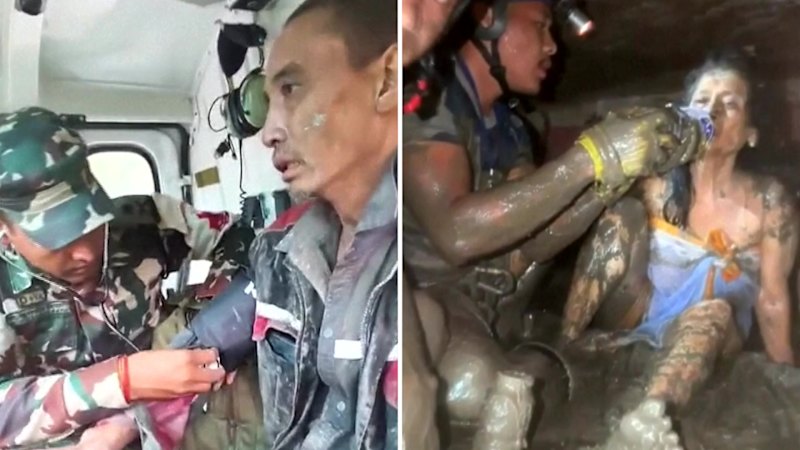
Ten days after a catastrophic glacial collapse and wall of flash floods tore through the Himalayas along the China-Nepal border, recovery operations transitioned into moments of profound astonishment. Rescuers pulled survivors from deep underground hydropower tunnels and mud-choked houses long after official timelines for human endurance expired. The August 26 disaster left more than 1,300 dead and thousands missing, yet these isolated pockets of survival forced emergency planners to re-evaluate how trapped bodies maintain life under extreme environmental duress.
The Physics of Underground Air Pockets
When thousands of tons of mud, rock, and water surge through a restricted geography, intuition suggests total annihilation. Hydroelectric infrastructure, however, introduces complex architectural anomalies. Massive subterranean tunnels designed to channel water can trap compressed atmospheric pockets when sealed shut by thick sludge barriers. For a deeper dive into similar topics, we suggest: this related article.
At the Trishuli project sites and the Upper Trishuli corridor, workers caught underground faced immediate pitch darkness, rising water levels, and rapidly depleting oxygen. Survival across a ten-day window without food defies standard physiological models. The human body can survive weeks without sustenance, but water deprivation typically proves fatal within three to four days.
Subterranean environments following flash floods maintain near-saturation humidity. This hyper-humid microclimate drastically reduces transcutaneous water loss. Victims trapped in damp environments lose moisture through sweat and respiration at a fraction of normal rates. Furthermore, psychological conditioning plays an unrecognized role. Reports from the site indicate survivors relied on rhythmic breathing, chanting, and psychological compartmentalization to lower metabolic output. Lowered metabolic rates reduce oxygen consumption and preserve finite cellular energy. To get more information on this development, comprehensive analysis is available at TIME.
The Logistics of the Impossible Search
Finding living souls beneath twenty meters of compacted silt requires more than standard rescue dogs and heavy machinery. Geological stability inside damaged tunnels remains precarious. Every movement risks triggering secondary collapses of slurry.
International disaster response teams from India, China, South Korea, and domestic forces had to crawl through narrow apertures. They relied on acoustic sensors capable of detecting faint taps or vocalizations through dense rock. When rescuers at the Trishuli plant heard faint shouting from deep within a blocked shaft, they realized standard recovery protocols were obsolete.
The operation required micro-tunneling techniques and precision air-supply lines before physical extraction could even begin. Heavy excavation equipment could not be brought close to the unstable portals without risking the lives of the operators. Instead, personnel advanced manually, clearing mud bucket by bucket in claustrophobic conditions.
Anatomy of a Catastrophe
The disaster itself was born from high-altitude instability. A massive glacial and rock collapse unleashed an unprecedented volume of water and debris down narrow mountain valleys. Infrastructure projects built to harness clean energy inadvertently became collection traps for the slurry.
Hydropower tunnels acted as massive barrels, catching the brunt of the kinetic force. Hundreds of construction workers and local residents found themselves trapped before they could reach higher ground. While initial emergency sweeps located bodies quickly, the deep subterranean complexes remained sealed by plugs of mud that took over a week to breach.
The survival of individuals like 64-year-old Chandrika Shrestha in the Nuwakot district, pulled from a home buried entirely up to its upper ceiling in sludge, proves that structural pockets can withstand immense external weight. Her home retained a pocket of air while surrounded by concrete and mud, shielding her from the crushing force of the moving mass.
The Psychological Aftermath and Medical Reality
Physical extraction is only the beginning of a complex trauma recovery process. Prolonged darkness, sensory deprivation, and hypercapnia—an elevated concentration of carbon dioxide in the blood—leave deep physiological markers.
Upon rescue, survivors exhibited severe jaundice, extreme dehydration, and acute psychological shock. Medical teams transported them immediately via military helicopter to intensive care units in Kathmandu. Initial evaluations pointed to acute kidney stress and rhabdomyolysis, a condition resulting from the breakdown of damaged muscle tissue releasing proteins into the blood stream after prolonged compression.
Families waiting at makeshift camps outside medical facilities experienced a roller coaster of grief and sudden disbelief. The discovery of these survivors injected a grimly persistent hope into operations that had largely shifted toward body recovery.
Governments and engineering firms face severe scrutiny over safety warning systems in high-risk glacial zones. As global temperatures alter high-altitude stability, valleys downstream of unstable ice masses remain vulnerable to sudden outbursts. Engineering a resilient grid requires anticipating events that operate on geological timescales rather than standard hydrological cycles.
Rescue teams continue to drill into remaining blocked sectors across the twelve affected hydropower sites, operating under the slim statistical probability that additional air pockets might shelter more survivors in the dark heart of the mountain.


