When two Palestinian gunmen opened fire at an Israeli military checkpoint in Hebron on October 23, 2026, killing two soldiers and wounding three others, the response from Jerusalem was immediate and sweeping. Within hours, the Israel Defense Forces (IDF) sealed off the occupied West Bank's largest commercial hub, erecting iron gates, bulldozing access roads, and displacing thousands of residents. Yet what wire dispatches framed as a standard counterterrorism sweep rapidly morphed into a 10-day siege that laid bare a deep rift between Israel’s military brass and its political leadership—all while strangling the Palestinian economy at the peak of its most critical agricultural season.
Wire coverage of the Middle East often reduces complex military operations to a tidy ledger of attacks and reprisals. A shooting happens; a city closes; regional tensions simmer elsewhere in Yemen, Jordan, or the Strait of Hormuz. That surface-level framing misses the structural reality on the ground. The October 2026 Hebron lockdown was not merely a tactical hunt for militants. It was a stress test of political survival, economic attrition, and the mechanics of modern military control in a territory where roughly three million Palestinians and 540,000 Israeli settlers live in volatile proximity.
The Anatomy of a Ten-Day Siege
Hebron is unlike any other city in the West Bank. It is the only urban center where hundreds of Israeli settlers live directly inside the core of a densely populated Palestinian municipality, guarded by a permanent military garrison. That geography turns every security incident into an immediate logistical chokepoint.
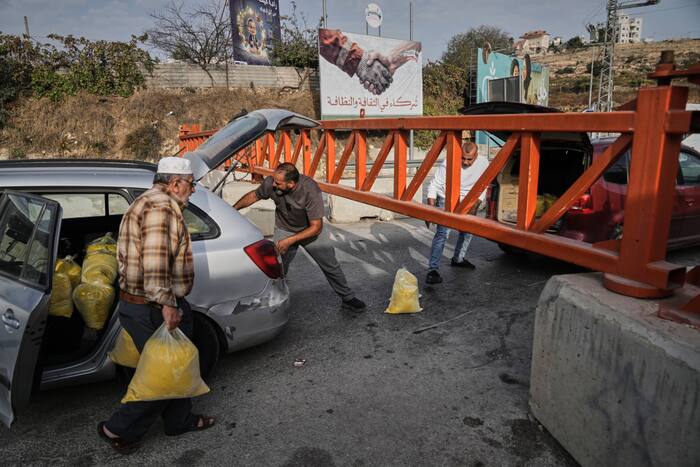
Following the October 23 shooting—in which troops from the Ari Battalion and the 101st Battalion of the 35th Paratroopers Brigade flanked and killed the two assailants—the IDF launched what it termed "precise, targeted and thorough searches" across the governorate. On the ground, precision looked like total immobilization. Soldiers blocked 10 major entry and exit points around the city. Vehicles were barred from passing military gates, forcing residents to haul bags of semolina and basic groceries on foot across dusty checkpoints before catching shared taxis on the opposite side.
The epicenter of the sweep hit neighborhoods like Ein Deir Baha and Al-Jalda. Troops used loudspeakers to order families out of their homes, turning residential blocks into closed military zones. Between 3,300 and 5,000 Palestinians were forcibly displaced over the course of the operation, according to local officials and international monitors.
When the military finally withdrew on the morning of November 2, the physical and statistical tally raised sharp questions about the operation's true purpose. Returning residents walked through shattered glass and violently breached doors into homes left in total disarray. Palestinian explosives experts had to tape off streets and inspect buildings before terrified children would even step back across their thresholds. Across 10 days of sweeping raids, home demolitions, and more than 110 arrests, the IDF announced it had confiscated exactly four weapons and 25 vehicles.
Political Timing Over Military Necessity
To understand why a search that yielded four firearms dragged on for a week and a half, you have to look at the Israeli electoral calendar rather than a tactical map.
The Hebron attack occurred just four days before Israel’s general election—a high-stakes vote widely viewed as a wartime referendum on Prime Minister Benjamin Netanyahu’s leadership. Within 24 hours of the initial lockdown, the military had already neutralized the immediate threat and swept the primary sector. According to reporting by Israel's public broadcaster and Haaretz, IDF Chief of Staff Lt. Gen. Eyal Zamir moved to end the operation and lift the Hebron closure by October 24, assessing that the military objectives had already been met.
Netanyahu and Defense Minister Israel Katz overruled him.
The political calculus was transparent. Lifting a major West Bank lockdown days before voters went to the polls risked projecting weakness to a right-wing electorate demanding visible deterrence. By keeping the iron gates shut and ordering forces to prepare for an expanded operation, the government maintained a posture of relentless force through election day.
Security analysts in Tel Aviv have long warned about this exact friction. When military closures are prolonged for domestic political theater rather than actionable intelligence, they stop functioning as a security shield and start acting as a recruitment engine. Every family forced to sleep on a relative's floor for ten days, and every shopkeeper watching inventory rot behind a concrete barrier, absorbs a lesson in collective punishment that outlasts any election cycle.
Economic Strangulation During the Olive Harvest
The timing of the Hebron siege also collided with the most fragile window in the Palestinian calendar: the autumn olive harvest.
Hebron is the industrial and commercial engine of the southern West Bank, home to stone-cutting quarries, shoe factories, and agricultural distribution networks. Sealing the city's arteries did not just inconvenience commuters; it severed trade routes for the entire region. Local authorities estimated that the blockade drained between 10 million and 12 million Israeli shekels—roughly $2.7 million to $3.2 million—from the local economy every single day, while leaving 13 industrial plants damaged.
Outside the city limits, the closure compounded an escalating crisis in the countryside. By early November, the United Nations Office for the Coordination of Humanitarian Affairs (OCHA) had documented 410 harvest-related settler attacks since the season began on September 1. Farmers already barred by military permits and physical roadblocks from reaching their groves faced arson, crop theft, and live ammunition when they tried to salvage their annual yield. For tens of thousands of rural households, the olive harvest is not a cultural tradition; it is the primary source of annual cash liquidity. Cutting off Hebron's markets while rural roads remained choked meant farmers could neither harvest their crops nor move them to buyers.
The ripple effects hit schools and clinics just as hard. UN data from late 2026 shows that education-related incidents—ranging from military delays at checkpoints to school closures—affected nearly 28,000 students across 149 West Bank schools over a single three-month span, a 120 percent jump over the previous year. In Hebron, doctors and patients were forced to abandon ambulances and private cars at military barriers, walking across checkpoints to reach medical appointments.
The Broader Regional Tinderbox
Mainstream news summaries often lump the West Bank closures together with flashpoints across the wider Middle East, creating the impression of isolated, unrelated fires. In reality, the autumn of 2026 demonstrated how tightly these theaters are wired together.
While Israeli paratroopers patrolled sealed intersections in Hebron, commercial shipping faced renewed strikes in the Strait of Hormuz, Iranian commanders issued warnings against U.S. naval deployments in the Persian Gulf, and Houthi forces launched ballistic missiles toward Saudi cities. Simultaneously, gunmen attacked a Greek Orthodox church in Karak, Jordan, and airstrikes continued to batter Gaza.
Washington and regional capitals watch the West Bank closely because it remains the most volatile domestic fuse in that regional network. Unlike a naval standoff in the Persian Gulf or a cross-border missile exchange, the West Bank involves daily, face-to-face friction between an occupying army, armed settler outposts, and a civilian population pushed to the brink of economic collapse. Even in mid-November, weeks after the Hebron gates reopened, the underlying pressure continued to build—with troops seizing small quadcopter drones across West Bank towns and Border Police dismantling illegal settler outposts only after riots broke out.
The Illusion of Permanent Containment
Israel's security establishment relies on a familiar playbook after fatal attacks: seal the perimeter, flood the zone with troops, demolish the assailants' family homes, and wait for quiet to return. Tactically, checkpoints and roadblocks create friction for militant cells trying to move weapons or fighters along highways like Route 35.
Yet decades of field evidence show a glaring flaw in that doctrine. You cannot seal off a city of over 200,000 people without dismantling the daily routines that give ordinary residents a stake in stability. When checkpoints turn a five-minute drive home into a multi-hour ordeal, and when military operations displace thousands of innocent families to net four rifles, the boundary between counterterrorism and collective attrition vanishes.
The iron gates around Hebron eventually swung back open, and bulldozers cleared the dirt mounds blocking the neighborhood streets. What remains behind is an economy bleeding millions of shekels a day, a generation of children afraid to walk through their own front doors, and a security doctrine that mistakes temporary silence for lasting control.
For a closer look at the fallout on the ground, watch this report on Hebron residents describe damage and shock as they return home following Israeli troop withdrawal, which captures the immediate aftermath for displaced families inspecting their ransacked neighborhoods once the military blockade lifted.