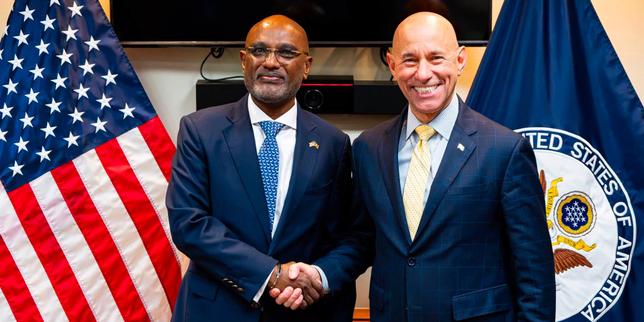
Washington is currently running its continental diplomacy through two entirely separate pipes, and neither one connects to the other. On one side sits Frank Garcia, the Senate-confirmed Assistant Secretary of State for African Affairs. He is a former naval intelligence officer and congressional insider who views the map of sub-Saharan Africa through the narrow, high-contrast lens of great-power competition and hard security. On the other side operates Massad Boulos, a heavily empowered White House senior adviser whose background is commercial trade rather than statecraft, and whose portfolio stretches effortlessly across both North Africa and the sub-Saharan interior.
This strange dual-track arrangement has turned American foreign policy into an exercise in bureaucratic friction. While foreign ministries from Abuja to Pretoria try to figure out which official actually speaks for the Oval Office, the State Department's internal machinery remains hollowed out. Roughly thirty ambassadorial posts across the continent sit vacant, stripped of leadership during successive waves of recalls that left permanent missions without Senate-confirmed chiefs. When a foreign policy is executed by competing power centers while the actual embassies stand half-empty, the result is not strategy. It is improvisation disguised as authority.
The Intelligence Mindset Meets the Transactional Arena
To understand why American outreach feels so jagged, look closely at who is writing the directives. Garcia spent years as a congressional staff adviser focused on defense intelligence before taking over the State Department’s Africa Bureau. His professional DNA prioritizes threat matrices, counter-terrorism alignment, and locking down critical supply chains for strategic minerals before rival extraction networks beat American firms to the punch.
When Garcia tours the continent, his itinerary reads like a ledger of transactional demands. In West Africa, stops in capitals like Abuja and Abidjan are tied directly to hard leverage: pressuring local governments on migration control agreements, threatening visa restrictions for non-compliance, and pushing bilateral trade terms that favor American corporate interests over long-term civil development. There is no pretense of traditional partnership or institutional capacity building here. It is a stark, utilitarian framework. Washington wants resources, security cooperation, and border enforcement. In exchange, it offers commercial access and selective diplomatic backing.
Yet this hard-nosed approach collides directly with the parallel diplomacy run by Boulos. Operating with direct access to the president, Boulos has spent his time jetting between North African energy summits and eastern Congo peace talks, attempting to broker high-profile deals through private commercial channels. Where Garcia relies on bureaucratic compliance and intelligence oversight, Boulos works through personal networks and corporate emissaries.
The friction between these two approaches creates institutional whiplash. African heads of state quickly realized they can bypass the traditional diplomatic corps entirely if a deal suits them better through White House channels. Conversely, career diplomats find themselves blindsided by policy declarations made by presidential advisers that contradict the statutory guidelines managed by the State Department.
The Cost of a Hollowed-Out Diplomatic Corps
The structural weakness of this setup goes far beyond personality clashes at the top. Effective diplomacy requires institutional memory and continuous, granular engagement—qualities that cannot be supplied by a whirlwind presidential envoy or a newly minted bureau chief.
Consider the administrative vacuum left by widespread ambassadorial vacancies. For over a year, dozens of American embassies have operated under temporary leadership. Chargés d'affaires do their best to keep the lights on, but they lack the political weight required to negotiate complex trade pacts or resolve tense regional disputes. When a crisis flares up, host governments look for a permanent American counterpart with direct lines to executive power. Too often, they find an empty chair.
This absence creates a vacuum that other global actors are more than willing to fill. While Washington shifts its focus toward short-term resource extraction and transactional security pacts, competitors who maintain stable, long-term diplomatic staffing continue to entrench their economic positions. African governments notice the difference between a partner that invests in multi-decade infrastructure and institutional growth versus one that shows up primarily when it needs votes at the United Nations or security guarantees against local insurgencies.
Furthermore, tying diplomatic cooperation explicitly to domestic political objectives—such as aggressive migration enforcement and rapid deportation quotas—places immense strain on fragile bilateral relationships. African leaders face severe domestic political costs when they appear to bend to external migration demands without securing substantial economic concessions in return. When American envoys treat these negotiations as take-it-or-leave-it propositions, they routinely miscalculate the agency of local governments who are increasingly adept at saying no.
Managing the Institutional Disconnect
The fundamental flaw in the current architecture is the illusion that grand strategy can be decoupled from institutional depth. A presidential adviser can sign a framework agreement in Washington, and an intelligence veteran can demand compliance during a brief continental tour, but neither action builds the bureaucratic plumbing required to make those agreements stick.
Agreements break down when local ministries realize that the American officials who negotiated them have no permanent presence to follow through on the details. Without stable embassy leadership to manage daily friction, grand visions dissolve into rhetorical posturing.
The future trajectory of this relationship will depend entirely on whether Washington can bridge the gap between its high-level ambitions and its depleted operational footprint. Until the administration fills its vacant diplomatic posts and aligns its competing power centers under a single, coherent chain of command, its continental policy will remain vulnerable to crossed wires and missed opportunities. Real influence requires showing up consistently, listening to local realities rather than issuing transactional edicts, and trusting that traditional diplomacy outlasts political cycles