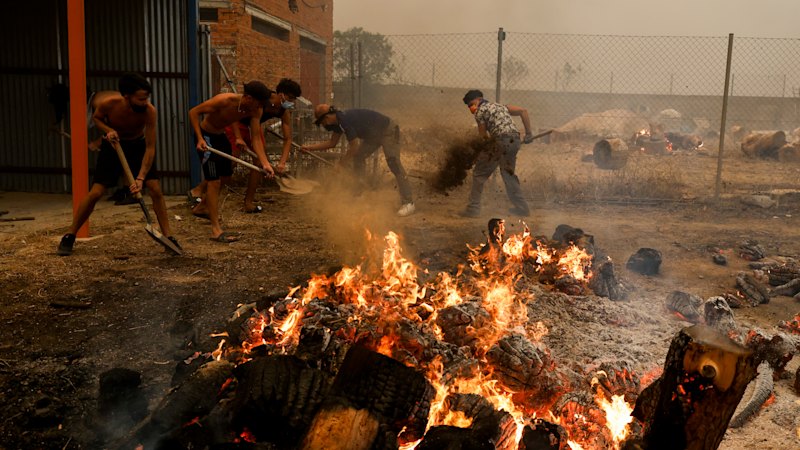
The smoke arrives long before the sirens. It hangs heavy over the limestone rooftops of Bordeaux, tasting of scorched pine, dried resin, and the bitter ash of thousands of acres of ancient woodland gone up in smoke. Across the Gironde estuary and down through the scorched pine plantations of the Landes forest, the reality of climate displacement has stopped being a distant projection on an evening news broadcast. It is happening right now. More than 200,000 residents and tourists have been forced to flee their homes and campsites as monstrous walls of fire sweep across southwestern France and northern Spain.
The immediate headline is evacuation. Buses rumble down national highways, their windows reflecting orange skies. Tents are pitched hastily in municipal gymnasiums miles away from the coast. Yet focusing solely on the human exodus misses the deeper, more systemic structural failure that allowed a regional emergency to transform into a continental catastrophe. This is not merely an act of angry weather. It is the predictable outcome of decades of industrial forestry management, ecological blind spots, and municipal complacency meeting head-on with an accelerating thermal reality.
The Monoculture Tinderbox
To understand why southwestern France became a tinderbox, you have to look down at the ground rather than up at the smoke. The vast Landes de Gascogne forest, which stretches south of Bordeaux toward the Spanish border, is the largest artificial forest in Western Europe. Millions upon millions of maritime pine trees stand in rigid, uniform rows.
For generations, this design served commercial efficiency. It streamlined logging, maximized resin extraction, and turned a once-swampy wasteland into an economic engine for the region. Ecologically, however, a monoculture plantation is an invitation to disaster.
Nature despises uniformity. When a forest consists of a single species planted at identical densities with identical ages, it lacks the resilience found in diverse, mixed-age woodlands. There are no natural firebreaks of deciduous trees like oak or chestnut, which hold more moisture and resist high-intensity crown fires. Instead, the Landes functions like a giant matchstick holder. The trees are packed tight, their needles are laden with highly flammable volatile oils, and the resin acts as an accelerant.
When a spark catches during a historic heatwave, the fire does not merely burn along the forest floor. It climbs the trunks, leaps from crown to crown, and creates its own weather system. Fire tornadoes spin through the canopy, driving temperatures past 1000 degrees Celsius and turning timber into shrapnel.
Forestry officials knew this risk existed. Academic papers warned about the vulnerability of maritime pine monocultures to prolonged drought for decades. Economic imperatives consistently overrode ecological caution. The timber industry demanded volume, and the regional infrastructure delivered volume, right up until the moment the whole system caught fire.
The Cross-Border Ripple Effect
The crisis has never respected national borders. While the international media focuses heavily on the dramatic evacuations around the Arcachon Bay and the vineyards of the Gironde, the exact same atmospheric and ecological dynamics are playing out across the Pyrenees in northern Spain.
Catalonia, Aragon, and Navarre have faced concurrent blazes that stretch emergency response teams to their absolute breaking point. Water bombers cross the international border under mutual aid agreements, landing in French fields to refill before heading back toward Spanish mountain ridges.
This cross-border spillover exposes the fragilities of European civil protection models. When every nation in Southern Europe is baking under the same severe heat dome, neighboring countries cannot easily spare their aerial firefighting fleets. Spain needs its planes. Portugal, dealing with its own inland infernos, needs its crews. France stands alone with its domestic assets stretched thin across multiple fronts, from the pine forests of the west to the scrublands of the Mediterranean coast.
The logistical nightmare of evacuating 200,000 people further highlights the strain on municipal infrastructure. Coastal towns designed to handle a predictable influx of summer holidaymakers suddenly found themselves managing an emergency population shift equivalent to a major city packing up and leaving within hours. Traffic clogged narrow two-lane departmental roads designed for leisurely wine tours. Fuel stations ran dry as panicked drivers topped off their tanks. Communication networks stuttered under the surge of mobile data traffic as families tried to coordinate meeting points.
The Economic Shocks to the Wine Capital
Bordeaux is a global brand. Mention the name, and people instantly picture gravelly soils, grand châteaux, and centuries-old bottles of claret resting in cool, dark cellars. That romantic mythology is currently colliding with the harsh physics of modern pyrology.
While the flames have largely stopped short of major urban architecture, the smoke has settled heavily over the vineyards of the Médoc, Graves, and Saint-Émilion. Grapevines in late summer are intensely vulnerable. When smoke blankets a vineyard for days or weeks during the crucial ripening period, the porous skins of the grapes absorb volatile phenols.
Winemakers call this smoke taint. You cannot taste it immediately in the fresh juice, but it reveals itself months later in the bottle, rendering expensive vintages tasting like wet ash, smoked bacon, or a chemical swamp. For small family-owned vineyards operating on thin margins, a single tainted harvest can mean bankruptcy. Crop insurance schemes, built for traditional hail or frost risks, often fail to cover the comprehensive losses associated with persistent smoke damage.
Furthermore, the tourism sector—the lifeblood of regional summer commerce—has suffered a severe blow. Campgrounds around the Dune of Pilat, Europe's highest sand dune and a massive tourist draw, have been reduced to smoldering charcoal. Families who saved all year for a coastal French holiday found their tents incinerated and their itineraries upended. The economic recovery for these local hospitality businesses will take years, assuming insurance payouts arrive and insurance companies are willing to renew policies in high-risk zones.
The Flawed Logic of Suppression
For decades, the standard operating procedure for firefighting in Europe and North America has been absolute suppression. Every time a wisp of smoke appeared, airplanes dropped tons of chemical retardant, and ground crews rushed in with heavy machinery to stamp it out.
From a short-term political standpoint, total suppression makes sense. Elected officials want to show that they are protecting citizens and property immediately. Ecologically, however, total suppression is a trap.
By aggressively putting out every small, low-intensity fire, land managers allowed dead wood, brush, and undergrowth to accumulate undisturbed for half a century. When fires are prevented from clearing out the forest floor naturally, fuel loads build up year after year. When a fire finally breaks through the suppression net—fueled by record-breaking temperatures and dry winds—it is no longer a manageable ground fire. It is an unstoppable monster.
Fire experts have advocated for controlled burns and strategic thinning for years, but public pushback has been fierce. Homeowners living near forested areas object to smoke in their neighborhoods, and environmental groups sometimes protest actions that disrupt local wildlife habitats in the short term. The result is a system locked into paralysis. We suppress the small fires today to guarantee catastrophic fires tomorrow.
Rethinking the Rural Landscape
As the smoke finally begins to clear from the skies above Bordeaux and the refugees slowly return to inspect what is left of their properties, the regional conversation must shift from disaster relief to fundamental reconstruction. Patching up roads and rebuilding wooden cabins will not solve the underlying pathology.
The Landes forest cannot be replanted the exact same way. Recreating a dense, uniform maritime pine monoculture across hundreds of thousands of acres is an invitation for the next inevitable heatwave to finish the job. Land managers must embrace ecological diversity. Planting mixed forests featuring broadleaf trees, creating wide, permanent firebreaks, and restoring natural wetlands that act as natural humidity zones are mandatory steps for survival.
Agriculture and viticulture must also adapt. Vineyards may need to experiment with canopy management techniques that shield grapes from prolonged smoke exposure, or pivot toward grape varieties that mature earlier in the season before peak fire risks materialize.
The evacuation of 200,000 people across France and Spain was a wake-up call that cannot be hit with the snooze button. The climate has changed, the landscape has changed, and our approach to managing the earth beneath our feet must change with it. The alternative is a future where the sweet scent of pine in Bordeaux is forever replaced by the acrid reminder of what happens when we refuse to see the forest for the trees.