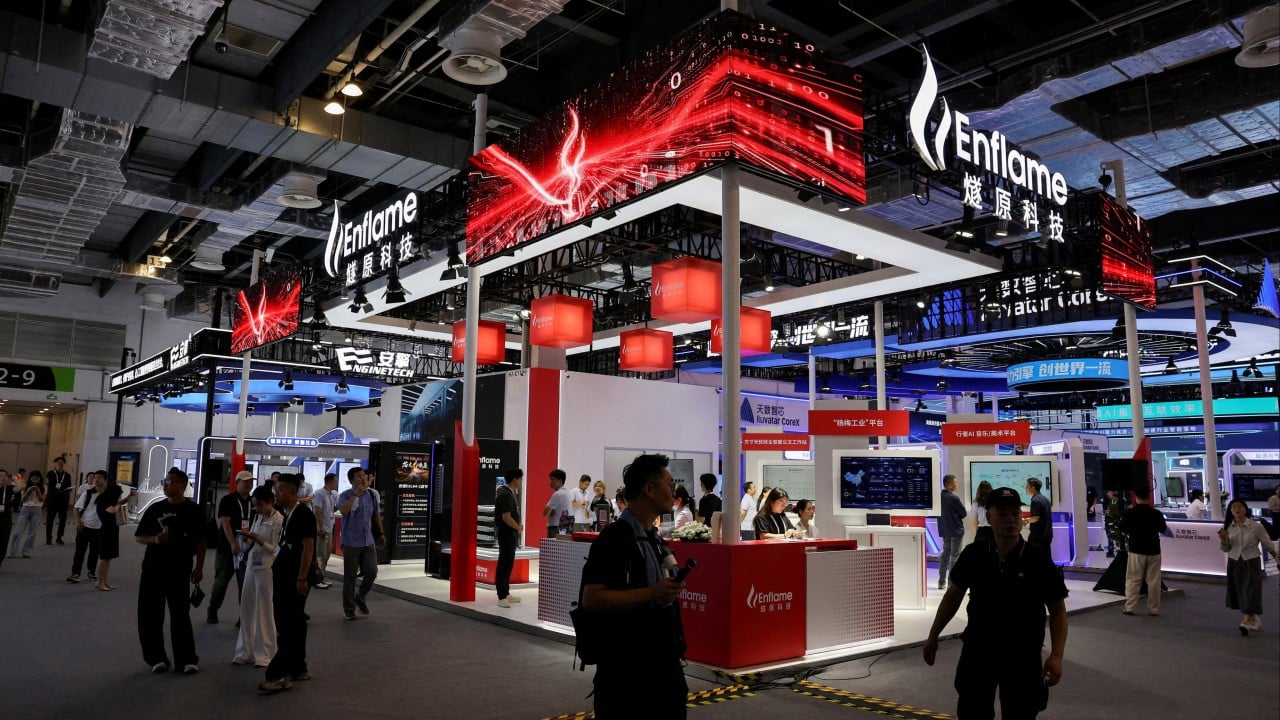
Shanghai Enflame Technology recently drew a staggering 4,073 times oversubscription for its retail tranche on China's STAR Market, hauling in approximately 5.98 trillion yuan in chasing orders. The numbers look like an economic distortion. Seven million individual investors swarmed the offering, hoping to capture a piece of the domestic semiconductor machine designed to break American hardware dominance. Behind the breathless retail mania, however, sits a stark operational reality. Enflame is burning capital at a frantic pace, lacks profitability, and relies on a single dominant corporate patron for the vast majority of its commercial survival.
The eight-year-old startup represents the final installment among China's self-styled "four little dragons" of artificial intelligence silicon to hit public exchanges, following peers like Moore Threads, MetaX, and Biren Technology. Yet the mechanics of this offering expose the unique pressure points governing Beijing's tech-autarky campaign. Investors are not merely pricing a company. They are purchasing a lottery ticket on national industrial policy.
The Architecture of Dependency
To understand why 7 million retail accounts threw money at an unprofitable business, look closely at the customer concentration disclosures buried within the exchange filings. Tencent Holdings owns a twenty percent equity stake in Enflame. That relationship extends far beyond a passive venture capital check. Tencent accounted for an astonishing eighty-four percent of Enflame's total revenue, jumping sharply from roughly thirty-eight percent the prior year.
This dynamic highlights a fundamental vulnerability in China's domestic semiconductor ecosystem. Many homegrown chipmakers function essentially as captive internal foundries or specialized hardware arms for domestic internet giants. When state-directed capital and export restrictions choke off access to foreign processing units, local cloud titans pivot inward, buying domestic silicon to sustain domestic data centers.
Enflame's engineering approach compounds this insular ecosystem. While Nvidia and most market leaders prioritize general-purpose graphics processing units capable of adapting to fluid workloads, Enflame leans heavily on domain-specific architecture. This design philosophy optimizes performance for narrow, predictable tasks like AI inference. Efficiency spikes for specific workloads. Flexibility plummets when algorithms shift.
Building a chip tailored explicitly for one primary cloud ecosystem creates an efficient feedback loop. It also makes independent market expansion remarkably difficult if outside enterprises demand standard programming frameworks that favor more adaptable architectures.
Valuation Realities Against Global Benchmarks
The public filing numbers demand sober analysis. Enflame priced its shares at 142.18 yuan to raise roughly 6.12 billion yuan, valuing the pre-profit enterprise at 61.8 times its 2025 sales.
Market analysts frequently point out that sixty-two times sales is astronomical by historical norms. Yet within the frantic vacuum of China's localized semiconductor exchange floats, it actually represents a relative discount. Listed domestic competitors Moore Threads and MetaX trade at revenue multiples exceeding 160. Meanwhile, Nvidia commands a multiple hovering around 25.4 times sales.
+--------------------+-------------------------+
| Company / Entity   | Approximate Sales Multiple|
+--------------------+-------------------------+
| MetaX / Moore Thr. | >160x                   |
| Enflame Technology | 61.8x                   |
| Nvidia Corporation | 25.4x                   |
+--------------------+-------------------------+
The multiple differential illustrates the distortion field created by capital controls and geopolitical friction. Domestic investors are paying a massive premium for localized security of supply, willingly ignoring traditional bottom-line metrics because the state-backed mandate guarantees a baseline of domestic demand. Enflame narrowed its net loss to 1.2 billion yuan from 1.5 billion yuan the previous year, projecting surging revenue figures for the upcoming reporting periods. Top-line growth is undeniable, driven by frantic data center buildouts across the mainland. But scaling revenue while locked into a single primary customer does not equate to a healthy, diversified enterprise.
The Next Generation Gamble
The capital raised from the 43 million newly issued shares is already spoken for. Management intends to channel the funds straight into research and development for its fifth- and sixth-generation AI architectures, alongside integrated hardware-software ecosystem projects.
Designing advanced silicon requires astronomical upfront expenditures on mask sets, advanced packaging, and engineering talent. Every iteration becomes more expensive as process nodes shrink and lithography access remains constrained by international trade restrictions. Enflame's ability to survive past this current funding injection depends entirely on whether its upcoming fifth-generation chips can break free from Tencent's balance sheet and find commercial adoption across independent enterprise buyers.
The retail frenzy on the Shanghai STAR Market proves that domestic liquidity remains fiercely hungry for technology plays. It also confirms that market participants are pricing political necessity rather than corporate risk. When the state-directed infrastructure boom eventually matures, the underlying economics of specialized chip design will assert themselves with absolute clarity.