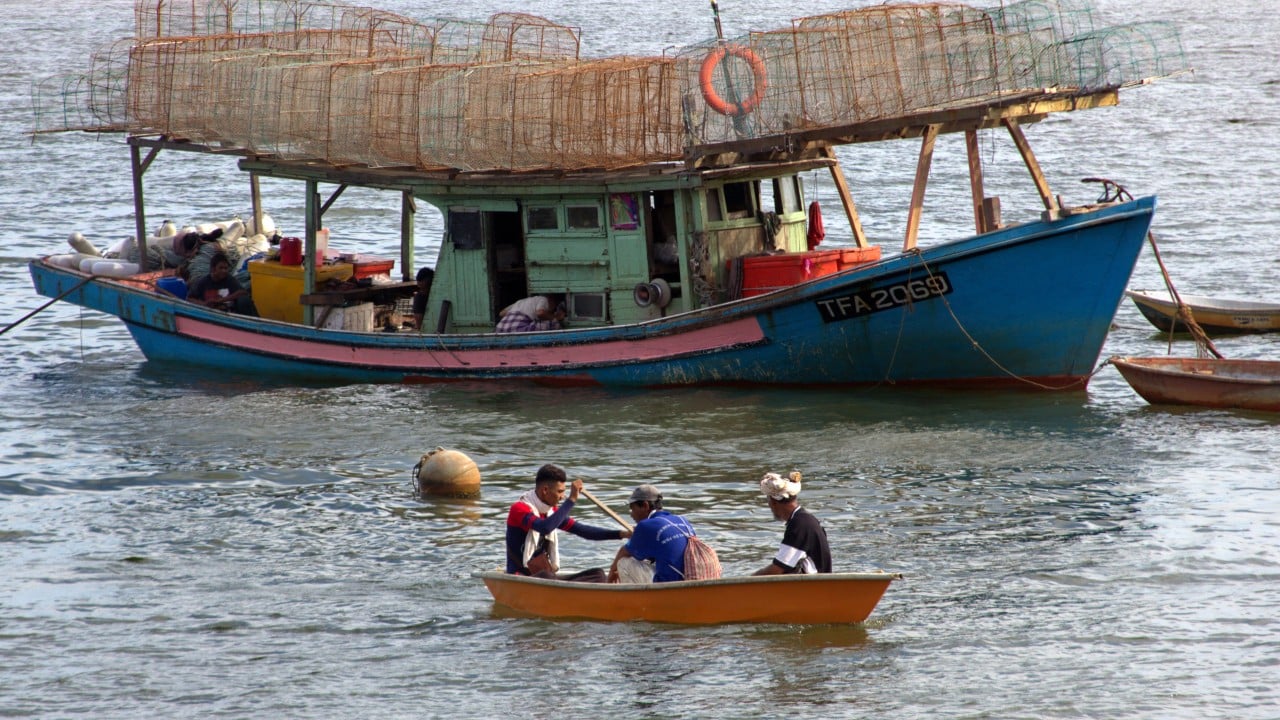
Malaysia is attempting to build a multi-billion-dollar maritime empire on a foundation of sand. The government has billed its vast marine territory as the next frontier for national wealth, drafting ambitious policies around aquaculture, tidal energy, and marine biotechnology. Yet, this grand economic plan is colliding with a harsh reality. The state cannot secure the waters it wants to commercialize. While elite policy circles debate resource optimization, foreign fleets are systematically draining the country’s maritime resources with impunity, exposing a severe gap between federal ambition and enforcement capability.
The Midnight Predation
Every week along the eastern coast of Peninsular Malaysia, the limits of state authority become clear. Under cover of darkness, commercial trawlers from neighboring countries slip into the rich fishing grounds near Pulau Redang and Pulau Bidong. They operate in the dead of night, deploying heavy industrial nets that scrape the seabed, destroying marine ecosystems in a matter of hours. By dawn, they evaporate back into international waters.
Local fishermen bear the direct consequences of this security failure. According to records from the Terengganu fishermen’s association, Penentu, these foreign incursions are regular, highly organized, and deliberately timed to exploit the gaps in government patrol schedules. Local crews find their lines cut, their traditional fishing grounds depleted, and their livelihoods undercut by foreign operations that face minimal resistance.
This is not a minor border dispute. It is a structural hemorrhage. Maritime authorities acknowledge that illegal, unreported, and unregulated fishing strips massive value from the economy every year. Historical tracking puts the annual loss close to $1.4 billion. For a country attempting to transform its marine spaces into sustainable economic drivers, this scale of unregulated extraction undermines the entire initiative before it can take root.
A Fleet Stretched to Breaking Point
The arithmetic of Malaysia’s maritime security simply does not add up. The country claims an Exclusive Economic Zone spanning roughly 450,000 square kilometers—an expanse significantly larger than its total landmass. To police this vast, porous territory, the Malaysian Maritime Enforcement Agency and the Royal Malaysian Navy rely on a collection of aging surface vessels, chronic maintenance backlogs, and limited aerial surveillance assets.
Enforcement crews face an impossible mandate. A single patrol vessel may be tasked with monitoring thousands of square kilometers of open ocean while simultaneously managing piracy risks in the Malacca Strait and tracking gray-zone naval incursions in the South China Sea. Foreign fishing fleets understand this resource deficit. They use basic radar technology and lookouts to map the movements of state assets, ensuring they are always positioned where enforcement is absent.
Attempts to modernize the fleet have run into bureaucratic delays and procurement scandals. Crucial defense acquisitions, including modern offshore patrol vessels and littoral mission ships, have faced years of production setbacks. Without these assets, the strategy relies on reactive enforcement, responding to incidents long after the offending vessels have crossed back over maritime boundaries.
The Bureaucratic Gridlock
The enforcement shortfall is compounded by structural dysfunction within the government itself. Responsibility for Malaysia’s ocean space is fractured across an array of competing ministries, departments, and state-level agencies. The Ministry of Agriculture and Food Security handles fisheries licensing, the Ministry of Transport manages ports and shipping, the Ministry of Natural Resources oversees environmental protection, and various security agencies handle enforcement.
| Agency / Entity | Core Mandate | Primary Operational Focus |
|---|---|---|
| MMEA | Maritime Law Enforcement | Coastal and EEZ security patrol |
| Department of Fisheries | Resource Management | Licensing and aquaculture development |
| State Governments | Coastal Jurisdiction | Tourism and local shoreline zoning |
| Royal Malaysian Navy | National Defense | Sovereign defense and external threats |
This fragmentation creates severe coordination barriers. Information collected by one department rarely reaches operational units on the water in real-time. Furthermore, a constitutional divide complicates governance, as state governments maintain control over coastal waters and land management, while the federal government retains authority over the deep sea. In resource-rich regions like Sabah, Sarawak, and Terengganu, this division leads to policy friction, overlapping mandates, and regulatory blind spots that sophisticated cross-border criminal networks easily exploit.
The Geopolitical Complication
The issue extends far beyond illegal fishing crews. Malaysia’s maritime economic ambitions are deeply entangled with the geopolitical tensions of the South China Sea. Traditional security threats, notably the persistent presence of foreign coast guard vessels near strategic features like Luconia Shoals, force the state to prioritize high-stakes diplomacy over local fisheries enforcement.
Kuala Lumpur has long favored a quiet, bilateral diplomatic approach to manage these territorial sensitivities. This strategy keeps open lines of communication with major trading partners, but it creates a security vacuum for coastal communities. When state security assets are diverted to monitor external naval movements or protect offshore oil and gas infrastructure, domestic fishing grounds are left completely unguarded.
Resolving the Sovereign Deficit
Rethinking the ocean economy requires shifting focus away from speculative future industries and toward basic sovereignty. No sustainable industry can thrive in an environment where the state cannot enforce property rights or environmental regulations.
To bridge this gap, the state must move past its reliance on traditional, asset-heavy naval patrols. Deploying uncrewed aerial vehicles for persistent maritime surveillance and integrating automated satellite tracking can give enforcement agencies real-time visibility over the entire economic zone at a fraction of the cost of building new warships. More importantly, Malaysia requires a singular, centralized maritime authority capable of overriding bureaucratic silos and unifying federal and state policy under a single operational command. Until the state can secure its borders, any discussion of a prosperous ocean economy remains purely theoretical.