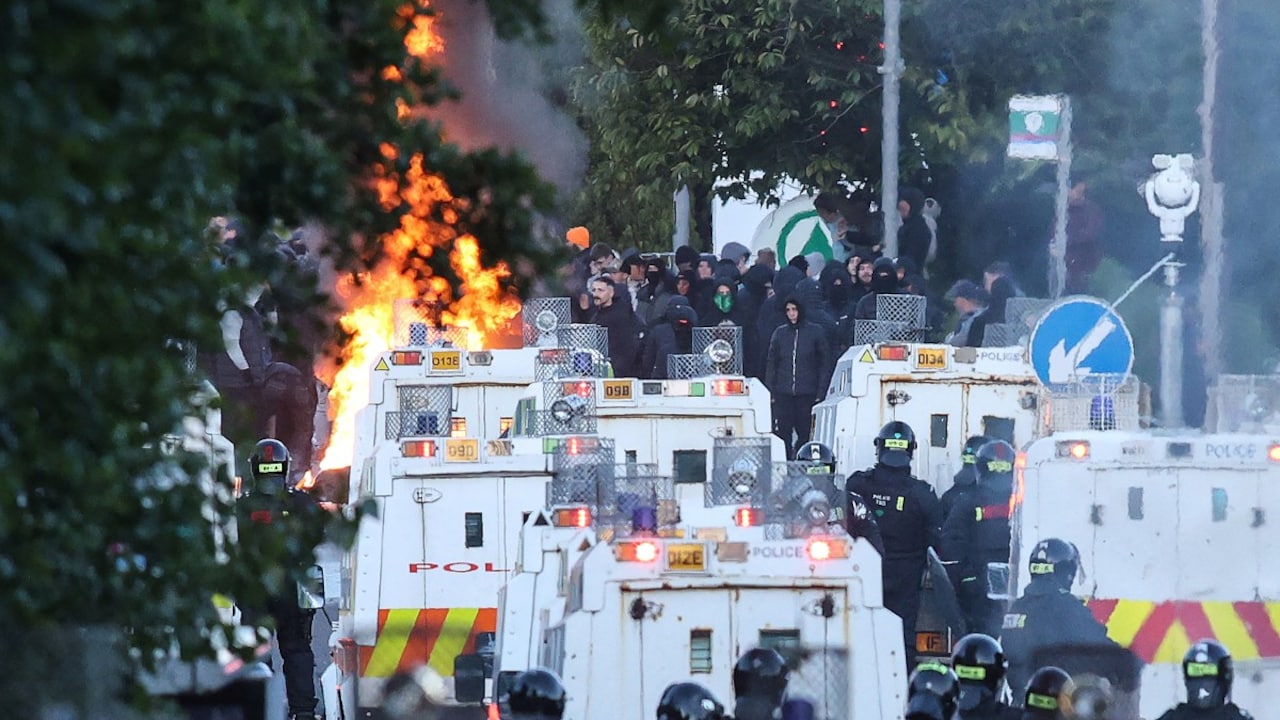
The Police Service of Northern Ireland (PSNI) declared a critical incident this week as violent anti-immigration riots engulfed multiple neighborhoods in Belfast. The unrest, which led to the burning of a public transit bus, cars, and minority-owned homes, erupted after a Sudanese asylum seeker was charged with attempted murder following a brutal knife attack on June 8. While mainstream narratives frame the violence as a spontaneous reaction to a horrific crime, the underlying crisis stems from a volatile mixture of modern algorithmic radicalization, historic sectarian territorialism, and a cross-border asylum loophole that authorities have systematically failed to close.
The immediate catalyst for the violence was undeniable. A graphic video surfaced online showing a man being viciously assaulted outside a block of flats in north Belfast, sustaining severe head, neck, and back wounds. Members of the public, including a local man wielding a hurling stick, intervened to save the victim's life.
Within hours of the footage going viral, the digital infrastructure of the global far-right shifted its collective focus toward Northern Ireland. High-profile international figures and domestic agitators weaponized the incident to orchestrate what local representatives have termed a race-based pogrom. Masked men marched through loyalist strongholds like the Lower Newtownards Road and Sandy Row, chanting anti-immigrant slogans, launching fireworks, and physically forcing minority families from their residences.
The Digital Architecture of Local Panic
The speed with which the Belfast protests transformed into coordinated arson attacks highlights a fundamental shift in how civil unrest is manufactured. The PSNI was not merely fighting rioters on the street; they were fighting a decentralized network of online actors who used the stabbing to validate pre-existing anti-immigration rhetoric.
Chief Constable Jon Boutcher revealed that the 30-year-old Sudanese suspect arrived in Belfast in February 2023 via a transit route spanning Paris and Dublin. He possessed a legal residence permit valid until 2028 and had no prior record on national security databases. However, these bureaucratic details were instantly buried beneath a deluge of incendiary social media posts.
Online platforms acted as an accelerant. Tech executives and political commentators amplified localized anger, transforming a specific criminal investigation into a broad referendum on United Kingdom border policy. The rhetoric was intentionally designed to bypass local political structures, reaching directly into disenfranchised communities where historic grievances remain close to the surface.
The Dublin to Belfast Loophole
To understand why Belfast has become a flashpoint, one must analyze the geographic reality of the Common Travel Area (CTA) between the United Kingdom and the Republic of Ireland. The land border on the island of Ireland remains entirely open, a foundational requirement of the 1998 Good Friday Agreement.
This open border has unintentionally created a highly efficient pipeline for asylum seekers seeking entry into the UK without undergoing traditional channel crossings. As immigration enforcement tightens along the English Channel, the Dublin-to-Belfast bus route has become an alternative corridor.
Consider a typical journey through this administrative blind spot. An asylum seeker arrives in Dublin, enters the Republic of Ireland legally or illegally, and simply boards a transnational bus or train heading north. There are no passport control checkpoints at the border. By the time the individual arrives at Europe Buscentre in central Belfast, they are inside the United Kingdom.
This mechanism complicates relations between London and Dublin. The UK government faces internal pressure to secure its borders, yet physical infrastructure on the Irish border is politically impossible. Consequently, Northern Ireland absorbs a disproportionate shifting share of the UK's asylum intake relative to its infrastructure, creating localized pressure points in working-class neighborhoods that are ill-equipped to handle sudden demographic shifts.
The Intersection of Sectarianism and Xenophobia
Northern Ireland remains one of the least ethnically diverse regions of the UK, with the 2021 census indicating that nearly 97 percent of the population identifies as white. For decades, working-class communities in Belfast have been defined by segregation, territorial mapping, and intense anxiety over demographic supremacy between unionist and nationalist populations.
When new immigrant communities settle in these areas, they enter a social ecosystem where territory is aggressively guarded. The anti-immigration sentiment observed in districts like east Belfast and Sandy Row does not exist in a vacuum. It borrows the exact tactics, aesthetics, and structural networks of traditional paramilitary organizations.
The masked men burning a Glider bus on Newtownards Road or kicking in doors of ethnic minority homes used the exact same logistics traditionally deployed during sectarian marching season disputes. For local extremist elements, the arrival of foreign nationals is framed as a new demographic threat to traditional community identity. Justice Minister Naomi Long noted that bad-faith actors are actively weaponizing genuine societal anxieties, mapping old sectarian territorial defenses onto modern anti-immigrant panic.
The Economic Reality Behind the Anger
While political actors debate the ethics of the riots, the economic conditions of the affected neighborhoods receive little scrutiny. The areas seeing the worst of the violence—parts of north and east Belfast—suffer from chronic underinvestment, generational unemployment, and severe social housing shortages.
When the state places asylum seekers into private rental accommodations or temporary lodging within these specific wards, it places a strain on localized resources. A working-class resident who has spent seven years on a social housing waiting list looks at a newly arrived asylum seeker through a lens of resource competition.
This is where the populist narrative gains its traction. Political factions exploit this economic friction, convincing residents that their lack of prosperity is a direct consequence of a porous border rather than decades of domestic policy failure. The resulting violence does nothing to solve the housing crisis or improve local schools, but it successfully diverts community anger away from elected officials and toward vulnerable minority populations.
The Corporate and Social Fallout
The immediate aftermath of the riots has forced a severe reckoning across Belfast's commercial sector. Sudanese business owners on Sandy Row were forced to bolt steel shutters over their storefronts, while the Belfast Islamic Centre suspended evening prayers out of direct concern for the safety of its congregants.
The impact extends deep into the local economy. Major employers across the city are now rewriting duty-of-care protocols. Legal experts have issued urgent guidance reminding businesses of their statutory obligations to protect staff from racial harassment, both within the workplace and during commutes through high-risk areas. With public transport lines targeted by rioters, the basic infrastructure of daily commerce in the capital has been compromised.
A Broken System Without a Clear Fix
The standard political response to the Belfast riots follows a predictable pattern. Executive ministers issue joint statements condemning "thuggery," the Prime Minister promises the full force of the law, and police forces deploy armored Land Rovers to restore a temporary, fragile peace.
None of these measures address the core vulnerabilities. The open border with the Republic of Ireland cannot be closed without collapsing the peace process. The global digital platforms that facilitate rapid mobilization remain entirely outside the jurisdiction of stormont or Westminster. Meanwhile, the economic desperation of Belfast's working-class estates continues to fester.
The unrest in Belfast is not an isolated incident of racial intolerance. It is the predictable outcome of a structural failure where international migration patterns, unmonitored transit corridors, and unmoderated digital algorithms collide with the unresolved trauma of a post-conflict society. Until policy makers address the systemic reality of the Dublin-Belfast transit route and the economic neglect of these communities, the peace of Northern Ireland will remain entirely at the mercy of the next viral video.