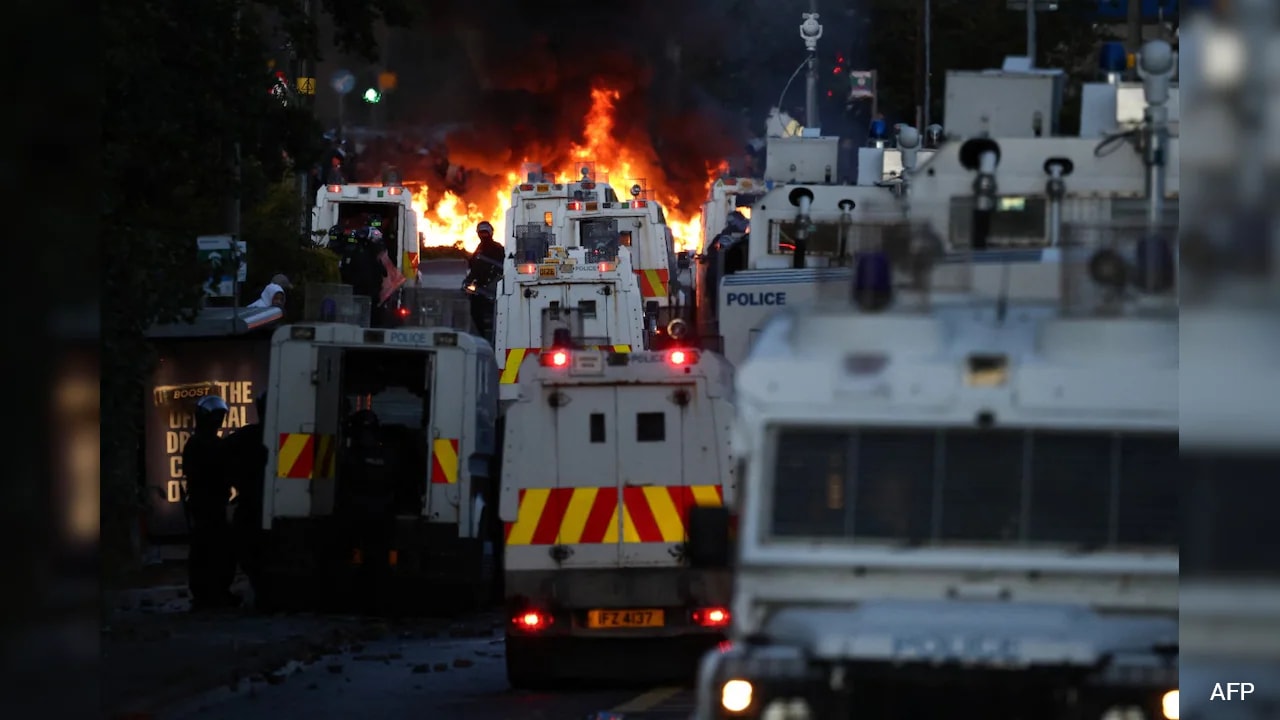
A quiet crisis is unfolding across Northern Ireland. South Asian professionals, specifically Indian healthcare workers and IT specialists recruited to fill critical labor shortages, are facing a targeted campaign of intimidation and arson. While mainstream reporting often reduces these incidents to random outbursts of street violence, the reality is far more organized. It is a systematic failure of localized policing colliding with a volatile mix of post-Brexit anxieties and paramilitary territorialism.
For the doctors, nurses, and engineers who moved to Belfast under official UK visa sponsorship, the promise of a peaceful European career has transformed into a calculation of daily survival. They are caught in the crosshairs of a society still wrestling with its past, where minority communities are being used as leverage in a completely different domestic dispute.
The Reality of the Belfast Street Campaign
Over the past year, police records in Northern Ireland have shown a sharp increase in racially motivated attacks. The incidents follow a distinct, chilling pattern. Petrol bombs thrown through the windows of terraced houses. Cars torched in the middle of the night. Racist graffiti scrawled across the doors of newly arrived families.
These are not spontaneous acts by disaffected youth. The targeting is precise. It focuses heavily on neighborhoods where affordable housing overlaps with areas still heavily influenced by loyalist paramilitary factions.
For an Indian software engineer or an NHS nurse, the British immigration system presented Belfast as an attractive option. Lower cost of living compared to London. Welcoming universities. A desperate need for skilled labor. The marketing, however, omitted the complex territorial mapping that still governs working-class Belfast. When a migrant family moves into a street adorned with paramilitary flags, they are often unknowingly crossing an invisible line drawn by local gang bosses who view any demographic shift as a threat to their territorial control.
Why the Standard Xenophobia Narrative is Wrong
To understand why this is happening, one must look beyond simple prejudice. Racism exists everywhere, but the violence in Belfast is driven by unique structural mechanisms.
Northern Ireland is still recovering from decades of conflict. In many working-class areas, the peace process did not bring economic prosperity; it brought stagnation. Local paramilitary organizations, officially on ceasefire for decades, transitioned into mafia-style criminal enterprises. These groups maintain control by policing their own communities and manufacturing external threats to justify their continued existence.
[Paramilitary Territorial Control]
       │
       ▼
[Housing Scarcity & Economic Stagnation]
       │
       ▼
[Targeting of Visible Minorities as "Outsiders"]
       │
       ▼
[Manufactured Community Fear to Maintain Local Power]
When the UK government expanded the Health and Care Worker visa to address severe shortages in the National Health Service, thousands of South Asian professionals answered the call. Northern Ireland's health service, perpetually on the brink of collapse, welcomed them. But the infrastructure to integrate them was non-existent.
When a public sector worker from Kerala or Punjab secures a rental property in a working-class Belfast neighborhood, local criminal elements weaponize the move. They tell residents that "outsiders" are jumping the social housing queue or driving up rents. It is a blatant lie—most of these professionals rent privately using their own salaries—but in an area starved of investment, the lie takes root. The violence that follows is a tool used by gang leaders to project power, showing both the local population and the state that they, not the police, dictate who lives on these streets.
The Failure of the Stormont and PSNI Response
The Police Service of Northern Ireland (PSNI) finds itself structurally ill-equipped to handle this specific brand of hate crime. Decades of counter-terrorism policing have left the force optimized for dealing with large-scale riots or historic dissident activity, but deeply deficient in handling localized, low-level urban terrorism directed at minorities.
When an arson attack occurs, the official response follows a weary, predictable script. Politicians issue press releases condemning the "mindless thugs." The PSNI opens an investigation. No one is arrested.
This lack of enforcement stems from a culture of fear. Neighbors who see petrol bombs being prepared are terrified to speak out. They know that the perpetrators belong to local criminal gangs that operate with relative impunity in their estates. The police, wary of sparking wider civil unrest or disrupting delicate political balances, often treat these attacks as isolated anti-social behavior rather than what they actually are: organized, politically useful hate campaigns.
This systemic inaction has created an environment of total vulnerability for Indian nationals. Unlike historic minority communities in larger British cities like Birmingham or Leicester, the South Asian diaspora in Northern Ireland is relatively small, dispersed, and politically unrepresented. They do not have the safety of numbers, nor do they have a powerful voice within the Stormont assembly to demand targeted protection.
The Economic Backlash Northern Ireland Cannot Afford
The human cost of this crisis is immediate, but the long-term economic consequences will reshape the region for a generation. Northern Ireland is currently facing an unprecedented staffing crisis within its public infrastructure.
The Western and Northern Health and Social Care Trusts rely heavily on international recruitment to keep emergency rooms and intensive care units running. If a consultant radiologist or a senior surgical nurse feels unsafe walking from their car to their front door, they will not stay in Belfast. They will pack their bags and move to Manchester, Edinburgh, or Toronto.
The tech sector faces the same vulnerability. Belfast has spent the last decade positioning itself as a European hub for cybersecurity and fintech. That reputation depends entirely on the free flow of international talent. Global corporations will not place sensitive operations in a city where their engineering staff face the risk of nighttime arson attacks. The regional government is actively sabotaging its own economic future by allowing paramilitary remnants to dictate the demographic makeup of its neighborhoods.
Beyond the Rhetoric
Solving this crisis requires abandoning the polite political consensus that characterizes Northern Ireland's governance. The state must confront the reality that paramilitarism never went away; it simply changed its targets.
Treating arson attacks on minority families as standard vandalism is a form of institutional negligence. These crimes require the same level of intelligence gathering, surveillance, and aggressive prosecution that the state deploys against national security threats. If the PSNI cannot guarantee the safety of the professional workers invited to sustain Northern Ireland's public services, the UK Home Office will eventually be forced to intervene, potentially restricting visa allocations to the region due to safety concerns.
The Indian professionals living in fear across Belfast are not asking for special treatment. They are asking for the basic contract of a civilized society to be honored: that their taxes buy them protection, and that their contribution to the community shields them from the flames. Until the state decides to break the power of the local gangs enforcing these street-level purges, those flames will continue to burn.