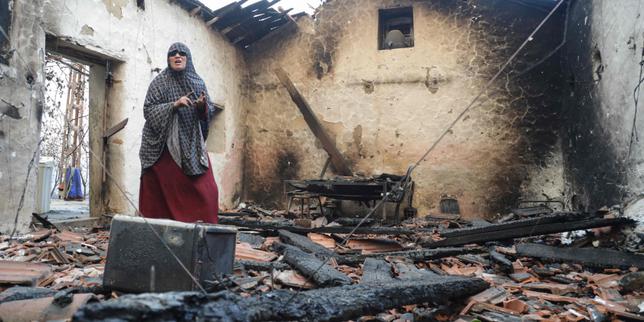
Twelve lives vanished in a matter of hours as walls of flame swept across Algeria's eastern provinces. The human cost was immediate. The political fallout proved even faster. President Abdelmadjid Tebboune stepped before state television to deliver a stark directive: the absolute re-imposition of capital punishment for anyone convicted of intentionally triggering forest fires.
A deadline was set. By September 15, the Ministry of Justice must submit a fully revised penal code transforming deliberate arson from a severe criminal offense into a capital crime.
This maneuver arrived amid a backdrop of diplomatic messaging, including expressions of solidarity from French leadership. Yet, focusing solely on foreign sympathy or the shock value of capital punishment obscures the deeper structural crisis gripping North Africa’s largest nation. Arson in an era of hyper-accelerated climate stress is no longer merely a domestic security challenge. It is an existential threat colliding head-on with systemic ecological collapse, political friction, and the limits of state deterrence.
The Anatomy of a Man-Made Catastrophe
When multiple blazes erupt simultaneously in the dead of night, coincidence ceases to be a credible explanation. President Tebboune pointed directly to this anomaly during an emergency security briefing, noting that surveillance footage captured synchronized ignitions at approximately one in the morning.
Synergizing ecological vulnerability with malicious human agency yields a catastrophic outcome. Northern Algeria features dense, highly combustible Mediterranean ecosystems baked dry by consecutive years of historic drought. When bad actors introduce accelerants to these tinderboxes under the cover of high-velocity winds, firefighting forces face an impossible logistical matrix.
Current Algerian law already carries severe penalties, including up to thirty years behind bars or life imprisonment for catastrophic arson. Yet, the jump to the death penalty signals a profound psychological turning point within the executive branch. The state is signaling that standard incarceration no longer suffices for crimes that border on mass homicide and ecological sabotage.
The Moratorium Paradox
Reintroducing capital punishment into active sentencing creates an immediate legal contradiction. Algeria has maintained a strict, de facto moratorium on actual executions since 1993. Courts continue to hand down death sentences for terrorism and aggravated murder, but those sentences quietly sit unexecuted in administrative limbo.
Ordering the justice system to bypass this decades-long standstill specifically for pyromanes introduces a razor-sharp legal wedge. Will the state actually pull the trigger on the executioner's drop after legal appeals exhaust, or will this remain a maximalist deterrent designed to satisfy public outrage?
Legal scholars point out that deterrence relies entirely on certainty of capture, not merely the severity of the ultimate punishment. Algeria's security apparatus has mobilized quickly, with the Gendarmerie nationale deploying technical squads to unearth forensic evidence and track down suspects. However, catching nocturnal saboteurs across rugged, mountainous terrain remains exceptionally difficult. A death sentence on paper does little to stop a match dropped in the dark if the perpetrator believes they will vanish into the rough topography before dawn.
Beyond the Flames: Infrastructure and Resilience
The immediate political priority requires balancing punitive rhetoric with rapid humanitarian triage. Tebboune instructed provincial governors to restore shattered electrical grids, gas lines, drinking water systems, and telecommunications networks within tight operational windows. Families who lost homes face immediate asset assessment committees tasked with dispensing state compensation.
Yet, infrastructure reconstruction addresses only the symptom. Every summer now brings a recurring nightmare of charred olive groves, incinerated livestock, and evacuated villages. The Mediterranean basin has transitioned into a global hotspot for rapid climate destabilization. Temperatures rise faster here than the global average, transforming ordinary summer heatwaves into relentless engines of destruction.
Relying on penal severity to solve an environmental crisis is an old political reflex. When forests burn year after year, citizens demand blood, accountability, and immediate retribution. But capital punishment cannot clear dead underbrush, build adequate firebreaks, or purchase enough specialized water-bombing aircraft to cover thousands of square kilometers of mountainous terrain.
As the September 15 legislative deadline approaches, the administration finds itself cornered by competing realities. The state must project absolute strength against those who turn nature into a weapon. At the same time, it must confront the brutal truth that no penal code, no matter how severe, can outpace a warming planet left unprotected by long-term environmental neglect.
The smoke still lingers over the Zéralda burn units where victims recover, and the ashes of a dozen citizens demand more than political theater. The ultimate test for Algiers is not whether it changes the laws governing execution, but whether it can engineer an ecological defense before the next dry season arrives.