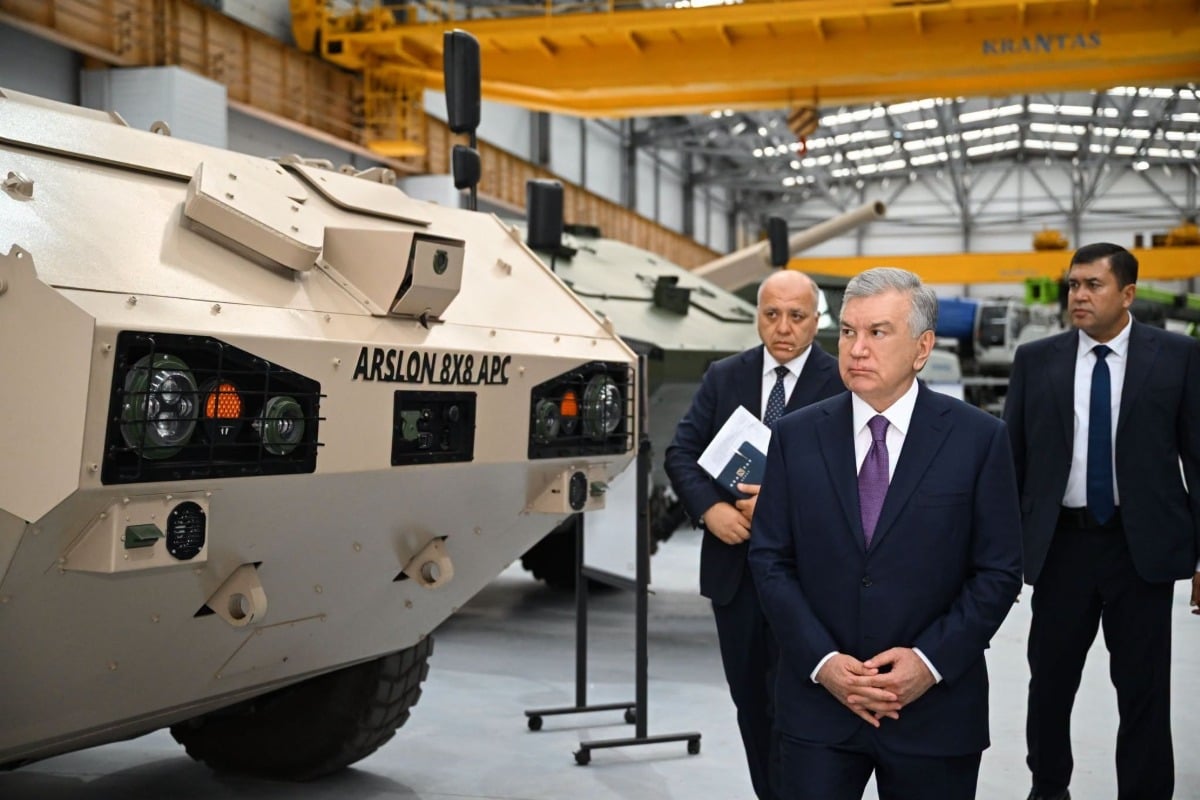
The shift from foreign military procurement to domestic design infrastructure represents a structural transformation in Central Asian statecraft. When nations transition from import-dependent consumers of defense hardware to sovereign producers, they encounter severe capital constraints, technical bottlenecks, and supply chain vulnerabilities. The recent unveiling and state trial completion of advanced armored platforms—such as the Arslon 6x6 and 8x8 infantry fighting vehicles by Nurafshon Maxsus Texnika in Uzbekistan—illustrate how mid-tier industrial economies attempt to bypass these traditional constraints. Deconstructing this shift requires looking past surface-level announcements to examine the underlying economic vectors, technological dependencies, and systemic engineering challenges of domestic defense manufacturing.
The Capital Allocation Vector
Building a sovereign defense manufacturing base demands heavy upfront capital expenditure paired with long amortization cycles. Modernizing a heavy machinery complex to produce specialized combat vehicles requires importing precision manufacturing technology from diversified global suppliers. In the case of Uzbekistan's primary defense manufacturing hubs, capital outlays exceeding fifty million dollars have been channeled into state-of-the-art tooling sourced across Western Europe, Asia, and Turkey.
The primary economic challenge in this model is unit cost dilution. Defense manufacturing operates under strict economies of scale. When domestic demand is constrained by the numerical limits of a regional military force, domestic production runs cannot easily absorb high fixed research and development costs. To mitigate this margin compression, industrial strategists rely on dual-use manufacturing models. Facilities designed to produce military combat platforms also output commercial heavy machinery, truck cranes, and utility transport. This dual-use allocation allows the enterprise to maintain workforce utilization rates and spread overhead across civilian and military balance sheets.
The Component Dependency Equation
A common analytical error in assessing domestic military production is assuming complete autarky. True end-to-end sovereignty in modern combat vehicle manufacturing is practically nonexistent due to the specialized nature of automotive and ballistic sub-components.
Vehicle survivability and mobility rely heavily on specialized subsystems that require decades of metallurgical and mechanical refinement:
- Powerplants and Transmissions: High-output diesel engines and heavy-duty automatic transmissions demand advanced casting and electronic control unit programming. Platforms like the Arslon series integrate proven commercial-military hybrid components, utilizing heavy-duty powerplants such as Cummins engines paired with Allison transmissions.
- Ballistic Protection Suites: Achieving specific STANAG protection thresholds requires specialized high-hardness armor steel and composite layering. Meeting Level 4 through Level 6 standards dictates precise welding techniques and rigorous stress testing against kinetic energy penetrators and high-explosive blasts.
- Fire Control and Optoelectronics: Modern turret systems, such as 30mm automatic cannon modules, rely on stabilized sighting systems, laser rangefinders, and digital ballistic computers that often require imported microelectronics and sensor components.
The engineering achievement lies not in inventing every raw input domestically, but in systems integration—the capacity to synthesize global sub-assembly components into a unified, reliable, and locally serviced combat architecture.
The Operational Mechanics of Structural Testing
Moving a combat vehicle from an initial engineering blueprint to serial production requires navigating a punishing validation protocol. State trials evaluate platform performance across three distinct operational stress vectors:
- Mobility Metrics: Power-to-weight ratios dictate tactical mobility across varied terrain. For instance, a 22-tonne 6x6 platform powered by a 450-horsepower engine achieves a distinct operational velocity profile compared to a 33-tonne 8x8 platform requiring 600 horsepower. Testing must verify these thresholds across extreme temperature gradients, high-altitude mountain passes, and unpaved regional infrastructure.
- Survivability Thresholds: Ballistic testing measures resistance against heavy machine gun rounds (such as 14.5mm ammunition) and underbelly blast mitigation against improvised explosive devices or anti-tank mines.
- Logistical Footprint: Maintenance accessibility, field-repair turnaround times, and commonality of parts dictate long-term fleet readiness. A domestically produced platform reduces logistical friction by eliminating international export licensing delays for replacement components.
Strategic Execution
Transitioning industrial sectors from prototype assembly to mass production requires instituting strict quality control checkpoints and expanding workforce pipelines to support high-precision machining. Regional defense manufacturers must focus on supply chain redundancy, securing long-term secondary sourcing for critical electronic and mechanical sub-assemblies to insulate production lines against geopolitical supply shocks. Long-term viability depends on scaling these manufacturing ecosystems to capture export markets among allied states, thereby transforming a domestic procurement cost center into a sustainable sovereign export engine.
Uzbekistan prepares assembly lines for NATO-standard Arslon armored vehicles provides a detailed overview of the industrial scale and testing milestones achieved at the manufacturing facilities in the Tashkent region.