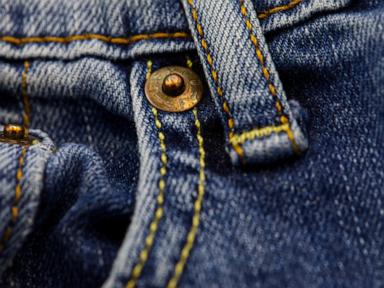
Run your thumb along the seam of your jeans. Feel that thick, diagonal ridge of the twill, the cool bite of the copper rivet against your hip, the stiff resistance of the cotton. If you are wearing them right now, you are draped in a fabric that has survived gold rushes, world wars, cultural revolutions, and the fickle whims of Parisian runways.
We don't just wear denim. We inhabit it.
Every scuff on the knee of a toddler’s overalls tells a story of discovery. Every frayed hem on a teenager's favorite pair marks a rebellion. Every faded thigh on a laborer's work pants represents a mortgage paid, an honest day's sweat, a life built piece by piece.
Yet, we rarely stop to think about how a heavy, coarse utility fabric meant for 19th-century miners became the undisputed global uniform of humanity. It is the only garment in existence that can be worn by a billionaire tech mogul, a cattle rancher in Wyoming, and a protester on the streets of Paris—all on the very same day, without any of them looking out of place.
How did we get here? To understand the grip this fabric has on our collective soul, we have to look past the fashion trends and look at the flesh, bone, and grit that gave birth to an American icon.
The Fabric Born of Friction
Imagine a young immigrant named Levi Strauss, arriving in San Francisco during the chaotic height of the California Gold Rush. The air smells of salt, mud, and unwashed ambition. Thousands of men are tearing into the earth, desperate to strike it rich.
But the earth fights back.
Rocks scrape. Shovels tear. The flimsy cotton trousers these men brought from the East Coast are shredding within days. A pair of pants failing in the middle of a wilderness isn't just an inconvenience; it is a disaster. It means exposure, lost wages, and profound misery.
Strauss sees the problem. He isn't a miner, but he understands supply and demand. He imports a sturdy, heavy-duty cloth from Nîmes, France—originally called serge de Nîmes, which our clumsy English tongues eventually shortened to "denim."
Then enters Jacob Davis, a tailor from Nevada with a wild idea.
Davis notices that the pockets of his customers’ trousers keep ripping under the weight of gold ore and heavy tools. He decides to take tiny pieces of copper—the kind used for horse harness straps—and rivet the corners of the pockets. The result is a garment that refuses to die.
On May 20, 1873, Strauss and Davis secure a patent for their riveted blue jeans. They didn't create fashion. They created a tool.
Consider what happens next: a garment engineered purely for survival begins to absorb the identity of the people wearing it. The indigo dye, unlike other colorants, doesn't penetrate the cotton yarn to its core. Instead, it sits on the surface. With every bend of the knee, every slide across a wooden bench, and every wash, the indigo flakes off, exposing the white thread beneath.
Your jeans change because you change. They become a living archive of your movements.
From Outlaws to Outcasts
For the first half-century of their existence, jeans stayed firmly on one side of the tracks. They belonged to the people who broke their backs for a living: railroad workers laying steel across the continent, factory hands driving the engine of American industry, and cowboys taming the West.
They were called waist overalls. To wear them out in polite society was unthinkable. It was a sign of poverty, or at least a sign that you hadn't cleaned up for supper.
Then came the 1930s. The Great Depression hit, followed closely by a strange cultural phenomenon: the dude ranch vacation. Wealthy Easterners, eager to escape the stifling reality of economic anxiety, traveled out West to play cowboy for a few weeks. They bought denim. They wore it back to New York and Boston as a badge of rugged adventure.
But the real transformation happened when the world went to war.
During World War II, denim was declared an essential commodity. Factory workers, including millions of women stepping into industrial roles for the first time, wore denim overalls to build the planes and tanks that won the war. Denim became synonymous with patriotism, resilience, and national survival.
Yet, when the soldiers came home, something shifted.
The children of those veterans looked at the conformist, gray-flannel-suit world of the 1950s and revolted. They didn't want the neat creases and pressed trousers of their parents' generation. They wanted something raw.
Hollywood gave it to them.
When Marlon Brando sneered from atop a motorcycle in The Wild One, he was wearing blue jeans. When James Dean stared down the camera in Rebel Without a Cause, his denim jacket became a symbol of teenage alienation.
Suddenly, jeans were dangerous.
School boards across the United States banned denim from classrooms. Principal after principal declared that blue jeans were a gateway to juvenile delinquency. They thought that by banning the fabric, they could contain the fire of youth rebellion.
They failed completely.
The ban only made denim more intoxicating. To put on a pair of jeans in 1957 was to make a statement without saying a word. It meant you side with the rebels. It meant you refuse to be processed, packaged, and filed away by authority.
The Great Equalizer on the Front Lines
We often think of the Civil Rights movement through the lens of Sunday-best clothing—the neat suits and polished shoes worn by Dr. Martin Luther King Jr. and protesters marching through Selma. But there is another, quieter history stitched into denim.
Young activists with the Student Nonviolent Coordinating Committee (SNCC) faced a massive practical problem. They were traveling into rural, impoverished communities in the American South to register Black voters. If they showed up in sharp northern suits, they alienated the local sharecroppers they were trying to help. Worse, a suit marked them instantly to hostile local police.
So, they put on denim overalls.
By wearing the uniform of the Southern working class, these activists built a bridge of trust. The heavy fabric allowed them to sit in the dirt, work alongside farmers, and endure the brutal physical realities of protests.
Denim wasn't just a style choice on those dusty roads; it was tactical gear for justice.
As the 1960s bled into the 1970s, the anti-war movement, the feminist movement, and the hippie counterculture all adopted denim as their official skin. It was cheap. It was durable. Most importantly, it was democratic. It shattered class lines. When a wealthy college student from Yale wore faded bell-bottoms alongside a mechanic wearing grease-stained Levi’s, the old social hierarchies crumbled, if only for a moment.
The Irony of the High Fashion Hijack
Every great rebellion eventually gets invited to the gala.
By the late 1970s and early 1980s, Madison Avenue realized that the counterculture could be bought, packaged, and sold back to the public at a premium. Enter the era of designer denim.
When a fifteen-year-old Brooke Shields looked into a television camera and whispered that nothing came between her and her Calvins, the trajectory of denim changed forever. Jeans were no longer just about utility or rebellion. They were about sex, luxury, and status.
Gloria Vanderbilt, Jordache, and Guess turned a workhorse fabric into a Thoroughbred. People who had never swung a hammer or marched in a protest were suddenly paying triple-digit prices for denim that had been intentionally ripped, bleached, and distressed in factories to look like it had seen hard labor.
It is a beautiful, bizarre irony. We pay fortunes to buy brand-new jeans that look old, yearning for an authenticity we are often too comfortable to earn ourselves.
A Second Skin for a Fragmented World
Today, the global denim market is worth tens of billions of dollars. We have skinny jeans, boyfriend jeans, high-waisted jeans, raw denim, stretch denim, and distressed denim. The options are dizzying.
But underneath the commercial noise, the emotional core of the fabric remains completely unchanged.
Think about your own favorite pair of jeans. They are probably sitting at the bottom of a drawer or thrown over the back of a chair right now. They might have a frayed pocket from where your phone always sits. Maybe there is a faint stain from a coffee spilled on a road trip you will never forget.
They don't fit anyone else quite the way they fit you. They have memorized the shape of your body, the way you sit, the way you walk.
In a world where everything feels temporary—where software updates every week, buildings are torn down overnight, and trends vanish in the blink of a digital eye—denim is one of the few things that actually gets better as it ages. It is an antidote to our disposable culture.
It reminds us that there is beauty in friction. There is value in enduring.
The next time you pull on that familiar indigo armor, look down at the rivets and the heavy blue weave. You aren't just getting dressed for the day. You are stepping into a centuries-old march of miners, rebels, activists, and icons. You are wearing the common thread of the human experience, written in cotton and dyed in the deepest blue.