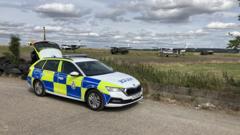
A fatal skydiving accident at a local airfield is rarely just an isolated stroke of bad luck. When a young woman loses her life under a canopy, the immediate public reaction shifts between horror and a resigned assumption that jumping out of planes is inherently suicidal. It is not. The tragedy usually exposes a systemic failure in equipment maintenance, regulatory oversight, or operational pressure at the drop zone. Parachute systems are engineered with redundant backups designed to prevent death even when a diver panics. When those systems fail, the root cause almost always traces back to human decisions made long before the aircraft left the tarmac.
The public views skydiving through the lens of extreme adrenaline. The industry, however, markets it as a highly regulated, Disney-like experience where technology eliminates the danger. This tension between perceived risk and commercial reassurance creates a dangerous complacency. To understand why modern skydiving fatalities still happen despite massive technological leaps, one must look past the grief and scrutinize the infrastructure of the sport.
The Myth of the Automated Safety Net
Every sport skydiver jumps with two parachutes: a main and a reserve. If the main canopy tangles, rips, or fails to open properly, the jumper cuts it away and deploys the reserve. For decades, the industry has relied heavily on a device called an Automatic Activation Device (AAD). This is a small, computerized barometer and processing unit nestled inside the parachute pack.
If a jumper passes through a critical altitude—usually around 750 to 1,000 feet—at terminal velocity, the AAD assumes the jumper is unconscious or incapacitated. It fires a small pyrotechnic cutter that slices the reserve parachute’s closing loop. The reserve shoots out automatically.
It is a brilliant piece of engineering. It has saved thousands of lives. But it has also fostered an culture of over-reliance among novice jumpers and commercial drop zones.
An AAD is a backup, not a guarantee. If a jumper is spinning violently, the aerodynamic wake created by their body can trick the device's barometric sensor. The air pressure in that pocket of dead air registers as a higher altitude than the jumper's actual position. By the time the computer realizes the error and fires, the jumper is already too low for the nylon fabric to inflate fully. Technology cannot completely engineer out the physics of high-speed descent.
The Problem with High Performance Canopies
The evolution of parachute design has outpaced the average jumper's skill level. Thirty years ago, parachutes were large, docile rectangles that landed like heavy blankets. Today, even entry-level canopies are highly agile, elliptical wings capable of generating immense speed.
- Wing Loading: The ratio of a jumper’s exit weight to the square footage of the parachute. High wing loading means faster descents and zero room for error.
- Low-Altitude Turns: The leading cause of serious injury and death in the sport. A jumper makes a sharp turn close to the ground to line up with the runway, loses lift, and impacts the earth at highway speeds.
- Toggle Input Errors: Over-correcting a minor malfunction during the final 300 feet of flight.
When a young or inexperienced jumper transitions too quickly to a smaller, faster canopy, they are essentially driving a race car with a learner's permit. Drop zones frequently allow this progression because high-performance flight looks impressive and keeps young thrill-seekers spending money on lift tickets.
Commercial Pressures and Airfield Realities
Skydiving centers, known as drop zones, operate on razor-thin margins. They are businesses driven by volume. A single turbine aircraft costs hundreds of dollars per hour to fuel and maintain. To turn a profit, a drop zone must pack planes, fly them to altitude, dump the jumpers, and get back down to the ground as fast as possible.
This creates a high-pressure environment for everyone involved, particularly the independent contractors who pack the parachutes.
The Exhausted Parachute Packer
A certified parachute rigger must pack reserve parachutes every 180 days, regardless of whether they are jumped. Main parachutes, however, are packed between flights by sports jumpers themselves or by hired packers.
Packers are paid by the piece. The faster they pack, the more money they make. On a busy summer Saturday, a packer might handle dozens of rigs, stuffing nylon and suspension lines into deployment bags in a hot, noisy hangar.
[Main Canopy] -> Folded rapidly -> Stuffed into D-Bag -> Lines stowed in rubber bands
                                                                   │
                                                   Risk of "Line Over" or Twist
                                                                   │
                                                                   ▼
                                                       High-Speed Malfunction
It is grueling, repetitive work. Under these conditions, minor errors creep in. A line can twist. A rubber band can snap prematurely. When a malfunction occurs due to a sloppy pack job, the jumper is forced to execute an emergency procedure under extreme stress. If that jumper is inexperienced or fatigued from a long day at the airfield, their reaction time slows. The margin between life and death shrinks to a matter of mere seconds.
The Illusion of FAA Oversight
The Federal Aviation Administration (FAA) technically oversees skydiving in the United States, but its primary concern is protecting commercial air traffic from falling bodies. The actual monitoring of skydiving safety is largely outsourced to the United States Parachute Association (USPA), a private organization.
This self-regulation model keeps bureaucratic red tape low, but it creates a conflict of interest. The USPA represents both the drop zone owners and the individual jumpers. When an incident occurs, the investigation is rarely handled with the same clinical, transparent rigor that the National Transportation Safety Board (NTSB) applies to a commercial airline crash.
Local police departments arrive at the airfield following a fatality, but they lack the technical expertise to analyze canopy malfunctions. They look for foul play. Finding none, they release the equipment back to the drop zone or the family, labeling the event a tragic accident. The deep engineering or behavioral analysis required to prevent the next death is often buried in internal industry reports that the public never sees.
The Human Factor and Panic
A human being falling through the sky at 120 miles per hour enters a state of high neurological arousal. For an experienced jumper, this translates to heightened focus. For a novice, it can easily degenerate into sensory overload and cognitive freeze.
Consider a hypothetical scenario where a jumper experiences a high-speed malfunction known as a "line over," where a suspension line passes over the top of the canopy, inflating it into two separate, uncontrollable lobes. The horizon spins violently. The ground rushes up.
In this moment, the jumper needs to perform two distinct actions: pull the cutaway handle to discard the broken main, and then pull the reserve handle. If they pull them out of order, or if they hesitate for just three seconds while trying to fix the unfixable canopy, they will pass the point where a reserve parachute can save them.
No amount of ground school training can perfectly replicate the terrifying reality of a spinning malfunction. The industry relies heavily on muscle memory developed through simulated training on the ground, but muscle memory fails when pure panic paralyzes the brain.
Redefining Risk in the Skies
The tragedy at the airfield is a reminder that aviation tolerates no shortcuts. Until the industry faces the uncomfortable realities of commercial volume pressures, the limits of automated safety devices, and the steep learning curves of modern canopy designs, young jumpers will continue to pay the ultimate price for systemic flaws. True safety is found in meticulous maintenance and unyielding discipline, not in the false comfort of a computerized backup plan.