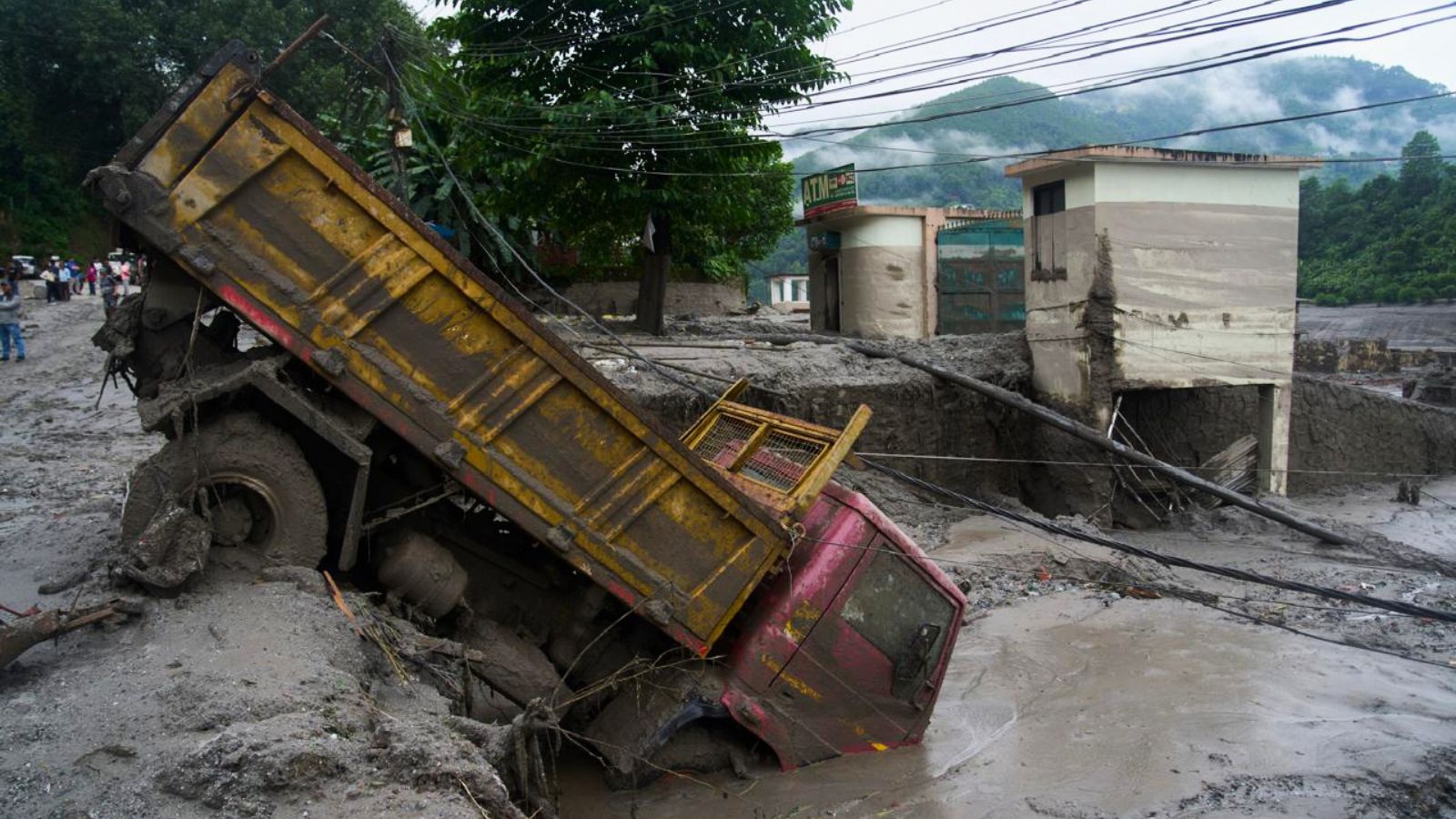
When a high-altitude water body breaches its terminal moraine, the resulting discharge is not merely a heavy stream; it is a high-energy gravity flow capable of reshaping regional topography within hours. The recent formation and subsequent breach dynamics of glacial lakes in the Himalayas highlight a recurring vulnerability in mountainous watersheds. Understanding this phenomenon requires moving past qualitative descriptions of flooding and examining the mechanical thresholds of moraine stability, the hydrodynamic forces of debris flows, and the structural limitations of downstream monitoring networks.
The Structural Mechanics of Moraine Breach
Glacial lakes frequently accumulate behind unstable natural dams composed of unconsolidated rock, ice, and sediment known as terminal or lateral moraines. These barriers lack the engineering cohesion of man-made concrete dams. They are dynamic, porous structures subject to continuous internal shifting. If you found value in this post, you should check out: this related article.
Two primary failure mechanisms govern these events: piping and overtopping. Piping occurs when hydrostatic pressure forces water through internal conduits within the moraine, eroding fine sediment and causing structural collapse from the inside out. Overtopping happens when mass displacement waves—triggered by an avalanche, icefall, or landslide plunging into the lake—force water over the crest of the dam, rapidly cutting an incised channel into the loose material.
Once the breach threshold is crossed, the rate of erosion accelerates exponentially. The outflow acts as a hydraulic saw, cutting vertically through the moraine core. As the channel deepens, discharge volume spikes, entraining millions of tons of sediment, boulders, and ice fragments. This transforms clear water into a hyper-concentrated debris flow with a bulk density far exceeding that of standard river water, exponentially increasing its destructive kinetic energy. For another perspective on this story, see the recent coverage from The Washington Post.
Hydrodynamic Scaling and Downstream Propagation
The downstream impact of a glacial outburst is a function of channel geometry, gradient, and sediment load. Standard flood routing models fail in these scenarios because they assume Newtonian fluid dynamics. Debris flows exhibit non-Newtonian behavior, maintaining high viscosity and yield strength even miles away from the breach source.
As the torrent descends steep mountain gorges, it acts as a conveyor belt, scouring riverbeds and undercutting valley walls. This process introduces additional material into the flow mass, often doubling or tripling its initial volume. Bridges, hydroelectric facilities, and settlements situated on alluvial fans—flat, depositional zones where mountain streams exit narrow valleys—are prime targets because these areas represent natural accumulation zones for high-volume sediment loads.
The velocity of the wave is dictated by the energy slope and the hydraulic radius of the channel. In narrow ravines, the restricted cross-sectional area forces water levels to rise rapidly, creating localized surges that exceed normal discharge metrics by orders of magnitude. The destructive potential is measured not just by peak water discharge, but by the total kinetic energy delivered per linear meter of the valley floor.
Mitigation Deficits and Monitoring Gaps
Mitigation strategies in high-altitude environments face severe logistical and economic constraints. Traditional engineering interventions, such as artificial lowering of lake levels via siphoning or tunneling through bedrock, require sustained capital investment and face hazardous operating conditions in remote terrain.
Early warning systems deployed in these watersheds rely primarily on automated water level sensors and acoustic flow monitors positioned along river corridors. However, these systems present high false-positive rates and struggle with maintenance access during extreme weather events. Communication infrastructure in remote Himalayan valleys is frequently fragile; seismic tremors, rockfalls, or the initial surge itself often sever transmission lines before downstream communities receive automated alerts.
Mitigation therefore requires a shift from reactive warning networks to proactive structural stabilization. This includes reinforcing spillways with engineered gabions, establishing controlled drainage channels, and restricting permanent settlement on active alluvial fans identified through historical sediment-deposition mapping.
Deploy immediate acoustic sensors coupled with satellite-based synthetic aperture radar interferometry to track surface displacement of moraine walls before catastrophic volume thresholds are reached.