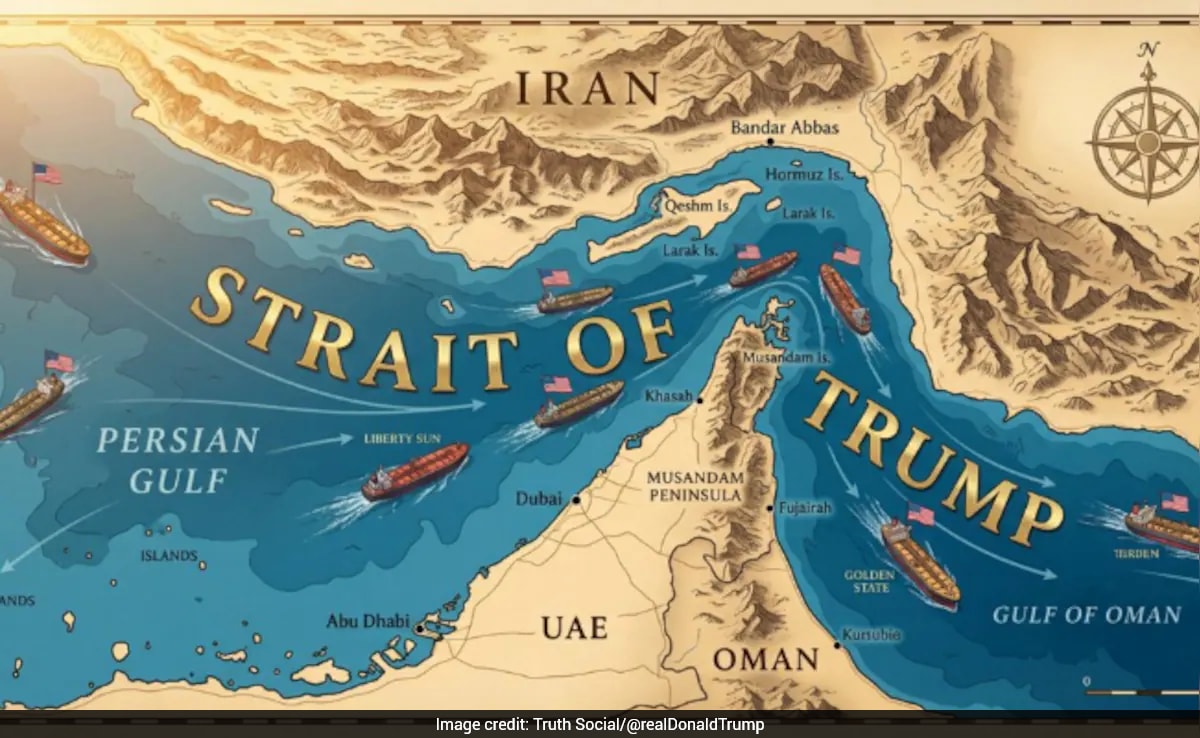
Geography is a stubborn thing, but ego is louder. When a map circulates renaming one of the world's most volatile maritime chokepoints—the Strait of Hormuz—after a sitting or former president, the media reacts with a predictable blend of pearl-clutching and mockery. They focus on the branding. They obsess over the narcissism. They treat it like a Twitter spat that spiraled out of control.
They are missing the point entirely. Also making headlines recently: The Empty Pavements of Red Square.
The "Strait of Trump" isn't about a name change. It’s a crude, loud-mouthed signal of a fundamental shift in how global power projects itself onto physical infrastructure. While pundits argue about the "disrespect" to international norms, they ignore the cold, hard reality: the era of "neutral" international waters is a fairy tale we’ve been telling ourselves since 1945. The renaming of a waterway is just an honest admission that the person with the biggest fleet owns the ink.
The Lazy Consensus of International Law
The mainstream narrative suggests that the Strait of Hormuz is protected by the United Nations Convention on the Law of the Sea (UNCLOS). They talk about "transit passage" as if it’s a magical shield that prevents missiles from hitting tankers. More information on this are detailed by NPR.
Here is the truth that makes diplomats squirm: UNCLOS is only as relevant as the navy willing to enforce it. The U.S. hasn't even ratified the treaty, yet we act as its primary guarantor. When a leader slaps their name on a map of a chokepoint, they aren't just trolling; they are asserting a "sovereignty of presence."
I’ve spent years analyzing maritime risk for firms that lose millions when a single VLCC (Very Large Crude Carrier) gets delayed by forty-eight hours. These companies don't care about the name on the map. They care about the insurance premiums. And those premiums are currently sky-high because we’ve allowed the "status quo" to become a slow-motion car crash.
The Naval Blockade Delusion
Everyone is terrified of a blockade. The media paints a picture of a total shutdown, a global economic heart attack.
They’re wrong.
A total blockade is a relic of 20th-century thinking. In the modern world, you don't need to stop every ship. You just need to make it too expensive for the third ship to try. It’s not about a wall of steel; it’s about a wall of data and risk. If a map change signals that the U.S. (or a specific administration) views a waterway as personal property, the risk profile changes instantly.
We aren't looking at a blockade. We are looking at "Geofencing by Ego."
The Strait of Hormuz handles roughly 21 million barrels of oil a day. That’s 21% of global petroleum liquids consumption. If you rename it, you are effectively telling the market: "The rules have changed. The protection is now transactional."
Why the Branding Matters More Than the Boats
In business, we call this a hostile takeover of a commodity.
By renaming a global asset, you perform a psychological de-anchoring. People stop asking "What does the law say?" and start asking "What does the Owner say?" This is a masterclass in disruptive optics. It forces the opposition to defend a "norm" that was already dying.
- The Competitor's View: This is a distraction from serious policy.
- The Reality: This is the policy. It’s the privatization of geopolitical influence.
Think of it like a developer putting their name on a skyscraper in a neighborhood they don't yet own. It drives the neighbors crazy, it lowers the property value of the opposition, and it stakes a claim that the legal system hasn't caught up to yet.
The Math of the Chokepoint
Let's look at the actual physics of the Strait. At its narrowest, the shipping lanes are only two miles wide in either direction.
$$W = \frac{S}{L}$$
Where $W$ is the effective width of the navigable channel, $S$ is the total strait width, and $L$ represents the density of legal/military layers. As $L$ increases—meaning more political friction—the "functional width" of the strait shrinks.
When you inject a massive, polarizing political brand into that equation, you increase $L$ exponentially. You aren't just navigating water anymore; you’re navigating a minefield of sanctions, tweets, and shifting alliances.
The Fragility of the "International Community"
We love to talk about the "International Community" as if it’s a board of directors. It’s not. It’s a group of people standing in a circle, hoping nobody starts swinging a bat.
When a leader renames a strait, they are swinging the bat.
The contrarian take isn't that this is "good" or "bad." It’s that it is honest. The facade of the "Global Commons" is a luxury of an era where one superpower held all the cards and didn't feel the need to put its name on the deck. That era ended in 2008, we just haven't stopped printing the old maps yet.
The Insurance Trap
If you want to see who really runs the world, don't look at the White House or the Kremlin. Look at Lloyd’s of London.
The moment a map change becomes "official" in the mind of a leader with a fleet, the War Risk Council meets. They don't care about the politics. They care about the "Strait of Trump" becoming a "Contested Zone."
By shifting the nomenclature, you create a "Naming Risk." It sounds ridiculous until you’re the one trying to secure a bond for a $200 million cargo. If the name of the water implies that one man’s whim dictates the passage, the math changes. The "Strait of Trump" isn't a joke; it’s a line item on a balance sheet.
Stop Asking if it's Legal
The "People Also Ask" sections of the internet are filled with questions like: "Can a president rename a body of water?"
You’re asking the wrong question.
The right question is: "Can anyone stop the person who controls the sensors and the missiles from calling it whatever they want?"
In 1904, we didn't ask if the Panama Canal was "legal" in the way we think of it now; we built it and called it ours. Power creates its own vocabulary. If you’re waiting for a court to rule on the name of a chokepoint while the ships are being diverted, you’ve already lost the war of information.
The Operational Reality
The sailors on the ground—or on the water—don't give a damn about the map in the briefing room. They care about the Rules of Engagement (ROE).
A map change signals a change in ROE. It tells the commanders that the "Global Commons" mindset is dead and the "National Interest" mindset is the only thing that matters. This is a pivot from policing to owning.
Most analysts see this as a decline in American prestige. I see it as a brutal, necessary clarification of American power. We are moving from being the world’s unpaid security guard to being the world’s most aggressive landlord.
The Takeaway Nobody Wants to Hear
We are entering an era of "Personalized Geography."
It’s not just the Strait of Hormuz. Expect to see "proprietary" names for trade routes, data cables, and orbital slots. The "Strait of Trump" is just the first draft of a world where infrastructure is branded by the people who can break it.
If you’re still clinging to the idea that the world is governed by 17th-century Dutch maritime law, you’re not just an optimist; you’re a liability. The map isn't the territory, but the name on the map tells you who is currently holding the pen.
The naval blockade isn't coming. It’s already here, made of ink, ego, and a total disregard for the "lazy consensus" of the 20th century.
Get used to the new names. The old ones were just placeholders anyway.