Stop treating the Guangdong-Hong Kong-Macao Greater Bay Area as a polite merger of equals. It isn't. It is a high-friction collision between two operating systems that were never built to share a kernel.
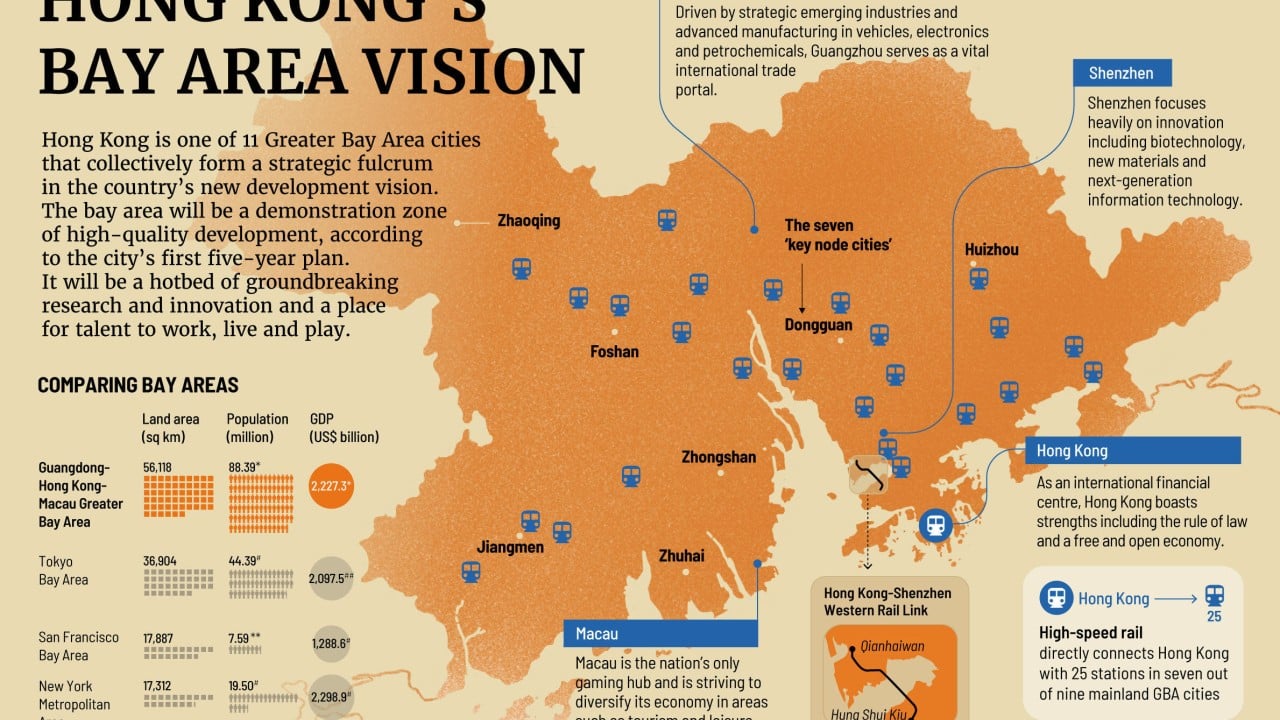
Most commentary on Hong Kong's Bay Area vision reads like a tourism brochure written by someone who never cleared customs at West Kowloon during a Monday morning rush. The lazy consensus goes something like this: build faster trains, open more cross-border wealth channels, slap a unified regional brand on nine mainland cities plus Hong Kong and Macao, and watch a 85-million-person megacity rival Tokyo or New York.
Sounds neat. Fails in practice.
I have watched multinationals blow seven-figure regional expansion budgets chasing that exact pitch. They rent sleek glass offices in Shenzhen expecting seamless access to Hong Kong's capital markets, or they set up a Hong Kong holding company assuming mainland engineering talent will happily commute across the border every morning like they take the Yamanote Line. Then reality hits. Data sovereignty rules bite. Tax residency triggers confuse finance teams. Talent packages clash. Legal remedies live in different jurisdictions with different evidentiary norms.
A bridge does not erase a border. Concrete does not equalize tax law.
To understand what is actually happening in the Greater Bay Area, you have to stop asking how Hong Kong fits into the Bay Area and start asking a sharper question: what happens when a common-law, free-port financial hub becomes a specialized node inside a state-directed industrial engine?
The Lazy Consensus Around "Integration"
Standard regional integration stories lean heavily on geography and GDP math. Add up the outputs of Guangzhou, Shenzhen, Dongguan, Foshan, Hong Kong, Macao, and the rest of the Pearl River Delta cluster, and the top-line numbers look huge. Add the Hong Kong-Zhuhai-Macao Bridge and the Guangzhou-Shenzhen-Hong Kong Express Rail Link, and pundits declare the distance problem solved.
That confuses physical transit time with economic friction.
Economists from Paul Krugman on economic geography to Dani Rodrik on globalization have spent decades showing why borders matter far more than distance alone. Even when tariffs fall and trains speed up, differences in currency convertibility, legal systems, regulatory enforcement, and labor mobility create massive transaction costs.
In the Greater Bay Area, those costs are structural features, not bugs waiting for an app update.
- Capital controls and convertibility: Hong Kong uses the Hong Kong dollar under a currency board system linked to the US dollar, with free capital flows. Mainland China manages the renminbi with capital account controls and targeted cross-border channels such as Stock Connect, Bond Connect, and Wealth Management Connect.
- Legal and judicial architecture: Hong Kong operates under common law with independent courts and familiar commercial contract norms. Mainland cities operate under civil law statutes and administrative guidance.
- Taxation and individual mobility: Corporate tax rates, individual income tax rules, and residency definitions differ sharply. A mid-level engineer or product manager cannot simply treat Shenzhen and Hong Kong as one unified labor pool without confronting immigration quotas, housing cost disparities, and tax exposure.
When lazy analysts talk about "full integration," they ignore the fact that Hong Kong's historical value came precisely from sitting outside mainland rules while serving as the financial valve connected to them. Erase the distinction completely, and you risk diluting the very arbitrage that made the city useful. Keep the wall too thick, and integration stays mostly ceremonial.
Defining Terms Before We Argue
Precision saves money. People throw around economic integration, re-industrialization, and regional agglomeration as if they mean the same thing. They do not.
Agglomeration is the clustering of firms, suppliers, and skilled workers so everyone benefits from shared pools of talent, specialized vendors, and knowledge spillovers. Shenzhen's hardware supply chain is a textbook example of industrial agglomeration. You can source custom PCBs, CNC enclosures, sensors, and assembly lines within a tight radius at speeds that make Western hardware startups weep.
Economic integration is the reduction of policy and institutional barriers between distinct markets so goods, capital, people, and data move with minimal friction. A single currency and a single legal code represent deep integration. Cross-border pilot schemes and customs fast lanes represent partial, managed integration.
Re-industrialization in a high-cost city like Hong Kong does not mean bringing back smoky factories making cheap consumer goods. Real estate math alone kills that idea. When industrial land and commercial rents are among the highest on earth, low-margin mass manufacturing cannot survive without heavy subsidies. High-value advanced manufacturing, medtech, precision robotics, and deep-tech R&D only work where unit value is high, IP protection is credible, and supply chain proximity saves real time.
Confuse those three terms and you make terrible bets. A company that mistakes physical proximity for institutional integration will underprice legal and compliance complexity. A policymaker who mistakes subsidized pilot zones for organic agglomeration will build empty office parks and call it innovation.
What "People Also Ask" Gets Wrong
Search engines are full of neat questions about Hong Kong's Bay Area vision. Most of them start from a shaky premise.
"Will the Greater Bay Area overtake Tokyo or New York?"
Wrong yardstick. Tokyo and New York sit inside single national legal, fiscal, and currency frameworks. One mayor or governor does not have to negotiate cross-border customs protocols with a separate legal jurisdiction just to move a software team or clear clinical trial samples across town.
A fairer comparison is a polycentric industrial-financial corridor. If you judge the Bay Area by combined hardware manufacturing scale, port and logistics throughput, and regional consumer depth, it already punches at a scale few regions can match. If you judge it by single-jurisdiction frictionless mobility, it is a very different animal. Comparing them head-to-head on a single metric misses how each system actually functions.
"Is Hong Kong losing its financial role to Shenzhen or Shanghai?"
Not as a zero-sum cliff drop, and not without real pressure. Shanghai has massive domestic scale and onshore market gravity. Shenzhen dominates hardware innovation, retail tech platforms, and domestic venture ecosystems.
Hong Kong remains a premier international financial center when global investors want common-law certainty, deep USD/HKD liquidity pools, international arbitration, and structured offshore access to China. Yet competition is real. Listings have faced cyclical headwinds, regional financial hubs compete aggressively for family offices and asset managers, and global capital allocators weigh geopolitical and regulatory risk more carefully than they did fifteen years ago.
Hong Kong's edge does not vanish overnight. It has to be earned every quarter through market depth, legal credibility, and clear positioning—not inherited from past glory.
"Can young Hong Kong professionals easily build careers across the Bay Area?"
Yes, if they target roles where cross-border fluency is genuinely scarce. No, if they expect mainland salaries and lifestyle to match Hong Kong's cost structure without compromise.
Imagine a scenario where a young product manager from Hong Kong takes a role in Shenzhen or Guangzhou. On paper, career exposure to fast-moving tech ecosystems and huge user bases looks terrific. In practice, compensation scales, tax rules, career progression paths, and daily life routines operate on different tracks. Those who thrive treat it as a deliberate strategic bet—learning mainland execution speed while keeping international communication and governance skills sharp—rather than a frictionless local transfer.
The Real Bottlenecks Nobody Likes Naming
If you want to know whether Hong Kong's Bay Area vision delivers real commercial value, watch four unglamorous bottlenecks instead of ribbon-cutting ceremonies.
- Cross-border data flow: Modern business runs on cloud telemetry, customer analytics, and AI training pipelines. Moving data across jurisdictions involves strict compliance regimes, localization rules, and audit overhead. A train moves people in an hour; a compliance review can stall a data pipeline for months.
- Talent friction beyond buzzwords: Saying "we want talent to flow freely" is easy. Aligning pension portability, tax equalization, housing allowances, school admissions, and licensing recognition for professionals like doctors, lawyers, and engineers is slow, granular work.
- Real estate and cost asymmetry: Hong Kong's housing and commercial costs remain a drag on business competitiveness and household affordability. Mainland cities offer lower operating costs and newer infrastructure in many pockets, creating constant tension over where teams and headquarters should sit.
- Over-engineered narratives vs. unit economics: Grand regional blueprints often sound great in speeches and struggle when a CFO asks for two-year payback on a cross-border expansion. Capital flows where return on invested capital makes sense, not where slogans sound boldest.
Honest Downsides to My Own Contrarian Take
Let me put my cards on the table. Taking a hard-nosed, skeptical view of grand Bay Area integration has its own blind spots.
First, underestimating state execution speed is a classic mistake. When policy priorities align across central and provincial levels, infrastructure builds fast, pilot programs expand rapidly, and bottlenecks that looked permanent for years can loosen in a single policy cycle. Being cynical about bureaucracy can blind you to real momentum on the ground.
Second, over-indexing on institutional friction can make you miss early movers. Companies that wait for every legal, tax, and data rule to become 100% frictionless often arrive after market leaders have already figured out practical workarounds, built trusted local partners, and locked in customer relationships.
Third, treating Hong Kong as static is lazy in the opposite direction. Markets adapt. Institutions adjust. New financial instruments, cross-border connect schemes, and specialized sector clusters can create real opportunities for firms that show up with clear eyes rather than rigid preconceptions.
Skepticism is a diagnostic tool, not a permanent bunker.
What Smart Operators Should Actually Do Next
If you run a company, manage capital, or plan a career around Hong Kong's Bay Area vision, stop buying vague "one big market" stories. Build a modular operating model instead.
- Split the footprint by function, not slogan: Keep international capital raising, common-law contracting, global treasury, and international client governance where those strengths actually reside. Place hardware engineering, supply chain iteration, or domestic-market product execution where local speed and cost advantages are strongest.
- Audit cross-border friction before signing leases: Map data flows, tax residency triggers, IP ownership, and employee mobility rules on day one. If your business model only works when legal and regulatory differences disappear, fix the model.
- Price for real unit economics: Demand clear customer demand, realistic hiring timelines, and conservative payback periods in each jurisdiction. Never fund a speculative regional outpost just to look "aligned" with a macro narrative.
- Bet on bridges, not illusions: Use cross-border channels where they solve a concrete problem—faster prototyping, broader capital access, specialized talent—and walk away from initiatives that exist only to check a strategic box.
Stop waiting for two different worlds to become identical. Build your advantage right across the seam.


