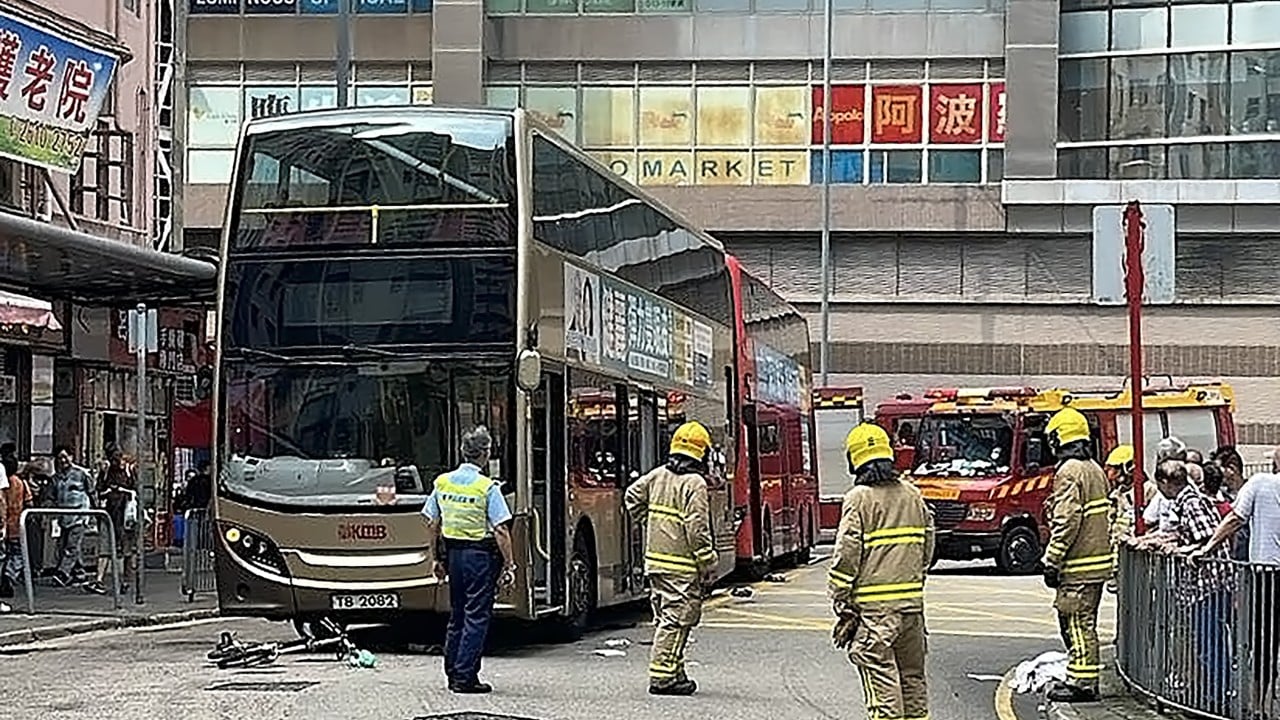
A 60-year-old cyclist is fighting for his life after getting crushed under a Kowloon Motor Bus (KMB) double-decker on Shek Yam Road. It happened right outside the North Kwai Chung Public Library around 2:50 pm on Monday. Firefighters had to drag him out from beneath the heavy front wheels. He was unconscious, bleeding, and rushed to Yan Chai Hospital before being shifted to Princess Margaret Hospital.
The 65-year-old bus driver was arrested on the spot for dangerous driving causing grievous bodily harm.
This is not an isolated freak accident. It is a symptom of a systemic crisis. Hong Kong treats cycling as a weekend hobby rather than a legitimate mode of transport, and people are paying with their limbs and lives.
The Brutal Reality of the Kwai Chung Crash
Witness accounts and physical evidence from the Kwai Chung crash paint a horrific picture. The cyclist, a resident of the nearby Shek Yam East Estate, reportedly lost control before the impact. The double-decker bus struck him, dragging him for roughly ten meters across the asphalt.
A long, dark skid mark trailed behind the vehicle. The right side of the bus windshield was completely shattered from the force of the collision. The victim's cap, sneakers, and overturned bicycle lay scattered across the road next to a large pool of blood.
Emergency crews worked fast to extricate the man, who suffered severe head trauma and massive lacerations. While the bus driver passed a roadside breathalyzer test with zero alcohol reading, the police are holding him for further questioning. KMB sent staff to the hospital to offer condolences, promising full cooperation with law enforcement. But corporate statements don't fix broken bones or stop internal bleeding.
The Invisible Workforce on Two Wheels
Mainstream media outlets love to report these incidents as simple traffic disruptions. They talk about the traffic gridlock or the route delays. They ignore the human element. The victim in Monday's crash was a food delivery courier trying to make a living.
The gig economy has flooded Hong Kong's narrow, hilly streets with thousands of delivery riders. They operate under brutal algorithm-driven time constraints. If they scramble slowly, they lose money. Yet, the city's infrastructure completely ignores their existence.
Step outside the manicured bike paths of Shatin or Tseung Kwan O, and cycling infrastructure vanishes. Urban areas like Kwai Chung, Mong Kok, and Sham Shui Po are concrete jungles built exclusively for motorized traffic. Delivery riders are forced to play a daily game of chicken with twelve-ton double-decker buses, erratic minibuses, and impatient taxi drivers.
Why Urban Cycling Planning in Hong Kong is Failing
The Transport Department insists that Hong Kong is a safe city for commuters. On paper, mass transit works beautifully. Below the surface, the policy toward cycling is intentionally hostile. The government actively discourages cycling in urban centers, citing narrow streets and high traffic density.
This logic is completely backward. Streets are congested because the city prioritizes large vehicles and private cars over micro-mobility.
- The New Territories Bias: The government has built a beautiful 60-kilometer cycling track network connecting Tuen Mun to Ma On Shan. It's great for weekend cycling enthusiasts. It does absolutely nothing for a worker trying to navigate Kowloon or Hong Kong Island.
- Zero Separation: In urban zones, cyclists must share the regular traffic lanes. A standard double-decker bus is about 2.5 meters wide. Throw in narrow Hong Kong road lanes, and there's zero margin for error. A single pothole or sudden gust of wind can throw a cyclist directly under a bus wheel.
- The Blind Spot Menace: Double-decker buses have massive blind spots, especially on the front left and right quarters during tight turns. In cramped urban corridors like Shek Yam Road, these blind spots become lethal zones.
Critical Steps for Survival on Urban Roads
If you ride a bicycle or an e-bike for work or commuting in Hong Kong, you cannot wait for the government to fix the infrastructure. You need to adapt your riding style to survive the current hostile environment.
Never Undertake a Large Vehicle
Never ride up the inside flank of a bus or a heavy truck at a red light or near a intersection. Drivers cannot see you. If the bus decides to turn or pull over to a bus stop, you will get pinned against the railing or dragged underneath.
Claim Your Lane
Riding too close to the curb is a psychological invitation for drivers to squeeze past you in the same lane. If the lane is narrow, ride confidently in the center of the lane. Force the vehicles behind you to slow down and overtake you properly by changing lanes. It will annoy them, but it keeps you alive.
Use High-Visibility Gear
A black t-shirt and a dark backpack are a death sentence during late afternoon or evening shifts. Use high-visibility vests and install high-lumen flashing lights on both the front and rear of your bike. Do not rely on streetlights to make you visible to a tired bus driver finishing an eight-hour shift.
The Kwai Chung crash shouldn't be treated as a routine traffic bulletin. It needs to be a wake-up call for the Transport Department to stop ignoring the delivery workers and urban cyclists who keep the city running. Until the city integrates cycling into its core urban transport blueprint, the blood on the asphalt will keep piling up.
For a closer look at the logistical challenges and safety hazards of operating heavy vehicles on Hong Kong's tight corridors, watch this Hong Kong double-decker bus crash footage which shows just how quickly collisions occur when things go wrong on the road.