The wind in southern Alberta does not just blow. It sweeps across the flat, open prairie with a relentless, scouring force, carrying the scent of dry earth, sugar beets, and cattle feed. Driving down Highway 3, the horizon stretches out indefinitely, an ocean of yellow grass under an impossibly wide blue sky. Then, you hit Taber.
For decades, this community of roughly 8,500 people was famous for exactly one thing: sweet corn. The kind of corn so crisp and sugary that people drive from hours away just to buy a burlap sack of it from a roadside cart. It is a town built on traditional agricultural roots, quiet faith, and hard work.
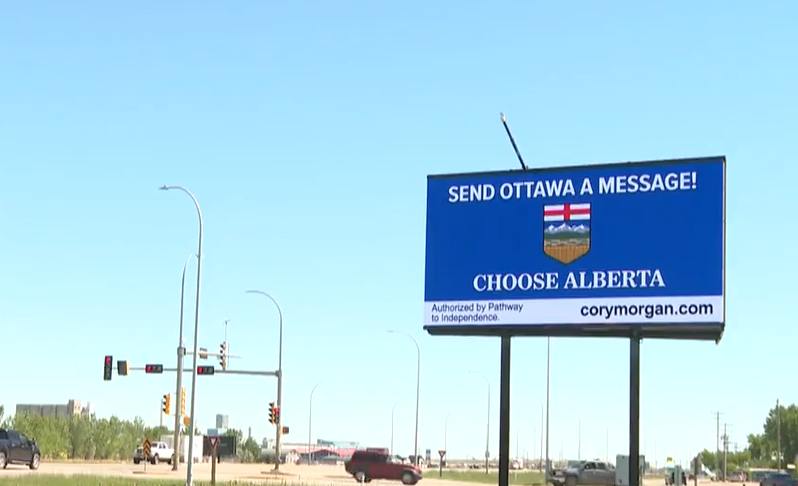
But drivers flashing past the town's perimeter recently encountered a massive, towering billboard that had absolutely nothing to do with agriculture. It did not advertise local honey, a farm implement dealership, or the annual Cornfest. Instead, the billboard injected a fierce, national culture war straight into the heart of the community.
The sign, erected by a group advocating for parental rights and traditional values, ignited an immediate, blazing controversy. It was not just a debate over ideology. Within days, the billboard transformed into an economic threat that left local business owners staring at their ledger books with a knot of anxiety in their stomachs.
The Weight of a Word
Imagine a local business owner—we can call her Sarah, a composite of the quiet anxieties currently rippling through the local chamber of commerce. Sarah runs a boutique shop on 50th Avenue. She relies on the summer traffic, the tourists who pull off the highway on their way to Lethbridge or the Crowsnest Pass. They stop for gas, buy lunch, and wander into her store.
When the billboard went up, Sarah’s phone did not start ringing with orders. It started buzzing with notifications from angry outsiders.
The message on the highway was blunt, touching on deeply polarized debates regarding school curricula, gender identity, and parental consent. To the group that paid for the space, the billboard was a necessary defense of family values, a public statement of what they believed to be a quiet majority's truth. To critics, both inside and outside the town limits, the sign was exclusionary, harmful, and exclusionary to vulnerable youth.
But the ideological battle quickly bled into commerce. On social media, calls for a total boycott of Taber began to gain traction.
"Don't stop for gas in Taber."
"Buy your corn somewhere else this year."
For a small town business, those sentences are terrifying. A highway billboard is designed to make people pull over. Suddenly, this one was acting as a massive, psychological roadblock, telling travelers to keep their foot firmly on the gas pedal until Taber was nothing but a speck in their rearview mirror.
The Vulnerability of the Rural Economy
To understand why a single sign can cause such panic, you have to look at how a rural economy actually functions. It is a fragile ecosystem.
Think of a small town’s economy like a vintage watch. Every gear, no matter how tiny, relies on the pressure of the gear next to it. The farmer sells the crop, the farmhands spend their wages at the local grocery store, the grocery store owner hires a local contractor to fix the roof, and everyone eats at the diner on Friday night.
When outside money—tourist dollars—stops flowing into that ecosystem, the gears begin to grind.
Taber is not a metropolis with deep pockets or corporate headquarters to cushion a sudden drop in revenue. The town relies heavily on its reputation as a welcoming, family-friendly stopover. When an external audience looks at a billboard on the edge of town and decides that the entire community holds a specific, polarizing viewpoint, the innocent suffer alongside the vocal. The diner waitress who has no opinion on school policies suddenly sees her tips cut in half because the tables are empty.
The local town council quickly found itself walking a tightrope over a canyon. On one side stood the principles of free speech and the property rights of the landowner who leased the space for the billboard. On the other side stood the collective panic of a business community facing the prospect of becoming a cultural no-go zone.
When the Private Becomes Very Public
The real friction in this prairie town is not just between liberals and conservatives, or outsiders and locals. It is the friction of visibility.
In a big city, dissenting voices are swallowed by the sheer volume of the crowd. You can pass a protest, a radical advertisement, or a controversial display, and it dissolves into the background noise of the urban landscape. In a small town, everything is magnified. A billboard on Highway 3 is not just an ad; it feels like a collective manifesto, whether the townspeople agreed to it or not.
Consider what happens next when a community gets branded this way. The controversy creates a profound sense of isolation. Local leaders wrestled with the legality of the sign, discovering, as many municipalities do, that local bylaws are often toothless when it comes to regulating the content of political speech. They could not simply tear it down without inviting a massive, costly legal battle over constitutional rights.
So, the sign remained. Towering over the ditch, gleaming under the prairie sun, while the town beneath it held its breath, waiting to see if the summer crowds would still arrive for the harvest.
The Human Cost of the Culture War
Behind the arguments about bylaws, advertising standards, and economic boycotts, there is a quieter, sadder reality.
Small towns survive on neighborliness. You help pull your neighbor's truck out of a muddy ditch regardless of who they voted for in the last election. You buy raffle tickets for the high school sports team from the guy whose worldview makes you roll your eyes. You live together because you have to.
When national political battles are imported into these spaces via giant vinyl signs, that essential neighborliness begins to fray. People start looking at each other differently across the aisle of the hardware store. They wonder who funded the sign. They wonder who is secretly applauding it, and who is quietly weeping because of it.
The boycott threat may materialize as a drop in summer revenue, or it may fade as the news cycle moves on to the next outrage. But the invisible stakes are already claimed. The trust that takes generations to build in a small place can be eroded by a single season of bitter division.
As evening falls over southern Alberta, the long shadows of the grain elevators stretch across the soil. The billboard by the highway catches the last rays of the setting sun, illuminated and unblinking. Below it, the people of the town go home to their dinners, sitting at tables in the quiet dark, wondering if the world outside sees them for their famous sweet corn, or only for the words written on the wall at the edge of town.
.jpg)