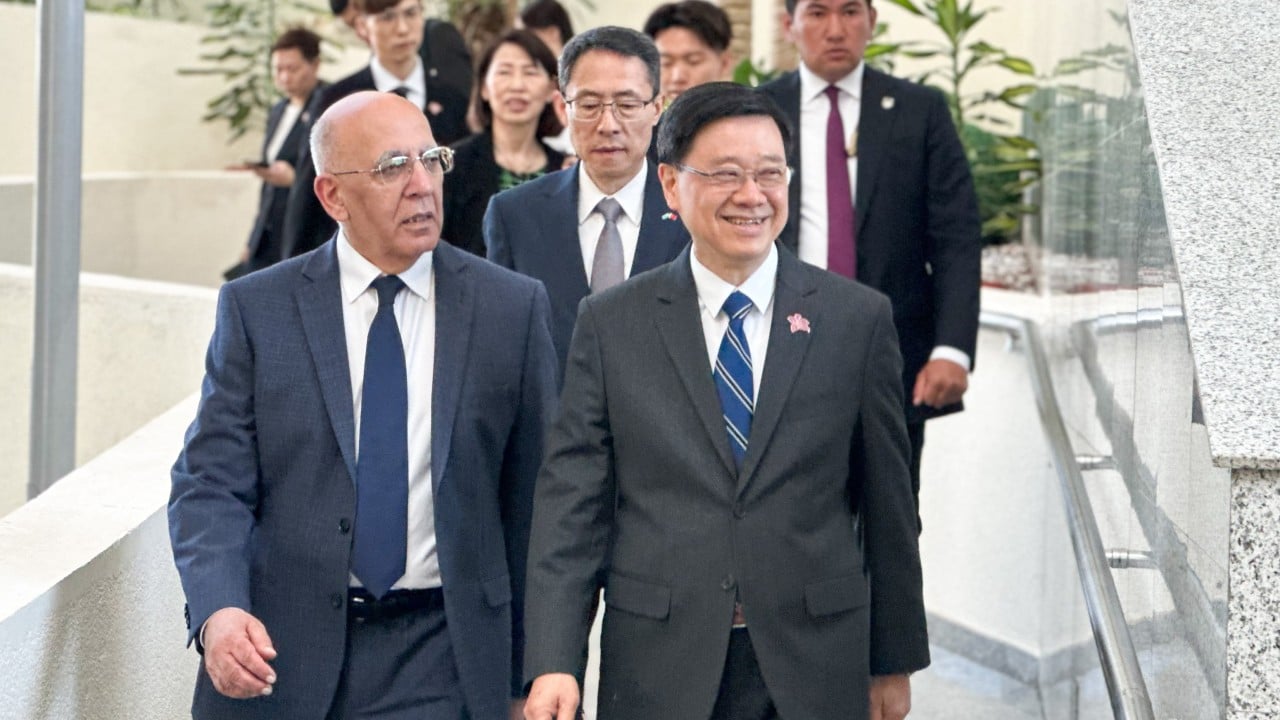
Political tourism disguised as academic breakthrough has become the default mode for university administrators looking to pad their annual reports. The latest spectacle features Hong Kong Chief Executive John Lee leading a 70-person delegation through Central Asia, culminating in a flurry of signed Memoranda of Understanding (MOUs) between Hong Kong higher education institutions and Nazarbayev University in Astana. The official press releases are predictably glowing, celebrating "enduring foundations," "joint curriculums," and a shared vision for global talent.
It is a beautifully staged performance. It is also an operational mirage.
The lazy consensus dominating international education reporting suggests that signing an MOU is equivalent to creating an institutional asset. It assumes that because Hong Kong boasts five universities in the global top 100, and because Nazarbayev University is the premier research institution in Central Asia, a bureaucratic bridge between them will naturally spark a flow of high-caliber talent.
As someone who has watched public universities blow through seven-figure budgets chasing geopolitical trends, I can tell you the reality is far more sobering. Academic integration cannot be decreed by executive fiat, and a handful of scholarship funds will not fix the structural friction built into these agreements.
The Flawed Premise of the Hub to Hub Model
The current narrative champions a "hub-to-hub" cooperation model, suggesting Kazakhstan serves as Hong Kong’s gateway to Central Asia while Hong Kong acts as Central Asia’s anchor in the East. This sounds compelling in a business luncheon speech, but it collapses under basic economic analysis.
Universities operate on prestige, resource concentration, and post-graduation market integration. They are not pieces on a diplomatic chessboard. The structural mismatches between these two jurisdictions are being completely ignored in favor of photo opportunities.
The Illusion of the Joint Degree
Consider the joint Bachelor of Business Administration in Eurasian Business, a partnership between the Hong Kong University of Science and Technology (HKUST) and Nazarbayev University. The program splits a student’s time evenly: two years in Astana, two years in Hong Kong.
On paper, it sounds like an elite cross-border experience. In practice, it introduces immense logistical friction for the students involved:
- Curriculum Fragmentation: Aligning the rigorous, finance-heavy prerequisites of a top-tier Hong Kong business school with a Central Asian curriculum requires massive administrative compromises. Usually, this results in a watered-down syllabus that satisfies both internal review boards but excels at neither.
- Network Disruption: The primary value of a business degree from a global financial capital is the local network, the term-time internships, and the immediate pipeline into corporate recruitment. Splitting that time means students are constantly uprooting themselves, missing critical recruitment cycles in both markets.
- Asymmetric Value: A degree from a top-100 global university carries distinct international currency. Forcing that brand into a shared structure with a younger, regional institution risks diluting the perceived value for prospective employers in major global markets, regardless of Nazarbayev University’s local dominance.
The Recruitment Reality Check
The administration proudly points to the 500 Kazakhstani students currently studying in Hong Kong as proof of concept. Let's do the math. Across Hong Kong’s publicly funded university sector, which serves tens of thousands of undergraduates, 500 students over multiple year cohorts is a rounding error. It is a boutique cohort subsidized heavily by the Belt and Road Scholarship scheme.
True talent hubs do not rely indefinitely on state-funded life support. They attract self-funded talent because the local economy offers immediate, high-yield career outcomes.
Why Top Talent Moves East But Wont Stay
The premise of the "Study in Hong Kong" brand is that it serves as an open invitation for Central Asian youth to build their futures in the Special Administrative Region. But this assumes that international students choose their study destinations based purely on academic rankings and government hospitality.
They don't. They look at corporate realities.
+-----------------------------------+-----------------------------------+
| Hong Kong's Academic Pitch        | The Corporate Reality Check       |
+-----------------------------------+-----------------------------------+
| Five universities in the top 100  | Hyper-localized job market        |
| global rankings.                  | requiring Mandarin/Cantonese.     |
+-----------------------------------+-----------------------------------+
| Robust state-funded scholarships  | High cost of living outpaces entry|
| for regional talent.              | level visa-sponsored salaries.    |
+-----------------------------------+-----------------------------------+
| Gateway to Asian corporate        | Strict work visa quotas and heavy |
| ecosystems.                       | domestic competition.             |
+-----------------------------------+-----------------------------------+
I have interviewed dozens of international graduates who arrived in Asia on full scholarships only to hit an invisible wall upon graduation. The Hong Kong job market is deeply localized. For any client-facing role in banking, consulting, or corporate strategy, fluency in Mandarin and Cantonese is no longer a bonus; it is a baseline requirement.
A brilliant computer science or business graduate from Astana might navigate an English-medium degree with ease. But when they enter the local job market, they find themselves competing against bilingual mainland Chinese graduates and local residents. The result? A massive portion of this state-subsidized talent uses Hong Kong as a stepping stone to Western markets or returns home, completely defeating the local talent-retention goals.
The Bureaucracy of the Non Binding Agreement
What actually happens after a delegation leaves and the ink dries on an MOU? In the vast majority of cases, absolutely nothing.
An MOU is an agreement to agree. It carries zero financial obligation, zero legal liability, and zero operational accountability. It is an administrative safety blanket. University presidents sign them because it shows their respective governing boards that they are aligned with state priorities.
Once the press release is archived, the execution falls to overworked department heads and faculty members who have no teaching relief or budget to actually manage cross-border research collaborations. The agreement quietly expires in five years, having produced nothing more than a couple of faculty exchange visits and a stack of unread brochures.
If institutions were serious about deep integration, they would bypass the generalized MOUs and sign binding, well-funded joint research contracts with specific commercial outcomes. But that requires actual skin in the game, risk allocation, and measurable benchmarks—things bureaucratic institutions avoid at all costs.
Dismantling the Foreign Policy Education Premise
Whenever education policy merges with foreign policy, logic takes a backseat to symbolism. The official rhetoric leans heavily on the fact that Nazarbayev University was the site where the Silk Road Economic Belt was first proposed in 2013. That makes for an excellent historical footnote, but history does not fund lab space or secure corporate sponsorships.
We need to stop asking, "How many agreements did we sign?" and start asking, "What is the net economic return per dollar spent on these alliances?"
If the goal is to build an international talent corridor, the current approach is backward. Do not fund institutions to sit in rooms and sign non-binding paperwork. Instead, redirect those resources directly into the private sector. Create tax incentives for Hong Kong companies that establish R&D outposts in Astana’s technology parks, or fund direct corporate internships that bypass university bureaucracies entirely.
The market moves talent far more efficiently than an academic committee ever will. Until the universities involved admit that these alliances are driven more by diplomatic compliance than market demand, these agreements will remain exactly what they are: expensive performance art designed for an audience of administrators.