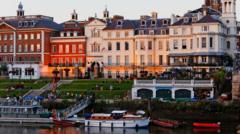
Richmond upon Thames has once again claimed the crown as the happiest place to live in Britain, according to Rightmove’s annual Happy at Home Index. The southwest London borough topped the national rankings based on thousands of resident responses measuring community spirit, access to green spaces, and local amenities. Yet behind the celebratory headlines and estate agent press releases lies a stark economic reality that the survey largely obscures. Happiness in Richmond is real, measurable, and heavily gated by some of the highest property prices and living costs in the United Kingdom.
To understand why Richmond consistently dominates quality-of-life metrics, you have to look at what the survey actually measures. Rightmove polls tens of thousands of residents across Great Britain each year, asking them to rate their local area across thirteen specific factors. These include friendliness and politeness of locals, access to nature, quality of schools, and availability of essential services. Richmond scores near the top across nearly every metric, driven by its unique geography. It is the only London borough situated on both sides of the River Thames, encompassing over 2,500 acres of royal parkland at Richmond Park and Bushy Park, alongside Kew Gardens.
The numbers look great on paper. Residents report an extraordinary sense of pride in their surroundings, bolstered by clean streets, low violent crime rates compared to inner London, and independent high streets in Twickenham, Barnes, and Richmond town center. When you walk along the towpath on a Sunday morning, the appeal is obvious. Rowers glide past historic pubs, families cycle through ancient oak woodlands, and District Line trains connect commuters to central London in under thirty minutes.
The Selection Bias Inside Happiness Surveys
Property portal surveys are not sociological peer-reviewed studies. They are marketing engines built on self-selecting data, and they inherently capture the sentiment of people who have already cleared the financial hurdle of living in a given postcode.
Consider how the survey mechanism works. People who live in Richmond upon Thames and respond to an online property questionnaire are disproportionately homeowners or affluent long-term tenants. If you can afford a seven-figure mortgage for a Victorian terrace near Richmond Green, your baseline stress levels regarding housing security, neighborhood safety, and municipal maintenance are already dramatically lower than the national average. The survey measures satisfaction among the winners of the British property market, then presents that satisfaction as a universal geographic trait.
Financial security acts as a massive buffer against daily friction. When household income is high, local problems become minor inconveniences rather than existential threats. A delayed South Western Railway train is annoying, not a trigger for losing an hourly wage. Private healthcare and private tutoring absorb the strain of overstretched public services. Even the celebrated community spirit benefits from economic homogeneity, because residents share similar schedules, leisure habits, and civic expectations.
What the Headlines Leave Out About Living Costs
The barrier to entry in Richmond upon Thames is staggering. According to Land Registry data, average house prices in the borough routinely sit well above £750,000, with family homes in sought-after pockets like Barnes, East Sheen, and Richmond Hill regularly exceeding £1.5 million or £2 million. Renters face a similarly brutal market, where a modest two-bedroom flat commands well over £2,000 a month before council tax and utilities.
This creates a sharp demographic divide that rarely makes it into lifestyle coverage. While Richmond is celebrated for its welcoming atmosphere, the borough is steadily hollowing out its middle- and lower-income workforce. Teachers, nurses, hospitality staff, and retail workers who keep those beloved independent shops and riverside cafes running often cannot afford to live within the borough boundaries. They commute in from outer Surrey or cheaper neighboring boroughs, absorbing rising transport costs so that Richmond residents can enjoy frictionless local amenities.
For a hypothetical young couple earning the average UK salary, moving to Richmond is mathematically impossible without generational wealth. Even dual-income professionals in fields like law or finance find themselves dedicating half their net pay to housing costs just to secure a foothold near a good state primary school. Happiness surveys do not ask respondents how much equity they inherited, nor do they track the quiet anxiety of mortgage renewals at higher interest rates.
Green Space as an Economic Asset
Urban planners have long known that proximity to nature reduces cortisol levels and improves mental health. Richmond upon Thames possesses an unmatched concentration of protected parkland, which is the genuine secret behind its high wellbeing scores. Unlike central London boroughs where green space consists of fenced-in squares or crowded municipal parks, Richmond offers genuine wilderness within Zone 4.
However, green space in British cities is never distributed neutrally. Over decades, the presence of Richmond Park and the Thames embankment has acted as a permanent price floor for local real estate. Because strict conservation rules prevent high-density development near the parks and riverfront, housing supply remains permanently constrained while demand from wealthy domestic and international buyers stays relentless.
This dynamic turns natural beauty into a luxury commodity. Access to the parks is technically free, and visitors travel from across London to see the red and fallow deer in Richmond Park. Yet daily, effortless immersion in that environment—waking up to birdsong, walking the dog before work, running along the river at dusk—is rationed by postcode. The mental health benefits of urban nature are real, but in Richmond, they are capitalized directly into property valuations.
The Hidden Friction of Suburban Affluence
Living in Britain’s happiest borough is not entirely devoid of daily irritation. Anyone who actually spends time navigating Richmond knows that its geography creates severe infrastructure bottlenecks.
The River Thames is both the borough's greatest aesthetic asset and its biggest logistical headache. Crossing points are limited, and the closure of Hammersmith Bridge to motor traffic in 2019 permanently altered traffic flows across Barnes, Mortlake, and Sheen. Narrow Victorian streets that were never designed for modern SUVs regularly gridlock during school drop-off hours and weekend rugby matches at Twickenham Stadium. Air quality along major arteries like the South Circular and the A316 frequently breaches recommended health thresholds, standing in sharp contrast to the pristine air inside the parks just a few hundred yards away.
There is also the relentless noise of the Heathrow flight path. Depending on wind direction, commercial airliners descend directly over Richmond, Kew, and Twickenham every ninety seconds from early morning until late at night. Longtime residents claim they stop hearing the roar of jet engines after a few months, yet newcomers are often stunned by how loud Britain’s happiest town actually is when the easterly winds blow.
Why Other Towns Rarely Compete
When you look at the runner-up locations in national happiness rankings—places like Winchester, St Albans, or Guildford—a clear pattern emerges. The UK’s happiest places are almost always affluent commuter towns or wealthy outer-London suburbs with historic architecture, low crime, and strong transport links to major economic hubs.
Post-industrial towns in the Midlands and the North rarely crack the top ten, regardless of how tight-knit their communities actually are. This reveals a fundamental flaw in how national happiness indexes are interpreted by the media. A town with struggling high streets, underfunded local councils, and lower life expectancy will naturally score lower on metrics tied to local amenities and pride of place. Those scores reflect decades of uneven regional investment, not a deficit in human warmth or community resilience.
In Richmond, civic pride is reinforced by visible public maintenance. Hanging baskets appear on lampposts every summer, potholes are repaired faster than in cash-strapped boroughs, and local charities are flush with donations from wealthy patrons. Community spirit thrives easily when the underlying infrastructure works and residents have the free time and disposable income to volunteer for neighborhood associations.
The Reality Behind the Ranking
Rightmove’s annual survey captures a genuine truth about what human beings want from their physical environment. People want safe streets, clean air, walkable high streets, reliable public transport, and immediate access to trees and water. Richmond upon Thames delivers all of these things at a level few other urban areas in Britain can match.
If you already own a home in the borough, or if your household income comfortably absorbs London’s steepest living costs, Richmond genuinely earns its reputation. The combination of village atmosphere and metropolitan connectivity is extraordinarily rare. But treating Richmond’s ranking as a simple blueprint for national wellbeing misses the point entirely. You cannot separate the borough's happiness from its wealth, and for the vast majority of Britons priced out of southwest London, Richmond’s idyllic lifestyle remains something to admire from afar on a Sunday afternoon walk.


