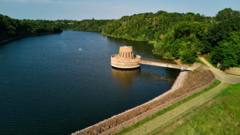
Surging global water demand has officially eclipsed the record-breaking peaks of the 2022 drought. Municipalities and industrial sectors are pulling liquid assets from dwindling reserves at a rate that outpaces natural replenishment. This is not just a seasonal spike driven by a few hot weeks. It is a structural failure. The immediate cause stems from a lethal combination of outdated infrastructure, intensive industrial agricultural practices, and data center cooling requirements that have quietly compounded over the last four years. The margin for error has vanished.
The narrative broadcast by water utilities usually blames individual consumers. They point to lawn sprinklers and long showers. This explanation is convenient, but it hides the true drivers of the crisis.
The Illusion of Abundance
To understand how we arrived here, look at the municipal grid. Massive volumes of treated, potable water never actually reach a single tap.
Water infrastructure across the developed world is rotting from the inside out. Water mains laid down over half a century ago are fracturing under pressure. Every single day, trillions of gallons of clean water leak directly into the dirt. This lost volume is known as non-revenue water. It is a hidden drain on municipal supplies that utilities have failed to address due to decades of deferred maintenance and budget shortfalls. When demand spikes during high-temperature events, the systemic weakness multiplies. The pumps work harder, the pressure increases, and the ancient pipes burst with greater frequency.
The financial calculus of fixing these systems is broken. For decades, city governments treated water as a cheap, infinite resource. Water tariffs were kept artificially low to avoid political backlash from voters. Consequently, public utilities lacked the capital required for wholesale pipeline replacement programs. Patching leaks became the standard operating procedure. This short-term strategy has backfired spectacularly now that regional aquifers are hitting historic lows.
Industrial Agriculture and the Ground Beneath Our Feet
Agriculture accounts for roughly seventy percent of global freshwater withdrawals. This fact is well-documented, but the underlying mechanics of how agricultural policy forces over-extraction deserve closer scrutiny.
Corporate farming operations have shifted toward high-value, water-intensive crops in regions that are fundamentally unsuited for them. Consider the proliferation of nut orchards and alfalfa fields in arid basins. These crops require continuous irrigation regardless of seasonal rainfall variations. Farmers are locked into long-term capital investments; an almond orchard takes years to mature and represents millions of dollars in future revenue. A farmer cannot simply decide to skip a watering cycle when a dry spell hits without destroying their entire business model.
Global Freshwater Withdrawal Distribution
┌─────────────────────────────────────────┐
│ Agriculture: 70%                        │
├────────────────────┬────────────────────┤
│ Industrial: 20%    │ Domestic: 10%      │
└────────────────────┴────────────────────┘
This economic reality incentivizes the exploitation of groundwater. Surface water allocations from rivers and reservoirs are heavily regulated and frequently cut during shortages. Groundwater, however, exists in a regulatory gray zone in many jurisdictions. Property owners often possess the legal right to pump as much water as they can extract from beneath their land.
The consequences are irreversible. Aquifers are underground rock formations that store water over thousands of years. When extracted at modern industrial speeds, the empty spaces collapse. The ground above actually sinks. This phenomenon, known as subsidence, permanently reduces the storage capacity of the aquifer. Even if massive rainstorms return, the subterranean storage tank no longer exists to hold the overflow. We are destroying our natural savings accounts to fund annual crop yields.
The New Digital Thirst
A fresh competitor for freshwater resources has emerged since the 2022 crisis. The explosive growth of cloud computing and artificial intelligence has triggered a massive wave of data center construction.
These massive facilities generate immense heat. To prevent processors from melting, data centers rely heavily on evaporative cooling systems. This method is favored because it consumes less electricity than traditional air conditioning, allowing operators to boast about their energy efficiency metrics. However, this energy efficiency comes at a direct cost to the local water supply. A single large data center complex can consume millions of gallons of water every day.
Many of these digital hubs are strategically located in regions with cheap land and favorable tax structures, which frequently overlap with areas facing severe water stress. The sheer volume of consumption places a sudden, concentrated burden on local water authorities. While a manufacturing plant might recycle a portion of its process water, evaporative cooling literally sends the resource into the atmosphere, removing it entirely from the immediate local watershed.
Public opposition is mounting. Communities that were once eager to welcome tech investments for the promised tax revenue are realizing the trade-off. When a data center consumes the equivalent of a small city's daily water budget, local residents face rising utility bills and tightening usage restrictions. The tension between digital infrastructure growth and basic human resource needs is becoming a major flashpoint for local governments.
The Limits of Tech Fixes
The market has responded to this growing scarcity with a predictable wave of technological promises. Desalination plants and advanced wastewater recycling systems are frequently championed as the ultimate solutions to the supply crunch.
The reality is far more complicated. Desalination, the process of removing salt from seawater, is incredibly energy-intensive and financially prohibitive for most inland regions. Moving desalinated water from coastlines to high-altitude cities requires immense pumping infrastructure, adding further capital costs and carbon emissions to the equation. Furthermore, the process produces a highly concentrated chemical brine byproduct. Dumping this brine back into marine environments disrupts local ecosystems, creating dead zones devoid of oxygen.
Wastewater recycling faces a different hurdle. The technology to purify sewage water into perfectly safe drinking water exists and is highly reliable. However, the psychological barrier remains high. Public resistance to what critics call toilet-to-tap schemes has stalled numerous recycling initiatives. Even when public education campaigns succeed, upgrading treatment plants to perform advanced purification requires billions in capital investments that many mid-sized cities simply do not possess.
The Regulatory Void
National policies continue to treat water management as a localized issue rather than a coordinated strategic priority. This fragmented approach leads to legal warfare between neighboring territories.
Upstream users routinely divert river flows to support their own economic growth, leaving downstream communities with diminished volume and degraded water quality. Interstate compacts negotiated nearly a century ago were based on historically wet years that do not reflect modern climate realities. These legal frameworks are obsolete, yet modifying them requires years of litigation and political negotiation that nobody wants to initiate.
Market-based solutions, such as water rights trading, have yielded mixed results. In theory, allowing users to buy and sell water allocations encourages efficiency. In practice, investment funds and private equity firms have begun purchasing water rights as speculative assets. By holding these rights, private entities can drive up the price of water, turning a fundamental human necessity into a commodity traded for corporate profit. When capital efficiency dictates resource allocation, small-scale farmers and municipal consumers are invariably priced out.
The trajectory since 2022 shows that the current consumption model is entirely unsustainable. Relying on hopes for a wetter winter is a failing strategy. Without immediate, massive capital investments in infrastructure repair, a fundamental restructuring of agricultural subsidies, and strict regulation of industrial and digital cooling consumption, the next supply failure will not just match the 2022 drought. It will permanently alter the economic viability of entire regions. The water is running out, and the time for incremental policy tweaks has passed.