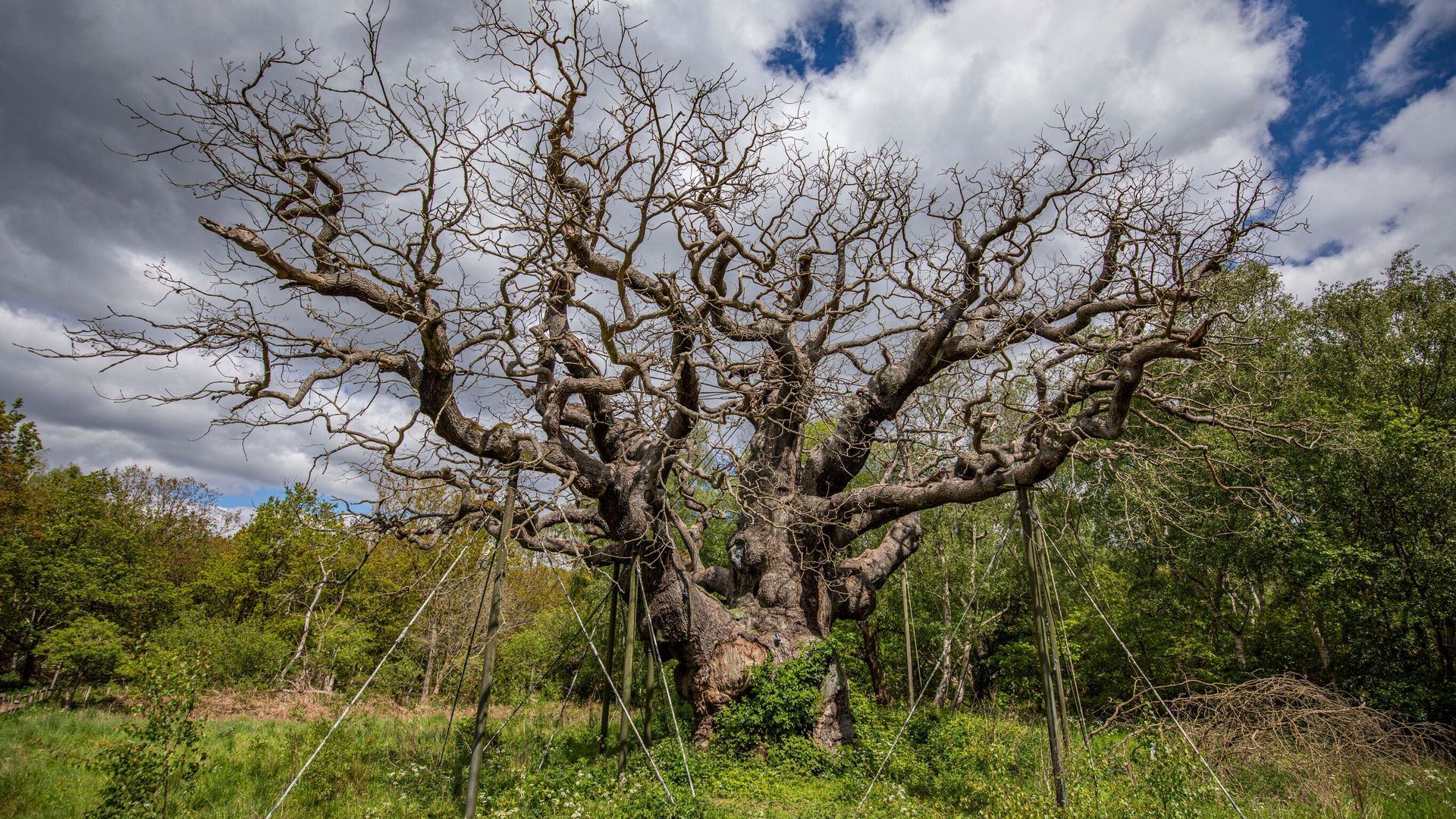
The silence of a dying giant does not sound like a crash in the woods. It sounds like nothing at all.
This spring, in the damp heart of Nottinghamshire, a thousand-year-old pulse simply stopped. For twelve centuries, the Major Oak stood in Sherwood Forest, anchoring the soil, outlasting empires, and holding up a canopy that once spanned nearly a hundred feet across. It was the legendary sanctuary of Robin Hood, the fabled "trystle tree" where outlaws supposedly shared their spoils and hid from the Sheriff of Nottingham.
But this year, when May bled into June, the buds did not open. The branches remained gray, naked, and brittle against the English sky. The most famous tree in the world is dead.
To read the standard news reports, the tree succumbed to a predictable, clinical list of environmental stressors: soil compaction, climate shifts, and structural fatigue. But those dry facts obscure a much darker, deeply human paradox. The Major Oak was not killed by a sudden act of malice or a lightning strike. It was slowly, systematically loved to death by us.
Consider a hypothetical visitor from the mid-nineteenth century, let us call him Thomas. Thomas arrives in Sherwood Forest on a newly constructed Victorian railway line, eager to escape the coal-smoke of industrializing Britain. He walks up to the great oak, marveling at its massive thirty-three-foot girth. He runs his hands over the deeply fissured bark. He steps onto the dirt right at the base of the trunk, perhaps even climbing inside the hollow belly of the tree where folklore says the Merry Men slept.
Thomas means no harm. He feels a profound connection to the natural world and the romantic myths of his ancestors.
Now multiply Thomas by millions.
Over two centuries, a relentless tide of human footsteps trod upon that exact patch of earth. Under the sheer weight of our collective adoration, something invisible happened beneath the surface. The loose, aerated woodland soil was pressed down, layer by layer, decade after decade. Recent underground testing by soil microbiologists revealed that sections of the earth around the roots had become literally as dense as solid concrete.
Imagine trying to breathe through a stone mask. That is what we asked the Major Oak to do.
The root system became strangled and starved, entirely disconnected from the ecosystem around it. Rain could no longer penetrate the hardened ground. Microscopic underground life—the complex fungal networks and beneficial bacteria that trade nutrients with oak roots—withered away. While we looked up in awe at the majestic green silhouette, the tree was quietly suffocating from the bottom up.
When we finally realized the danger and put up a protective fence in the 1970s, the damage was already deeply entrenched. We tried to fix it with our hands, but our help carried its own heavy irony.
For nearly a hundred years, well-intentioned arborists installed massive metal cables, chains, and wooden props to hold up the oak's sprawling, twenty-three-ton limbs. It seemed like the right thing to do. If a branch is heavy, you support it. But biology is a master of efficiency. When a tree branch is artificially propped up, the tree stops pumping the necessary structural sugars and water to those outer limbs because it no longer feels the mechanical stress of the wind.
The props made the tree lazy. The trunk became depleted of water as it struggled to pump life through a system that had forgotten how to support its own weight. Yet, conservation managers could not remove the props; if they did, the entire structure would have collapsed under its own mass. We had built a living monument that could no longer survive without its crutches.
Then came the final ten percent of the oak's life, a tiny sliver of time that broke a millennium of endurance.
The climate broke with it. The last five years brought a succession of brutal, unprecedented heatwaves and parching droughts across the United Kingdom. In July 2022, temperatures breached forty degrees Celsius. For an organism born in the cool, damp climate of the early Middle Ages—a tree that grew through the Little Ice Age and survived centuries of steady rainfall—this sudden, searing heat was an existential shock. The starved roots had no water reserves to draw from. The leaves withered early, the canopy thinned, and the energy reserves ran dry.
This spring, the bill came due. The tree simply ran out of choices.
Walking through Sherwood now, the loss feels personal, even to a stranger. There is a specific grief in watching an ancient thing expire on our watch. The Major Oak was a seedling when Vikings sailed up the English rivers. It was a mature tree when the Magna Carta was signed. It grew timbers that built St. Paul’s Cathedral and floated the warships of Nelson’s navy. It survived the rise and fall of the British Empire, only to be brought down by a combination of Victorian footprints and modern carbon emissions.
Conservationists from the Royal Society for the Protection of Birds are devastated, but they are also clear-eyed about the future. The dead tree will not be chopped down or cleared away. In the economy of the forest, death is not a vacancy; it is an opening.
A standing dead ancient oak is almost as valuable to the ecosystem as a living one. A quarter of all forest species depend on deadwood at some point in their lifecycle. Over the coming decades, the Major Oak will become a bustling metropolis for rare beetles, fungi, owls, and bats. It will continue to stand as a natural monument, a stark gray sculpture at the heart of the woods.
But we must look at it for what it truly is: a monument to our own impact.
There are nearly four hundred other living ancient oaks scattered across Sherwood Forest, and thousands more throughout the world. They do not have special legal protections. They do not have fences. Every single day, they face the same concrete-making footsteps, the same shifting water tables, and the same escalating summer heat.
The Major Oak survived for twelve hundred years because it was left alone in the dark, quiet rhythm of the woods. It died because we turned it into a destination. Its empty branches are a beautiful, heartbreaking warning that the things we cherish most cannot survive on our admiration alone. They require our restraint.


