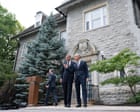
The wind off the Ottawa River carries a chill even in June, but the real frost radiates from the stone facade of 24 Sussex Drive. Stand close enough to the iron gates, and you do not smell history. You smell rot.
For more than a decade, the official residence of Canada’s head of government has sat entirely empty. It is a 34-room testament to political paralysis. While leaders of the world's most powerful democracies host summits in grand historic estates, Canada's prime minister lives down the road in a borrowed, inadequate cottage. Meanwhile, the mansion meant to anchor our national identity has been systematically eaten away from the inside out by toxic black mould, crumbling asbestos, and generational infestations of rodents.
It is an embarrassment.
It is also the ultimate metaphor for what happens when a nation becomes too terrified of a bad headline to invest in its own legacy.
On Friday, Prime Minister Mark Carney stood outside those decaying walls and broke the paralysis. He announced an independent national design-and-build competition, paired with a non-partisan philanthropic fundraising campaign orchestrated by the Rideau Hall Foundation. The goal is to salvage the 1868 structure and transform it into a secure, sustainable, and functional working venue for future leaders.
But this is not a story about blueprints, masonry, or procurement frameworks. It is a story about the price of political cowardice, and the collective shame of letting our symbols crumble because we forgot how to value them.
The House of Dead Mice
To understand how we arrived at a point where a G7 leader's home is a certified biohazard, you have to look at the math of fear.
Imagine a hypothetical prime minister sitting at their desk, looking at a briefing note. The roof at 24 Sussex leaks. The wiring is a fire hazard dating back to the mid-20th century. The plumbing is failing. The estimated cost to fix it is tens of millions of dollars.
Now imagine the opposition headlines. “PM Spends Millions of Taxpayer Dollars on Personal Mansion While Canadians Struggle.”
So, the prime minister kicks the can down the road. The next leader does the same. Decades of deferred maintenance stack up like dry kindling. By the time Stephen Harper packed his bags in 2015, the property had deteriorated past the point of basic repair. When Justin Trudeau took office, security and civil servants gave him a stark warning: do not move your children into that house. He didn't. He moved into Rideau Cottage instead.
Left vacant, the mansion did what all abandoned buildings do. It died.
By 2024, crews had to completely gut the interior just to strip out the hazardous materials. Contractors pulled rotting mouse carcasses and heaps of droppings out from inside the heritage walls. Taxpayers continued to shell out tens of thousands of dollars every year just to keep the heat on in an empty shell so the remaining stone wouldn't crack in the winter freeze.
We were spending money to maintain a corpse.
An Architectural Jury to Reclaim the Future
Carney’s newly unveiled plan strips the partisan ammunition out of the equation. By launching an open competition managed alongside the Royal Architectural Institute of Canada, the government is shifting the narrative from a political spending scandal to a celebration of domestic talent.
The framework is simple yet ambitious:
- The Competitors: The contest is restricted to eligible Canadian firms, ensuring the rebirth of the property is designed by Canadians, for Canadians.
- The Jury: A distinguished panel of design, heritage, and architecture experts will evaluate the submissions. The jury will be chaired by Moshe Safdie, the iconic architect behind Habitat 67 and the National Gallery of Canada.
- The Timeline: The independent jury will recommend a winning design to the federal cabinet, with the official announcement slated for Canada Day on July 1, 2027.
- The Funding: To shield the public purse from the full weight of the project, the Rideau Hall Foundation will lead a national fundraising campaign, allowing philanthropic organizations and everyday citizens to financially support the restoration.
"I will never, in any event, live in 24 Sussex Drive," Carney stated bluntly during his Friday announcement. He understands the optics. He knows he cannot be the beneficiary of the space. But he also recognizes that leadership requires handing things off in a better state than you inherited them.
Consider the alternative. If we do not rebuild, we eventually bulldoze. And when you bulldoze a designated Classified Federal Heritage Building that has hosted ten prime ministers from Louis St. Laurent onward, you erase a piece of the national fabric.
What We Lose When We Refuse to Build
Every country requires physical spaces that command respect. They are the stages upon which history is performed. When a foreign dignitary visits Ottawa, the setting matters. It signals competency, stability, and national pride.
When we allow our highest public office's physical manifestation to become a literal punchline about rat infestations, we send a clear message to the rest of the world: we do not take ourselves seriously.
The previous reluctance to fund repairs was rooted in a profound misunderstanding of public trust. Politicians assumed Canadians would despise them for spending money on a historic house. But true stewardship means protecting public assets from ruin.
The 2021 estimates suggested that restoring 24 Sussex to a basic "good" condition would require roughly $36.6 million—a figure that climbs past $44 million today when adjusted for modern inflation. The final cost of this new design-and-build initiative will depend entirely on the winning proposal. It will not be cheap.
But the hidden cost of doing nothing was far higher. It was the slow, corrosive tax of embarrassment.
The upcoming national competition forces us to confront a fundamental question about who we are as a society. Are we a nation that abandons its heritage the moment the maintenance bill arrives? Or are we capable of building something functional, sustainable, and beautiful that will stand for another century?
The designers who submit their blueprints over the coming months will not just be drawing walls and picking out energy-efficient windows. They will be rebuilding a broken symbol.
As the independent jury prepares to gather under Safdie’s leadership, the empty stone house on the cliffside waits. For the first time in eleven years, the air inside those gutted rooms feels less like dust and decay, and more like a quiet, collective intake of breath.