The air in northern Manitoba does not just smell like smoke when the black spruce burns. It smells like old memories turning to ash. It coats the back of your throat with a dry, metallic sting that water cannot wash away.
In the summer heat, the sky over O-Pipon-Na-Piwin Cree Nation turned a bruised, apocalyptic purple. Twelve thousand hectares of wilderness were on fire. For the people who live here, the forest is not a postcard view. It is home. It is larders, family histories, and sacred paths. But when the wind shifted, the forest became a wall of advancing heat.
Imagine standing on the gravel road that leads out of your community, watching the horizon glow orange, knowing there is only one way out.
Hundreds of people had already fled. They packed what they could fit into plastic bins and the trunks of sedans, leaving behind the quiet lives they had built. Priority residents—the elders, the babies, the people whose lungs couldn't handle the thick, suffocating air—were gone.
Only seventy-one people remained.
Among them was a fifty-nine-year-old woman. She was a front-line worker, the kind of person every small town relies on to keep the wheels turning when things fall apart. She stayed behind because someone had to guide the evacuation. Someone had to make sure the vulnerable got out safely.
She did her job. But the system built to protect her did not.
The Agony of the Long Distance
On a Thursday afternoon, as the smoke hung heavy over the dirt roads, the woman’s all-terrain vehicle veered into a ditch.
In a city, an accident like this triggers an immediate, rehearsed sequence of events. You dial three digits. Within minutes, sirens pierce the air. A paramedic team arrives with oxygen, heart monitors, and backboards.
In O-Pipon-Na-Piwin, there was only silence.
Because of the evacuation, the local nursing station had no medical staff. The community was empty of the very people trained to save lives. When the call went out, the closest wildfire service paramedics had to fly in from Leaf Rapids. But the severity of her injuries required more than basic first aid. She needed a trauma helicopter.
The helicopter was in Thompson.
Thompson is more than three hundred kilometers away.
Think about that distance. Picture a helicopter lifting off from a tarmac, its blades cutting through the hazy air, flying mile after mile over endless stretches of muskeg and lake, while a woman lies dying in a ditch.
Time does not stretch in an emergency. It breaks.
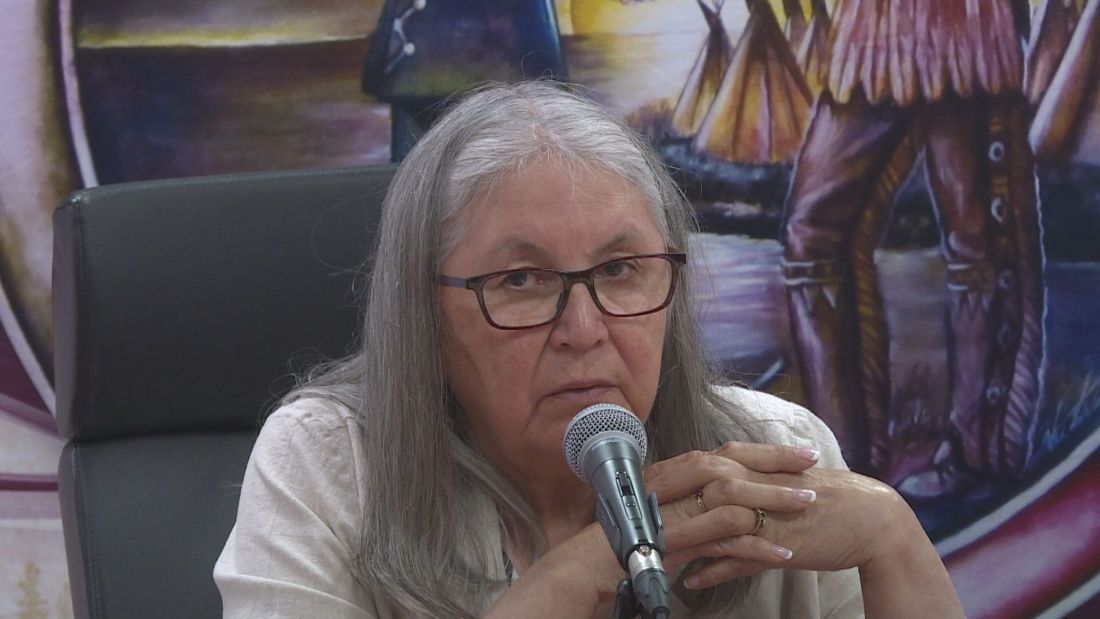
"We didn't have medical staff," Chief Shirley Ducharme said later, her voice carrying the heavy weight of a grief that should have been prevented. "Emergency support did not arrive in time, resulting in the loss of a beloved community member."
The woman died at the scene.
"We felt very helpless at the time," Chief Ducharme recalled. "There is a need for emergency response, and that wasn't there."
The tragedy was not an isolated stroke of bad luck. It was the predictable result of a fragmented, hollowed-out safety net that consistently treats northern Indigenous communities as an afterthought.
The Year the Lights Went Out
To understand why a community of hundreds is left without basic medical support during a crisis, you have to look at the wires that connect them to the rest of the province. Or rather, the wires that fail to.
Consider what happened the year before. In 2025, a massive wildfire swept through the same region. It did not just burn trees. It devoured one hundred and fifty wooden power poles, snapping them like dry toothpicks.
The community was plunged into darkness.
For weeks, then months, O-Pipon-Na-Piwin struggled without reliable electricity. Food rotted in freezers. Medical equipment sat useless. The hum of diesel generators became the background noise of daily life, a constant, expensive reminder of their isolation. Power was not fully restored until September of that year.
Now, the calendar says 2026, and the nightmare has returned.
Thirty more poles have burned down. Once again, hundreds of residents are without power.
Manitoba Hydro crews are waiting on the sidelines. They cannot get in because the ground is still hot and the winds are unpredictable. The utility company says they have wrapped thousands of poles in fire-resistant mesh and cleared brush to prevent this exact scenario. Yet, the lights are still out.
It is a cycle of reaction. The fire burns, the power goes out, the community evacuates, the government promises to do better, the snow falls, the ice melts, and the fire returns.
But the real problem lies elsewhere. It is not just about the wooden poles. It is about how we view the people who live among them.
The Illusion of Partnership
When a crisis hits a First Nation, a strange bureaucratic dance begins.
Emergency response in Canada operates under a bizarre, overlapping web of jurisdictions. The federal government holds the ultimate responsibility for First Nations under the constitution. But provincial systems manage the actual physical emergency services, like water bombers, provincial highways, and medical helicopters.
When things go wrong, everyone points a finger at someone else.
"There remains jurisdictional ambiguity," Chief David Monias of the nearby Pimicikamak Cree Nation observed during a gathering of northern leaders. "Emergency response still operates across federal authority, through provincial systems."
He pointed out a fundamental truth that many outside these communities fail to grasp.
"First Nations are not service recipients within the emergency framework," Monias said. "We are governments, and we must be treated as such."
When a city like Winnipeg or Brandon faces a natural disaster, municipal leaders do not beg for a seat at the table. They are the table. They coordinate directly with provincial and federal counterparts. They have their own emergency plans, their own budgets, and their own staff.
But northern First Nations are often treated like passive victims, waiting for the Red Cross or the provincial government to fly in and save them.
This passive model is deadly.
Consider Mathias Colomb Cree Nation, another northern community. During the previous wildfire season, their people were evacuated for one hundred and twenty-eight days because a fire destroyed the transmission line to Pukatawagan.
One hundred and twenty-eight days. That is more than four months of living in cheap hotel rooms, eating fast food, and sleeping in crowded shelters far from home.
The community could not wait for the government to find a solution. They took matters into their own hands. They spent eight million dollars of their own money to buy back-up generators so they would never be forced to leave their homes just because a wire burned. They did this without any promise of reimbursement from the federal or provincial governments.
No community should have to choose between going bankrupt or abandoning their ancestral lands to the flames.
Moving Beyond the Band-Aid
If you want to stop the cycle, you have to change how you build.
Chief Ducharme has made it clear that the current approach is not working. It is reactive, slow, and ultimately fatal.
What does a real solution look like?
It looks like wrapping every single power pole in fire-resistant material before the fire starts, not after. It means clearing wide buffer zones of vegetation around critical infrastructure so that a forest fire cannot jump into a residential area. It means placing backup generators in every northern community as a standard safety feature, not a luxury.
More than anything, it means ensuring that when an evacuation is ordered, those who stay behind to protect the town are not left entirely defenseless.
It is easy to look at a map of northern Manitoba and see nothing but empty space. From a high-altitude airplane, the boreal forest looks like an endless green carpet, interrupted only by the occasional blue vein of a river. It is easy to assume that a fire there is just nature taking its course.
But people live there.
They are people who teach their children how to hunt, who care for their elders, and who want nothing more than to live in peace on the land they have inhabited for thousands of years.
When we ignore their calls for better roads, reliable power, and localized medical care, we are saying that their lives are worth less because of their postal code. We are accepting that a fifty-nine-year-old woman should die in a ditch because a helicopter has to fly three hundred kilometers to reach her.
The fire in O-Pipon-Na-Piwin is now under control. The smoke is beginning to clear. The immediate danger to the physical structures has passed.
But the silence that remains in the wake of the tragedy is deafening. It is the silence of a community that did everything right, only to find themselves completely alone when the sparks began to fly.