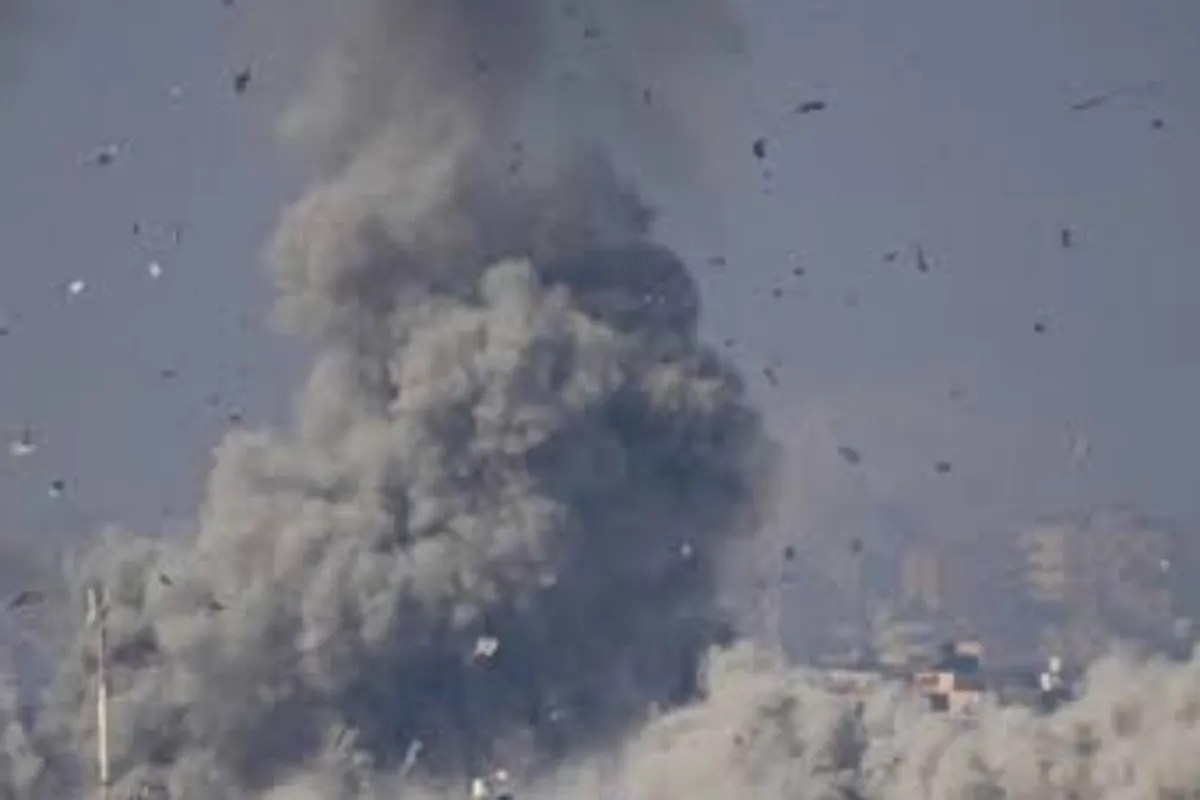
Dawn breaks over dusty stone streets with a sound that never quite leaves your ribs. Not thunder. Not wind. Something tighter, sharper, carried on dry air before the first kettle whistles on a stove.
In standard news dispatches, a morning like that shrinks to a single line. Five armed militants killed during an Israeli military operation. Another tactical success chalked up on a ledger that has been accumulating entries for decades. Clean words. Neat arithmetic. Five minus five.
Numbers feel tidy from a distance. Up close, they splinter.
To understand what an operation of this kind actually means on the ground, we have to look past the headline's triumph and trace the ripples moving outward from the alleyways where the gunfire stopped. A headline tells you an outcome. It rarely tells you what changed in the next room, in the next neighborhood, or in the quiet hours after the dust settles.
The Morning the Alley Went Quiet
Picture a narrow lane between concrete apartment blocks where laundry hangs limp in the cool early light. To make the invisible mechanics of this moment clear, consider a hypothetical family living two doors down from the site of a raid—not tied to any militant faction, just trying to get children to school and keep bread on the table.
Listen.
First comes the hum of drones overhead, thin and persistent like an insect trapped near a lamp. Then the bark of orders in Hebrew and Arabic echoing off stucco walls. Glass rattles in frames that haven't been replaced since the last round of unrest. Within minutes, five men are dead in an exchange of fire, and soldiers are already moving toward extraction points as sirens begin to wail somewhere closer to the main road.
For the Israeli military, such raids are framed around immediate security imperatives: disrupting armed cells before attacks reach civilians, gathering intelligence, and reasserting operational control in volatile areas where militant networks recruit and operate. From that vantage point, neutralizing five fighters is a concrete measure of deterrence. A cell is broken. A planned strike may have been averted. Commanders count precision, minimal friendly casualties, and mission completion.
Yet deterrence is a double-edged blade. Every strike alters the terrain it touches.
This is a metaphor for how violence reshapes human geography: when a stone drops into still water, the splash is brief, but the rings keep pushing outward until they hit the bank. In dense urban environments where militants and ordinary families share courtyards, water tanks, and narrow lanes, there is rarely a clean boundary between the target zone and everyday life.
Neighbors peek through shutter slats. Shopkeepers pull metal roll-down doors halfway shut, unsure whether to open for the morning rush or lock everything down until curfews and road closures clear. A boy on a bicycle brakes hard at a checkpoint, heart hammering against his ribs, calculating whether his ID card and his route home will pass scrutiny without delay.
Why Five Deaths Rarely End the Story
If conflict worked like a simple equation—remove five fighters, reduce violence by five units—the region would have found equilibrium long ago. History points in a stubbornly different direction.
Armed groups regenerate. When senior or active operatives are killed, factions move quickly to fill ranks, often turning frustration and grief into recruitment fuel among young men who already feel boxed in by checkpoints, economic stagnation, and years of blockade or occupation. Grief is volatile. Left unaddressed, it curdles into vengeance, and vengeance recruits faster than ideology alone ever could.
At the same time, Israeli families live under a constant calculus of threat. Bus stops, cafes, border communities, and crowded streets carry a weight that outsiders often underestimate until they stand in a shelter during a rocket alert or read the name of a young soldier killed in a raid. For Israelis, military action is often experienced not as aggression in the abstract, but as an attempt to keep loved ones alive in a neighborhood that feels perpetually hostile.
Both sides hold narratives built on real pain. That is what makes this conflict so exhausting to witness and so difficult to resolve.
Confusion.
Even seasoned observers struggle to hold two truths at once without losing their footing: that armed militants pose real, lethal danger that a state feels compelled to confront, and that recurring lethal raids inside densely populated communities deepen cycles of anger, displacement, and trauma that make long-term peace harder to imagine. When you admit how tangled that knot is, simple slogans start to sound hollow.
Let us look closely at what happens in the hours right after the tactical report is filed.
- The immediate security ledger: Military briefings highlight neutralized threats, seized weapons, and disrupted plots. On paper, the ledger shows a gain in security.
- The civilian shockwave: Families sheltering in place experience curfews, damaged walls, psychological shock, and fear of escalation—even when they want nothing to do with armed factions.
- The political aftershock: Funeral processions in Palestinian towns often turn into rallies of defiance, while Israeli leaders face domestic pressure to project strength or brace for retaliatory rockets, stabbings, or shootings.
None of these threads exists in isolation. Pull one, and another tightens.
The Invisible Stakes Behind the Headlines
When a news item calls five deaths a "success," it is speaking a specific language—the language of counterterrorism and military operations. Within that narrow frame, success means completing the objective without losing your own troops.
Step outside that frame, and the word begins to wobble.
What is the cost of a tactical success if it leaves behind a generation that knows only sirens, raids, funerals, and checkpoints? What is the cost when trust—already thin as paper—erodes another micron further? A military victory can buy time. Time can be used to build diplomatic off-ramps, support accountable governance, and protect civilians. Too often, time is simply filled with the next operation.
I have sat across from people in conflict zones who spoke with eerie calm about things no one should normalize: the sound of helicopters at three in the morning, the smell of cordite and dust, the way children draw soldiers and drones with the same casualness other kids draw soccer balls. You do not need to wear a uniform to carry that weight. You only need to breathe the same air long enough.
And yet, distance makes it easy to treat tragedy as content. You scroll past a headline while drinking coffee. Five militants killed. Next story.
It takes deliberate effort to remember that behind every statistic is a mother waiting for a son who isn't coming home, a family huddled in a hallway praying a stray round doesn't come through the window, and a young conscript on a rooftop wondering if the shadow moving in the dark holds a rifle.
Where the Cycle Tightens—and Where It Could Break
Consider what happens next:
A retaliation strikes a border town or a checkpoint. Sirens blare. Families rush into reinforced rooms. Now the pressure on the military to "respond decisively" mounts again, setting the stage for another raid, another set of casualties, another round of mourning and anger.
Round and round.
Why does this loop repeat with such grim predictability? Because military force addresses symptoms and immediate threats, while the underlying political and human grievances remain unaddressed. Rockets and raids can suppress capability for a season; they cannot resolve questions of sovereignty, security guarantees, dignity, or basic human freedom on their own.
Some people argue that without overwhelming military pressure, militant groups will simply grow bolder and strike harder. There is evidence in recent decades that armed factions exploit any perceived vacuum or restraint to rearm and plan attacks. Others argue that relentless military operations in crowded areas feed extremism, erode international standing, and push peaceful coexistence further out of reach.
The tension between those two arguments defines the tragedy of the conflict. If you ignore security threats, people die. If you rely almost exclusively on force, new threats grow out of the rubble and resentment.
There are no neat answers here, and anyone claiming an easy fix is selling an illusion. Real security for Israelis and real freedom and safety for Palestinians are bound together more tightly than either side likes to admit. One side's permanent subjugation or fear does not produce durable peace for the other.
When the smoke clears over that narrow lane, the world moves on quickly to the next breaking alert.
The dust settles on the stone. A shutter creaks in the morning breeze. And somewhere behind a locked door, a child asks if it is safe to go outside yet.