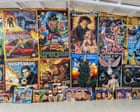
The scent of turpentine mixed with diesel exhaust stays in your clothes for days. If you walk through the bustling markets of Accra, Ghana, past the stalls of smoked fish and bright wax-print fabrics, you might miss the small, dusty workshops where a vanishing breed of artists changes how the world views cinema.
Decades ago, before digital screens and slick Hollywood marketing campaigns conquered the globe, a unique problem bred a wild, beautiful solution. In the late 1980s and 1990s, mobile cinema operators traveled across Ghana. They carried television sets, VCRs, gas-powered generators, and a curation of Hollywood action flicks, Bollywood musicals, and homegrown Ghanaian horror films. They moved from village to village, setting up impromptu theaters under the stars.
But a movie night needs an audience. Without access to official promotional materials or printing presses, these entrepreneurs turned to local sign painters. They handed them used flour sacks, stitched them together to form large canvases, and gave them a simple directive: make people want to buy a ticket.
What followed was a glorious explosion of untamed creativity.
The Canvas of Blood and Muscle
Consider a young artist sitting in a cramped studio in 1992. Let us call him Kwame, a composite of the legendary painters who forged this movement. Kwame is given a task. He must paint a poster for a movie he has never seen, based entirely on a two-minute description whispered to him by a frantic mobile cinema operator.
The movie is The Terminator.
Kwame does not have a glossy studio photo of Arnold Schwarzenegger. He has his imagination, a handful of cheap oil paints, and a canvas made of woven cotton that still smells faintly of wheat. He does not paint a faithful reproduction. He paints an mythic deity of steel and flesh. He adds extra guns. He paints rivers of crimson blood that never appeared in the actual film. He makes the villain twice as large as life because, in Kwame’s world, the stakes are everything.
These artists were not bound by copyright laws or studio notes. They were bound by the need to thrill. If a movie was a slow-burning thriller, the poster transformed it into a chaotic martial arts extravaganza. If a character died quietly in the script, the poster depicted them being swallowed whole by a giant, multi-headed snake.
It was marketing at its most visceral. It worked. People flocked to the screenings, drawn by the promise of the madness rendered on those flour sacks.
When the World Stopped Looking Away
For years, this art form existed in a hyper-local vacuum. The posters were tools. They were rained on, dragged through the mud, folded up, packed into the back of trucks, and eventually discarded when the paint flaked away to nothing. They were never meant to last.
Then, the world changed. The proliferation of cheap television sets and the rise of digital printing presses in the early 2000s nearly killed the tradition overnight. Why pay an artist to spend days painting a flour sack when you can print a perfect vinyl banner in fifteen minutes? The sign painters found their brushes drying up. The mobile cinemas faded into history.
But art has a strange way of refusing to die.
Western art collectors, traveling through West Africa, stumbled upon these weathered, bizarre canvases. What the locals saw as outdated advertising, global curators recognized as raw, unadulterated expressionism. The shift was sudden. Posters that once cost a few cedis to commission were suddenly hanging in high-end galleries in New York, London, and Paris.
The irony is thick. The very images created to lure teenagers into a makeshift video shack in rural Ghana are now sold for thousands of dollars to elite collectors who debate their subtext over champagne.
The Heavy Cost of Preservation
Step back into the reality of the creators. The global art market’s embrace of Ghanaian movie posters is a double-edged sword.
On one hand, it has provided a late-career lifeline to master painters like Deadly Cobra, Heavy J, and Papa Waris. They are finally receiving international acclaim for their contribution to pop culture. They are flown to exhibitions across Europe. Their signatures are studied by historians.
On the other hand, the context is completely severed.
When you strip a hand-painted poster of Matrix from the walls of a lively Accra neighborhood and frame it under museum-grade glass, something is lost. The grease stains, the tear marks from where a stray dog brushed against it, the faded corners bleached by the unforgiving West African sun—these are not defects. They are the biography of the object.
The true magic of these posters does not belong to the pristine white walls of a gallery. It belongs to the memory of a crowded room, the hum of a generator, the collective gasp of an audience seeing a cyborg on screen for the first time, and the smell of paint drying in the humid night air.
Kwame stands in his workshop today, surrounded by bright tubes of acrylic and digital prints. The flour sacks are harder to come by now. Most of his new commissions come from collectors abroad requesting recreations of his vintage work rather than promotions for current films. He paints the same monsters he painted thirty years ago, but the wild, chaotic urgency of the mobile cinema era is gone. He is no longer painting for the crowd gathering outside his door. He is painting for a catalog.
The brushes are still moving, but the street has gone quiet.