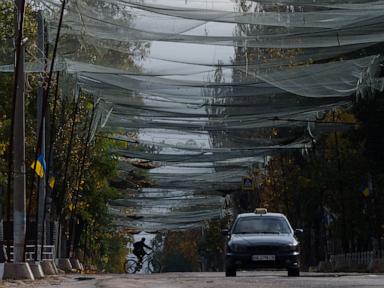
Silence.
When you have spent enough months listening to the low, metallic cough of outgoing mortar fire rattling the dust off window frames, the sudden absence of noise feels less like relief and more like an ambush.
On the left bank of the Dnipro River, in the Russian-occupied town of Oleshky, silence is an unnatural state of matter. For years, this flat expanse of sandy pine forests and low brick houses in southern Ukraine has been a frontline purgatory. Across the broad, muddy expanse of the river sits Kherson, liberated by Ukrainian forces in late 2022, turning the water between them into a lethal gallery of sniper fire, FPV drones, and endless artillery duels. Caught in the middle—trapped under occupation, battered by shelling, and largely cut off from the outside world—are the civilians who could not or would not leave.
Then, against every cynical instinct that war teaches you to trust, the firing stopped. Just for a few hours. Just long enough for a convoy of trucks carrying clean water, insulin, flour, and generators to roll across a bruised landscape during a localized ceasefire agreed upon by both Moscow and Kyiv.
To understand why a brief humanitarian truce in Oleshky matters—and why it is so agonizingly fragile—you have to look past the sterile diplomatic cables and step inside the kitchens where the tap water runs brown and the cellars where old women count out their last blood-pressure pills by flashlight.
The Geography of a Slow Suffocation
To grasp Oleshky’s predicament, picture a house where someone has locked the front door from the outside, bricked up the back exit, and then set fire to the neighboring yard.
Before the full-scale invasion in February 2022, Oleshky was a quiet satellite town of roughly twenty-four thousand people, connected to Kherson by the Antonivka Road Bridge. Residents commuted across the Dnipro to work, shop, or visit doctors. The river was a highway, not a wall.
Then came the occupation. Then came the liberation of the western bank. Then, in June 2023, came the catastrophic destruction of the Kakhovka Dam upstream, which unleashed a biblical wall of water that submerged Oleshky’s low-lying streets, drowned homes up to their eaves, and poisoned wells with sewage, industrial runoff, and rotting debris.
I remember standing on the high western bank of the Dnipro months after the floodwaters receded, looking through binoculars across the gray water toward Oleshky’s treelines. Even from miles away, you could see the watermark staining the plaster of abandoned buildings like a bruise that refused to fade. What you could not see were the thousands of mostly elderly, disabled, and impoverished residents left behind—people who lacked the money, the physical strength, or the Russian passports required to navigate checkpoints out of the occupied zone.
When the dam broke, international aid agencies were largely blocked from reaching the Russian-controlled left bank. Volunteers who tried to ferry civilians out in small boats under fire were shot at. Over the years that followed, Oleshky became an information black hole. Electricity flickered out for weeks at a time. Pharmacies emptied. If you needed dialysis, chemotherapy, or even basic antibiotics, you were at the mercy of an overstretched, under-supplied occupation administration or the black market.
A Hypothetical Morning on Mykhailivska Street
To see what a localized humanitarian pause actually buys in human terms, consider a hypothetical scenario—one grounded entirely in the documented testimonies of Oleshky residents and aid workers who have tracked conditions inside the town.
Imagine an eighty-one-year-old retired schoolteacher named Olena living in a single-story house a mile from the riverbank. Since the flood ruined her well, she relies on rainwater collected in plastic barrels and whatever bottled water neighbors can haul back from markets miles away. Her daughter fled to western Ukraine in 2022; they speak only once every ten days when Olena walks to a specific corner near a rusted grain silo where a faint mobile signal sometimes bleeds across the river.
By 6:00 AM on the morning of the truce, Olena is already awake, sitting on the edge of her bed in two wool sweaters because the gas pressure in the pipes dropped too low to fire her boiler overnight. She knows the rhythm of the war by heart. Usually, the drone buzz starts by dawn, followed by the sharp crack-thump of artillery exchanges over the marshes.
Today, nothing.
At 8:15 AM, a neighbor knocks on her shuttered window. Through the gap, Olena sees white vehicles marked with humanitarian emblems moving slowly down the cratered asphalt, escorted at a strict distance by military observers and coordinated through back-channel deconfliction lines that took weeks of painstaking negotiation to establish.
For Olena, geopolitics does not exist in that moment. Sovereignty, frontlines, and diplomatic leverage shrink down to the size of a five-liter plastic jug of clean drinking water, a box of thermal blankets, and a two-month supply of metformin for her diabetes.
How a Corridor Opens in the Dark
People often ask how two armies locked in a brutal war of attrition manage to agree on anything, even for six or eight hours. The truth is less romantic than a handshake and far more mechanical.
Think of a localized ceasefire not as peace, but as a surgeon clamping an artery just long enough to stitch a tear. The bleeding hasn't been cured; the pressure is simply held back by brute procedural force.
In conflicts like Ukraine, these micro-truces—often brokered through intermediaries such as the United Nations or the International Committee of the Red Cross—depend on excruciatingly specific choreography. Both sides exchange exact GPS coordinates for the transit route. They agree on the precise make, color, and license plate numbers of every truck. They establish a rigid window of time, down to the minute, during which artillery units, mortar teams, and drone operators along a designated sector of the front are ordered to hold their fire.
It is terrifyingly easy to break.
A nervous nineteen-year-old soldier in a trench who mistakes a civilian truck’s engine noise for an armored personnel carrier can ruin weeks of diplomacy with a single twitch of his finger. A rogue drone operator out of radio contact can drop a grenade and reignite an entire sector. Even in Oleshky, aid workers entering the zone know they are driving into an active kill box where the only armor they wear is a fragile promise made by men who are trying to kill each other every other day of the week.
And why do the warring parties agree at all? Sometimes it is international pressure. Sometimes it is the sheer logistical burden of an impending humanitarian collapse—cholera outbreaks, mass starvation, or freezing deaths in occupied towns create crises that neither military wants to manage behind its lines. Sometimes, rarely, a shred of shared humanity breaks through the bureaucratic armor.
The Trap of the Temporary
Yet celebrating a brief aid operation without looking at what follows is like applauding someone for throwing a bucket of water onto a burning house while refusing to turn off the gas main.
Here is the uncomfortable reality that anyone who has covered siege warfare knows well: temporary corridors often expose the sheer scale of the abandonment they are meant to relieve.
When trucks roll into a town like Oleshky for a single day, the lines stretch for blocks. People emerge from basements squinting against the daylight, carrying empty sacks, rusted wheelbarrows, and handwritten lists of medicines for bedridden spouses. Aid workers unload pallets as fast as human muscle allows, acutely aware of the ticking clock. Every minute spent explaining dosage instructions or listening to a resident beg for evacuation is a minute closer to the deadline when the truce expires and the sky becomes lethal again.
Worse still is the psychological whiplash. For months, survival in an occupied frontline town requires emotional numbness. You lower your expectations until survival itself is the only metric. When a humanitarian convoy arrives, hope rushes back in—dangerous, intoxicating hope that maybe the worst is over, maybe the corridor will stay open, maybe someone remembers you are alive.
Then the tailgates slam shut. The white trucks turn around and head back toward the checkpoints. The sun drops below the pine trees along the Dnipro.
What Remains After the Trucks Leave
It is easy, from thousands of miles away, to read a headline about a "brief truce" and feel a fleeting surge of optimism before scrolling on to the next crisis. We want tidy stories where small breakthroughs lead naturally to grand resolutions. War rarely grants us that comfort.
A single aid operation in Oleshky does not change the trajectory of the invasion. It does not rebuild the Kakhovka Dam, restore the blown bridges across the Dnipro, or return the displaced families scattered across Europe. It cannot erase the trauma of living for years under the hum of reconnaissance drones and the arbitrary power of an occupying force.
What it does is smaller, stubborn, and undeniably real. It keeps an eighty-one-year-old woman alive through another winter week. It buys a diabetic father thirty more days of insulin. It proves, however briefly, that even along one of the most heavily mined, fiercely contested riverbanks on earth, human beings still retain the capacity to stop shooting long enough to hand a stranger a loaf of bread and a bottle of clean water.
By nightfall, the truce window closes. In the damp cellars of Oleshky, families unscrew the caps of their new water jugs, set their flashlights on the floor, and wait for the first distant rumble to tell them the war has resumed.


