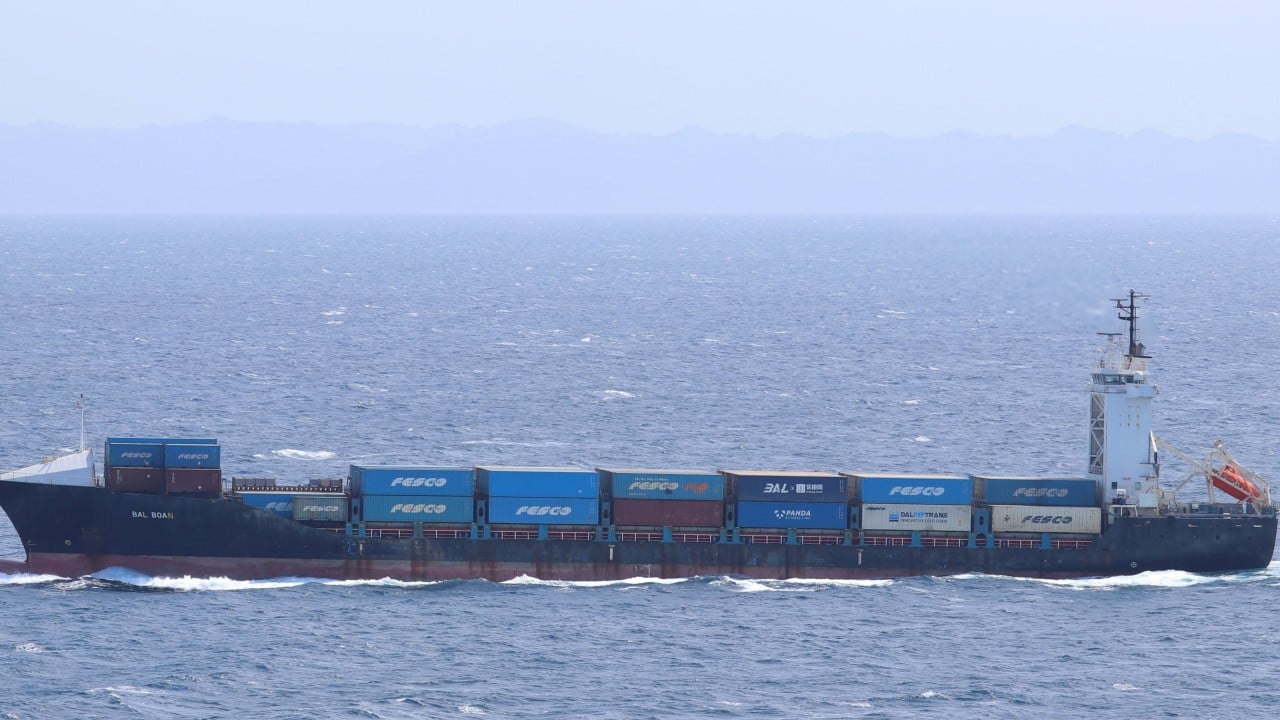
The United States military has escalated its maritime enforcement campaign in the Middle East, confirming that a Navy helicopter fired Hellfire missiles into the engine room of the Panamanian-flagged container ship M/V Vela Nova in the Gulf of Oman. According to United States Central Command, the vessel attempted to transit toward an Iranian port in direct violation of the American naval blockade. This strike highlights a widening operational crisis. Washington is attempting to economically strangle Tehran, yet the enforcement mechanism is entangling the US military in a prolonged and costly maritime containment strategy with no clear end in sight.
The Mechanics of Enforcement
Blockades are notoriously difficult to maintain, especially in congested global waterways. When the Pentagon reimposed its naval cordon around Iranian ports, the operational burden fell squarely on carrier strike groups and surface action units operating in the Arabian Sea and the Gulf of Oman.
The strategy relies on a tiered response protocol.
- First, commercial traffic is tracked via automated identification systems and maritime patrol aircraft.
- Second, suspect vessels bound for Iranian terminals receive verbal warnings and course-change directives.
- Third, if a crew refuses to comply, assets like MH-60 helicopters or carrier-based fighter jets deploy precision ordnance directly into non-vital propulsion infrastructure, such as smokestacks or engine rooms, to deaden the ship's steering and stop forward momentum without sinking the hull.
Central Command figures reveal the sheer scale of the operation. Officials state that American forces have redirected fifty-five commercial vessels, boarded two, and disabled three non-compliant ships since the policy took effect. Yet, every missile fired and every carrier deployed represents a drain on high-end munitions stockpiles that the Pentagon struggles to replenish at the speed of consumption.
The Strait of Hormuz Chokepoint
The friction at sea is a symptom of a much larger strategic stalemate. Following the outbreak of direct military hostilities between the United States, Israel, and Iran, Tehran effectively shut down traffic through the strategic Strait of Hormuz. This narrow waterway historically handled roughly one-fifth of the globe's petroleum supplies.
By deploying anti-ship missiles, fast-attack craft, and naval mines, Iran turned the passage into a killing zone. Global energy markets reacted instantly. Brent crude benchmarks climbed significantly, creating persistent economic shocks that ripple through Western political landscapes.
Tehran has maintained a rigid bargaining position. Iranian officials have made it clear that the Strait of Hormuz will remain sealed until Washington lifts its port blockade and rolls back economic sanctions. The US military response—targeting blockade runners like the Vela Nova—is designed to counter this leverage by proving that Iran cannot import critical goods while its own armed forces choke off international commerce.
The Insurance and Shipping Backlash
Naval blockades do not occur in a vacuum of gray-hull warships and missile strikes. They operate within the commercial reality of global maritime trade, where risk dictates every route and ledger.
Marine underwriters have responded to the Gulf of Oman skirmishes by classifying the entire region as a high-risk war zone. Premium rates for hull and machinery insurance have skyrocketed, pricing smaller shipping syndicates out of the market entirely. Shipowners who choose to gamble on running the blockade are typically flying flags of convenience, such as those of Panama or Palau, registered under opaque shell companies designed to insulate ultimate beneficial owners from liability.
When a Navy helicopter disables a container ship, the physical wreckage is only part of the problem. Salvage rights, environmental liabilities for potential fuel spills, and the legal status of detained civilian crews create a bureaucratic and diplomatic quagmire. Central Command statements frequently omit casualty figures or crew welfare details following these strikes, leaving maritime labor organizations to demand answers regarding the safety of seafarers caught in the crossfire of great power competition.
The Strategic Horizon
The military utility of stopping individual cargo ships does not solve the structural deadlock on land. Surface action groups can disable a dozen freighters, but as long as the underlying political objectives of Washington and Tehran remain mutually exclusive, the maritime theater will remain volatile.
Every enforcement action risks tactical escalation. A stray missile, a misidentified hull, or a fatal strike on a vessel carrying hazardous materials could instantly transform a constrained naval interdiction into a wider regional conflagration. The Pentagon's ironclad grip on the Gulf of Oman demonstrates tactical supremacy, yet it underscores a stark reality. Dominating the shipping lanes is easy; finding a way out of the blockade trap is nearly impossible.