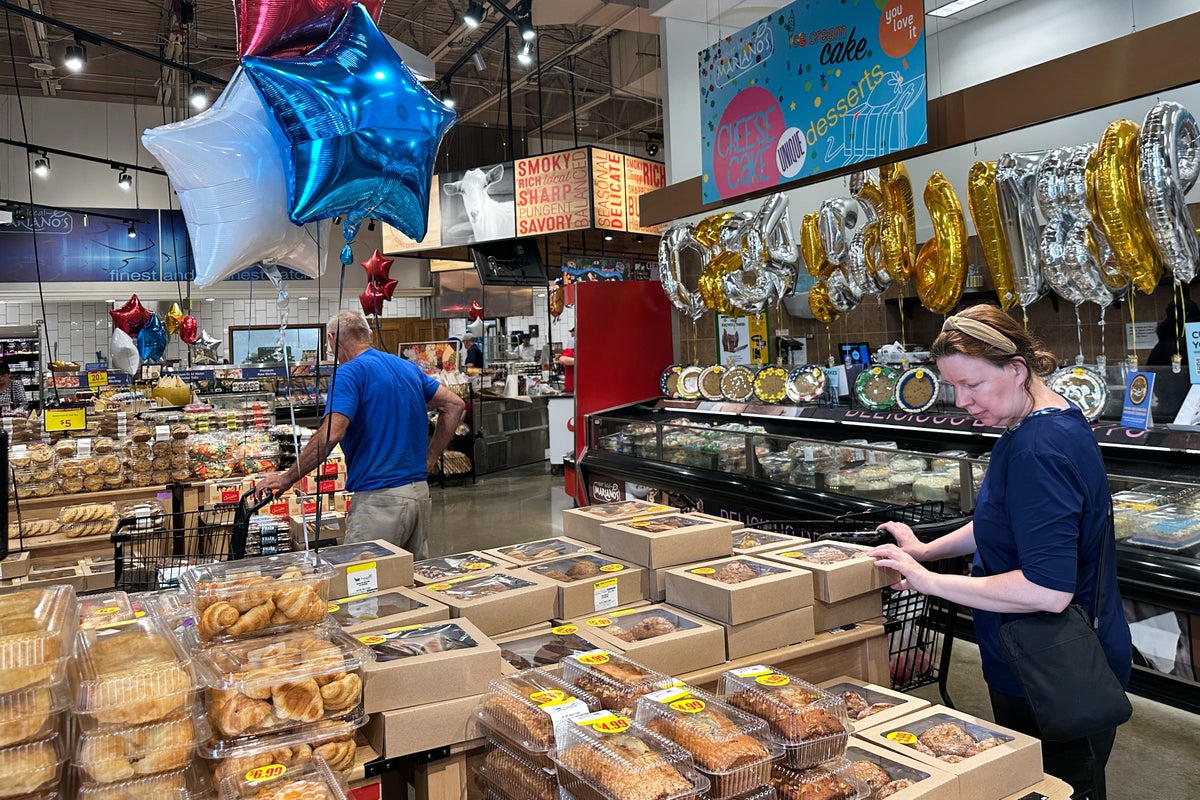
The fluorescent lights of the supermarket buzz with a low, irritating hum. Stand near the cereal aisle on any Tuesday evening, and you will see it. It is not a data point on a spreadsheet. It is a hesitation.
A woman stands with her hand hovering over a box of brand-name oats. She looks at the price tag. She blinks. Her hand drops, and she selects the generic store brand instead. If you found value in this post, you should look at: this related article.
This is where the true economy lives. Not on Wall Street, and not in the press briefings of the Federal Reserve. It lives in the micro-transactions of survival, the quiet mental math calculated over a carton of eggs, and the collective anxiety of millions of Americans trying to square the upbeat headlines with the reality of their bank accounts.
Recently, the major financial networks ran a series of dry, predictable headlines. "US consumer confidence inches up as economic pessimism lingers," they chanted in unison. They pointed to the Conference Board’s latest index, noting a fractional rise in public optimism. They threw around terms like "macroeconomic stabilization" and "cooling labor markets." For another look on this story, see the recent coverage from The New York Times.
But they missed the entire point.
When you look closely at the data, you realize that consumer confidence didn't actually surge. It merely stopped falling off a cliff. There is a massive, cavernous difference between feeling good about the future and simply feeling relieved that yesterday didn't break you.
We are living through a strange, psychological twilight zone. Economists tell us the worst is over. The numbers say inflation is leveling out. Yet, the ghost of high prices still whispers in our ears every single time we swipe a debit card.
The Myth of the Average American
To understand why the nation is gripped by this collective hesitation, we have to look past the aggregate percentages. Let us invent a family to represent the millions currently caught in this economic purgatory. We will call them Sarah and Marcus.
Sarah works in mid-level healthcare administration. Marcus manages a local auto parts supply store. Combined, they bring home what used to be a solidly middle-class income. They are not poor, but they are tired.
A few years ago, their financial life had a predictable rhythm. They paid their mortgage, put a little into savings, took a modest summer vacation, and didn't think twice about ordering pizza on a Friday night. Today, that rhythm is broken.
When economists celebrate a drop in the rate of inflation, Sarah looks at her spreadsheet in disbelief. She realizes what the talking heads on television rarely explain: prices are not going back down. They are just climbing at a slower pace. The $4 gallon of milk isn't returning to $2.50. It is just staying at $4, or creeping up to $4.10.
For Marcus, the pressure manifests at work. He sees the supply chain stabilizing, sure, but his customers are angry. They come in needing a new alternator, and when he gives them the price, they look at him as if he is personally robbing them. He watches people walk out of his store determined to drive a compromised vehicle because they simply cannot afford the fix.
When the Conference Board surveys thousands of households to track the Consumer Confidence Index, they are measuring the psychological scars of people like Sarah and Marcus. The index rose slightly this month because gas prices dipped in certain regions and the stock market hit a few record highs. But the underlying sentiment—the Present Situation Index—tells a far more fractured story.
People are looking around and realizing that the baseline cost of existence has permanently shifted upward.
The Invisible Stakes of a Two-Tier Economy
Why does this minor fluctuation in a consumer index matter so much? Because consumer spending drives roughly 70 percent of the United States economy. If the American consumer decides to pull back en masse, the entire engine stalls.
Right now, we are witnessing the birth of a two-tier consumer reality.
On one side, you have upper-income households that own assets. Their homes have appreciated significantly over the last four years. Their retirement portfolios are thriving on the back of tech stock rallies. For this group, the price of a restaurant meal or a flight ticket is an annoyance, not a crisis. They keep spending, which keeps the top-line economic data looking healthy.
On the other side is the silent majority. These are the renters, the hourly workers, and the middle-class families whose wages have failed to keep pace with the cumulative 20-plus percent rise in consumer prices since the turn of the decade. They are running out of runway.
Consider what happens next: credit card debt in the United States has soared to historic highs. For a long time, families used plastic to bridge the gap between their static income and skyrocketing expenses. It was a temporary band-aid. Now, the interest rates on those cards are hovering near 22 percent. The band-aid is pulling off the skin.
When you look at the slight tick upward in consumer confidence through this lens, it becomes clear that the optimism is incredibly fragile. It is the optimism of a swimmer who has finally managed to get their nose above water after minutes of gasping for air. They aren't celebrating because they are on dry land; they are just glad they haven't drowned yet.
The Jobs Paradox
The other pillar supporting this fragile optimism is the job market. For months, the narrative has been clear: unemployment remains low, so the economy must be good. If you have a job, you can survive.
But the ground beneath that pillar is shifting.
Talk to anyone currently looking for work, and the reality feels entirely different from the official statistics. The era of the "Great Resignation," when workers could easily jump ship for a 20 percent raise, is dead. Today, corporate hiring processes are grueling marathons. Job seekers endure four, five, or six rounds of interviews only to be ghosted by an automated email system.
Companies are quietly trimming fat. They aren't always executing massive, headline-grabbing layoffs, but they are engaging in "quiet cutting"—eliminating open positions, letting natural attrition shrink teams, and asking the remaining employees to take on double the workload without extra compensation.
Marcus sees this in his industry. Two of his delivery drivers left six months ago. His corporate office refused to approve job postings to replace them. Now, Marcus and his remaining counter staff are splitting the delivery routes themselves while trying to keep the store open. They are exhausted.
This environment breeds a specific kind of compliance born of fear. Workers are holding onto their current jobs with white-knuckled grips. They are less likely to demand raises, less likely to report toxic work environments, and far less likely to take entrepreneurial risks.
When people tell pollsters they feel "secure" in their jobs, it often doesn't mean they are happy. It means they are terrified of the alternative.
The Battle for the American Mind
Economics is ultimately a social science rooted in human behavior, which means it is governed by perception. If people believe hard times are coming, they stop spending, which ironically causes the hard times to arrive.
This is why institutions go to great lengths to manage public perception. We are bombarded with charts showing that real wages are finally outpacing inflation on a year-over-year basis. We are told that the United States has engineered a "soft landing," avoiding the brutal recession that many predicted.
Yet, you cannot gaslight a person’s grocery receipt.
The disconnect between official economic metrics and public sentiment exists because human beings do not experience life in annual percentages. We experience life cumulatively. If a bag of chips went from $3 to $5 over three years, our brains remember the $3 baseline. The fact that it only went from $5 to $5.10 this year feels like cold comfort.
The slight rise in the latest consumer confidence data represents a collective sigh, not a cheer. It is the realization that the chaotic price spikes of the post-pandemic era have subsided into a dull, manageable ache. We are adapting to our new, more expensive reality. We are learning to live with less, to cut out the extras, and to find solace in small stabilities.
The View from the Checkout Line
The true health of an economy cannot be measured by an index score of 102 or 103. It is measured in the quiet moments of decision-making that unfold in hardware stores, dental offices, and car dealerships across the country every single afternoon.
It is measured when a father decides to patch his son’s sneakers with duct tape one more time rather than buying a new pair. It is measured when a retired couple skips a prescription dosage to make the medication last through the end of the month. It is measured in the underlying, persistent current of worry that colors every conversation about the future.
The pessimists haven't left the building. They have just grown quiet, watching, waiting, and adjusting their budgets in the dark.
Back in the supermarket, the woman finally walks away from the cereal aisle. Her cart contains the generic oats, a carton of eggs, a loaf of bread, and a single, small bouquet of inexpensive flowers. A tiny luxury. A defiant statement that life must consist of something more than just balancing a ledger that refuses to stay balanced.
She pushes her cart toward the checkout line, her posture straight, her face a mask of careful calculation, moving forward into an uncertain economy one calculated choice at a time.


