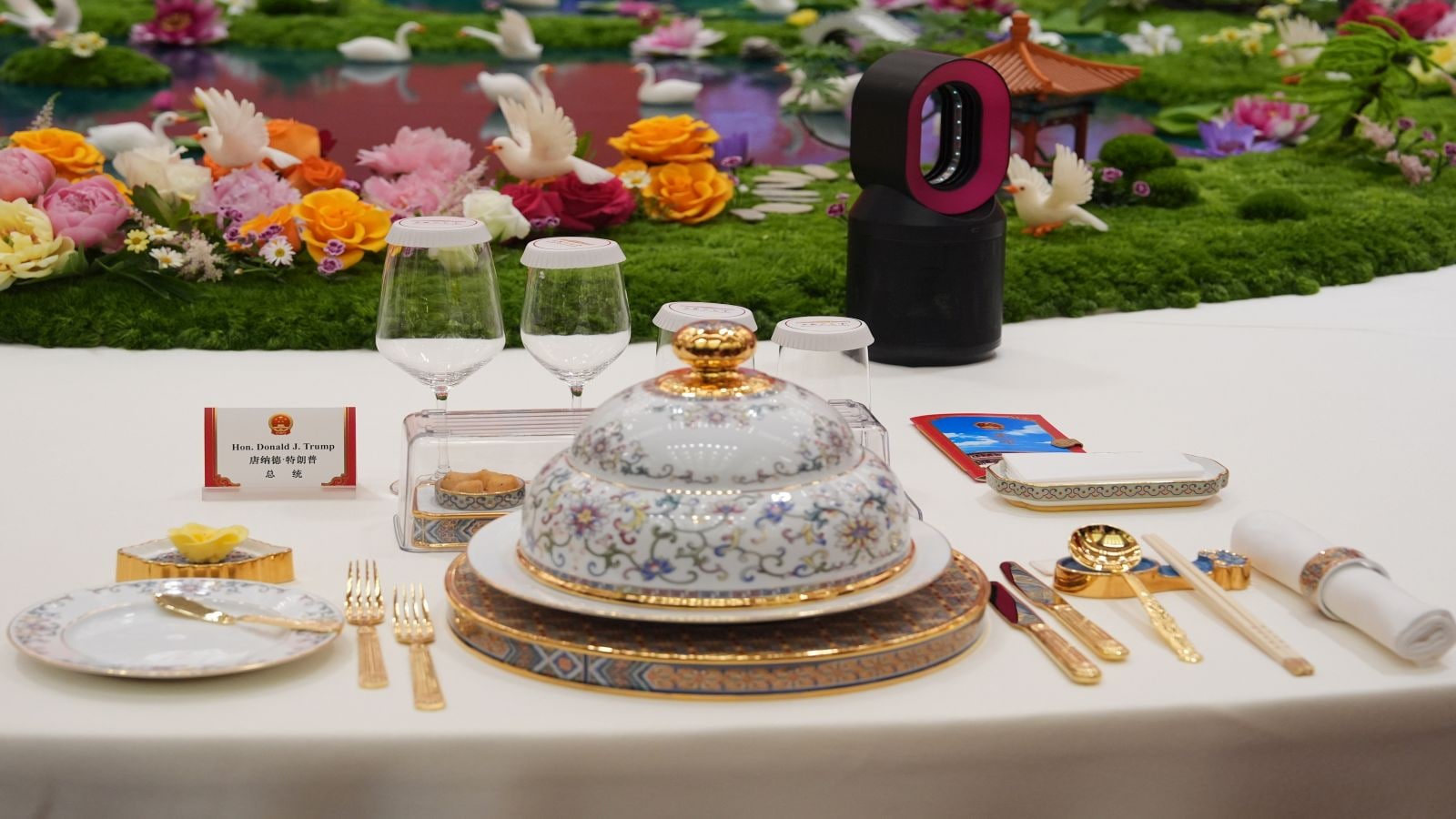
When the motorcade of a U.S. President rolls into the sprawling courtyard of the Great Hall of the People in Beijing, the high-stakes theater of international relations moves from the negotiating table to the round dinner table. The state banquet is rarely about the food itself. It is a calculated exercise in soft power where every ingredient serves as a diplomatic signal, and every course is a move in a multi-generational game of cultural branding. On May 14, 2026, as Donald Trump and Xi Jinping sat down for a lavish welcoming banquet, the menu followed a playbook refined over seven decades of Communist Party rule.
To the casual observer, the dishes—Kung Pao chicken, stewed beef, and the delicate broths of the Huaiyang tradition—might seem like a simple nod to local flavor. They are not. They are the result of a rigorous selection process designed to project a specific image of a modern, stable, and sophisticated China.
The Huaiyang Doctrine
While Westerners often associate Chinese food with the fiery spices of Sichuan or the dim sum of Guangdong, the Chinese state has long leaned on Huaiyang cuisine as its official diplomatic language. Originating from the region around the lower reaches of the Yangtze River, Huaiyang food is defined by its "middle way" philosophy. It is neither too spicy, nor too salty, nor too sweet.
This neutrality is intentional. In the world of high-level diplomacy, the worst thing a dish can do is offend. By serving Huaiyang dishes, Beijing ensures that even the most conservative Western palate finds nothing to object to. It is the culinary equivalent of a carefully worded joint communiqué: balanced, non-confrontational, and meticulously polished.
The true power of this cuisine lies in its symbolism of labor. Take, for instance, Wensi Tofu. A chef must slice a single block of soft tofu into thousands of strands, each no thicker than a human hair, which then float in a clear broth like a silk cloud. This is not just a soup. It is a demonstration of extreme discipline and mastery. To a visiting head of state, the message is clear: If we can do this to a block of tofu, imagine our precision in manufacturing, technology, and governance.
Accommodating the Big Mac President
The 2026 banquet, like Trump’s previous visit in 2017, faced a unique challenge. How do you honor a guest who famously prefers well-done steaks and fast-food burgers within the rigid framework of Chinese protocol?
The solution was a subtle hybrid. In 2017, the menu included stewed beef with tomato. This wasn't a traditional Huaiyang staple, but a clever bridge. It mimicked the flavor profile of a Western pot roast while utilizing Chinese slow-braising techniques. It was a "safe" dish—the culinary version of a handshake across the aisle. By 2026, this strategy had evolved. The chefs at the Great Hall have mastered the art of "gastronomic mirroring," where they serve dishes that feel familiar to the guest but are prepared with 100% domestic ingredients and techniques.
The Ghost of Zhou Enlai
The blueprint for these dinners was drafted by China’s first Premier, Zhou Enlai. He understood that the founding of the People's Republic in 1949 needed a new aesthetic—one that broke away from the perceived decadence of the imperial era but maintained a sense of ancient authority.
He chose Huaiyang cuisine for the "Founding Banquet" because it represented a "people's" cuisine that had been elevated by scholarly refinement. This tradition persists today. When you see a "Lion’s Head" meatball on a state menu, you are seeing a dish that has been served to every major world leader from Richard Nixon to Vladimir Putin.
Key Dishes of the Diplomatic Circuit
| Dish Name | Diplomatic Function | Historical Precedent |
|---|---|---|
| Lion’s Head Meatball | Represents unity and strength through its spherical shape. | Served at the 1949 Founding Banquet. |
| Peking Duck | The "heavy hitter" used to impress through spectacle. | The centerpiece of the 1972 Nixon visit. |
| Yangzhou Fried Rice | Demonstrates the "humble" roots of the Party. | A staple of G20 and BRICS summits. |
| Squirrel Fish | Showcases technical complexity and visual flair. | Often used to celebrate bilateral anniversaries. |
The Kissinger Chicken and the Power of the Set Menu
Culinary diplomacy in China extends far beyond the dining hall. It is a commercial engine. When Henry Kissinger made his secret visit to Beijing in 1971, a specific chicken dish was prepared for him. Decades later, that dish—and others like it—are sold in restaurants across the country as "State Banquet Sets."
This is the ultimate soft power move. By turning diplomatic menus into consumer products, the Chinese government reinforces a narrative of national pride and cultural superiority among its own citizens. It turns a closed-door political event into a shared national experience. When a local family in Shanghai orders the "Trump-Xi Set," they are consuming the same prestige as the leaders themselves.
The High Cost of a "Simple" Meal
Despite the rhetoric of "moderation" and "avoiding extravagance," these banquets are some of the most expensive and logistically complex events on the planet. The ingredients are often sourced from "Green Bases"—specialized, high-security farms that produce organic, hormone-free vegetables and meat exclusively for the top leadership.
Each plate is inspected for temperature, placement, and visual symmetry. If a single strand of tofu is out of place, the dish is discarded. This obsession with perfection serves a dual purpose. Externally, it projects an image of a flawless state apparatus. Internally, it reinforces the hierarchy of the Great Hall, where the kitchen is as strictly managed as the military.
Beyond the Plate
In 2026, the stakes are higher than they were a decade ago. Trade tariffs, technological competition, and territorial disputes loom over every toast. In this environment, the banquet is a pressure valve. It is the one moment where both sides agree to put aside the rhetoric and participate in a shared ritual.
But do not mistake the hospitality for weakness. In the lexicon of Chinese diplomacy, the host always holds the upper hand. By inviting a foreign leader to sit at their table, eat their food, and follow their protocol, the Chinese state is asserting its role as the center of the world. The food is merely the bait. The real meal is the recognition of China’s status as a peer superpower.
As the final course—usually a seasonal fruit platter or a light pastry—is cleared, the "Middle Way" of Huaiyang cuisine has done its job. It has provided a neutral ground where two of the world's most powerful men can coexist for two hours without a public spat. In the world of the Great Hall, a meal where nothing goes wrong is the greatest victory of all.
:max_bytes(150000):strip_icc():focal(819x186:821x188)/Murdaugh-Family-e90854a716884d608fb6fd925e18d840.jpg)
