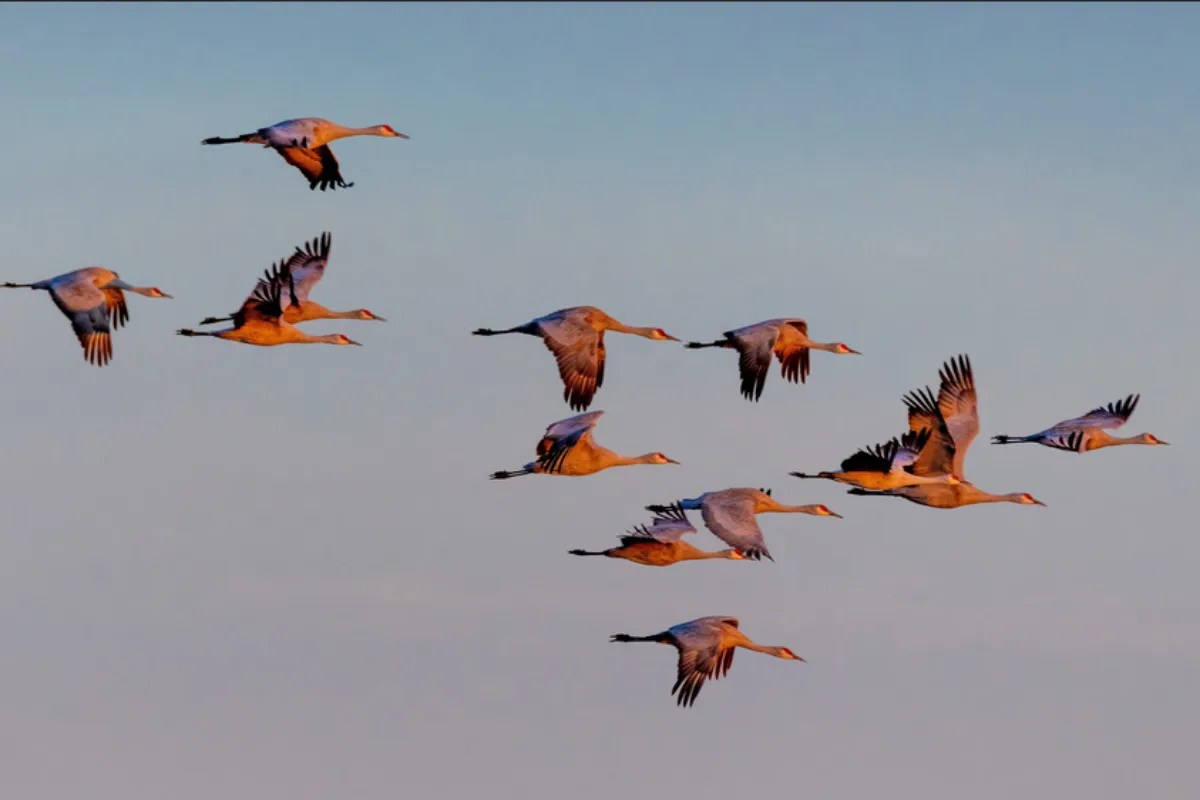
The morning air used to taste like urgency.
When I was ten, my grandfather would step out onto the balcony of our old house just before dawn, holding a steaming clay cup of tea, and look up. He didn't look at the sunrise. He looked at the shadows threading across the clouds. They’re early this year, he would murmur, pointing a calloused finger toward a dark, shifting ribbon of life carving its way across the pale horizon. Thousands of bar-headed geese, painted storks, and restless flyers, painting a temporary ceiling over our heads on their ancient pilgrimage from the freezing roof of the world down to the sun-soaked wetlands.
Motion. Sound. A chaotic, beautiful roar of beating wings that rattled the tin roof and woke the neighborhood dogs.
Today, the balcony is quiet. The tea still steams, but the sky is vast, blue, and utterly vacant.
Across the globe, more than half of all migratory bird species are in steep, terrifying decline. We are not just losing birds. We are losing the heartbeat of the seasons.
The Unseen Geometry of Flight
To understand what is happening, you have to look past the poetry and down into the mud.
Imagine a wetland. Not as a school textbook describes it, but as a bustling, microscopic engine room. Mudskippers dart, dragonflies hunt, and millions of benthic invertebrates churn the soil. Into this rich banquet drops a weary traveler. A migratory shorebird that has flown thousands of miles nonstop over oceans and mountain ranges, its body fat reserves burned down to a microscopic fraction.
It drops because the wetland is a pit stop on a celestial highway.
These highways are called flyways—the Central Asian Flyway, the East Asian-Australasian Flyway, the Atlantic Flyway. They are invisible corridors etched into the sky by millennia of instinct and survival. Birds do not pack maps; they carry an inherited compass tuned to the stars, the Earth's magnetic field, and the smell of wet earth.
When my grandfather watched those flocks, he was watching a living calendar. The arrival of the Siberian crane meant winter was knocking. The return of the Asian koel meant the mangoes were ripening.
Now, that calendar is breaking.
Scientists studying the data across continents have found a grim consistency. According to comprehensive ecological assessments, roughly forty-eight percent of migratory bird species are currently experiencing population declines, with aquatic and shorebird species bearing the heaviest blow.
Why? Because the highway has potholes. Massive, deadly ones.
The Concrete Trap
Let us walk through a hypothetical scenario, grounded in the reality of what happened to the wetlands near my childhood home.
Call her Maya. Maya isn't a human; she is a common redshank, a sleek, long-legged shorebird born in the high-altitude marshes of Central Asia. Last autumn, Maya and her flock took flight south. Their target was a vast, shallow lake surrounded by reeds—a place where their ancestors had refueled for centuries.
Maya flies for fourteen hours straight. Her wings ache. Her heart beats at five hundred beats per minute. She spots the familiar gleam of water below and begins her descent.
Except the water isn't there anymore.
Instead, she sees geometric grids of grey concrete, sprawling housing developments, and toxic froth pooling from an upstream factory. The muddy shallows where she expected to unearth nutrient-rich worms have been dredged, filled, and paved over to make way for a concrete warehouse.
Confused, exhausted, and running on fumes, Maya has to push onward into the unknown, burning the very muscle mass she needs to survive. Many of her flock do not make it. They drop out of formation one by one, falling into the urban sprawl below.
This is not a rare tragedy. It is happening billions of times over.
Wetlands worldwide are disappearing three times faster than forests. We drain them to build cities. We pollute them with agricultural runoff—heavy doses of nitrates and pesticides that turn vibrant aquatic ecosystems into toxic dead zones. We choke rivers with dams, altering the natural flood pulses that create the shallow mudflats migratory birds desperately need.
The Silent Unraveling
People often ask: So what if there are fewer birds? The sky is big. Life goes on.
This is where the illusion of isolation traps us. We think nature is a collection of distinct exhibits in a museum—here are the trees, here are the birds, here are the humans, each locked behind glass.
In reality, nature is a single, vibrating web. Pull one thread too hard, and the whole thing warps.
Consider what happens next when the birds vanish.
Birds are the ultimate frequent flyers of ecology. They are couriers of life. They carry seeds in their gut and mud on their feet, planting flora across vast geographic barriers. They are voracious predators of insects. A single colony of migratory swallows consumes tons of agricultural pests every single season, acting as a natural pesticide shield for the very crops we harvest.
When the migratory birds decline, insect populations explode. Farmers respond by pouring more synthetic chemicals onto the soil. The chemicals wash into the dwindling rivers. The water quality drops. The fish die.
And the cycle spirals downward.
We are dismantling the natural scaffolding that supports our own existence, and we are doing it in absolute silence.
The Weight of Silence
I went back to that balcony last year.
I stood there at dawn with my own cup of tea. The air felt heavy, sticky with urban smog rather than the crisp bite of autumn. I waited. Ten minutes. Twenty minutes.
Nothing crossed the pale blue. No wings. No chaotic chorus.
Just the distant hum of highway traffic and the dull roar of construction down the road where the last remaining marshland was currently being filled with truckloads of rubble.
It is easy to feel overwhelmed. The scale of global biodiversity loss feels like a mountain too steep to climb, a story already written and hurtling toward a sad ending. Sometimes, looking at the empty sky makes you want to turn back inside, close the windows, and pretend the world outside isn't unraveling.
We are tired of bad news. We are tired of being told that everything we touch turns to dust.
Yet, the birds do not give up easily. Even now, amidst the concrete and the pollution, resilient flocks still try to make the journey. They still trust the ancient rhythm, flying thousands of miles on exhausted wings, hoping against hope that the wetland they remember will still be waiting for them at the end of the world.
The question isn't whether the sky can empty out completely. We know it can.
The real question is whether we have the courage to build the rest stops back before the last wings fall.
The tea cools in my hand. The wind shifts, carrying the faint scent of diesel and dust. Somewhere far to the north, a new generation of wings is lifting off the ground, turning their eyes toward a south they have never seen, trusting a sky we are currently failing to protect.