Saltwater stings the eyes when you dive down past the sunlit upper layers, but the burn is nothing compared to the shock of silence. Up above, the world is full of engines, propellers, shouts, and the low, continuous hum of human urgency. Down here, thirty meters below the Mediterranean surface off the coast of Malta, time slows. The water is a clear, pale sapphire, cold enough to bite through a thick wetsuit.
I remember the exact weight of my air tank pressing against my spine the day the ocean changed its mind.
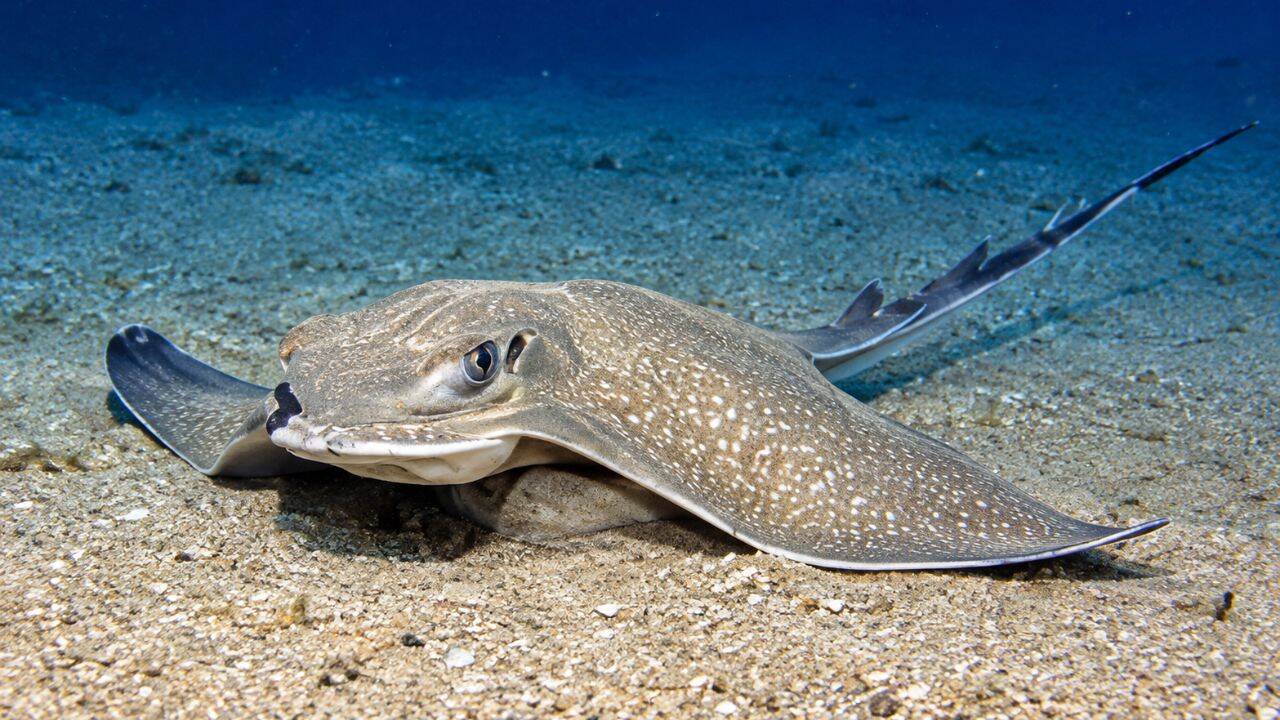
Marine biologists talk about aggregations the way accountants talk about quarterly earnings. They use terms like population density and spatial distribution. But numbers on a spreadsheet cannot capture the gravity of what happened in those quiet blue corridors. Over one hundred common eagle rays—creatures usually solitary, ghosts that flap their dark, diamond-shaped wings across the sandy expanses of the deep—decided to break their own rules.
They gathered. All at once. In numbers never before recorded in human history.
To understand why this matters, you have to look at how these animals live. Imagine spending your entire life walking a vast, empty desert alone, only stopping occasionally to cross paths with a traveler who shares your stride. Eagle rays are the nomads of the pelagic zone. They sweep through the water with a slow, hypnotic majesty, their long, whip-like tails trailing behind them like ink strokes. They are not built for crowds. Their mouths, lined with hard, flat plates designed to crush crabs and sea urchins, are tucked beneath their bodies, giving them a perpetually calm, almost ancient expression.
When a single ray glides past you, it feels like an accidental audience with a king.
When a hundred of them fill the water column like autumn leaves caught in a strong autumn updraft, the scale of reality shifts.
The first sign was not visual. It was a change in the water itself. A faint vibration, too slow to be sound, humming through the neoprene of my suit. My dive partner, Mark, tapped my shoulder and pointed toward the drop-off where the seabed plunges into the dark abyss.
At first, they looked like shadows cast by passing clouds. Then the shadows grew wings.
They came from the deep blue, rising in staggered layers, tier upon tier, like an amphitheater built of muscle and cartilage. Their wingspan averaged nearly two meters across, sweeping up and down in a synchronized cadence that defied the chaotic currents. There were no aggressive bursts of speed. No panic. Just a massive, deliberate procession of slate-gray bodies with white-spotted backs, their bellies stark white against the gloom.
Scientists who later analyzed the footage spoke of rare environmental triggers. Unusually warm summer currents, shifting food webs, perhaps an alignment of factors we are only beginning to decode. But standing there in the current, watching them circle in a massive, slow-motion vortex, science felt entirely secondary to wonder.
We know so little about what happens when the human footprint pulls back, even briefly. Malta’s coastal waters have felt the heavy hand of commercial fishing, shipping lanes, and coastal development for generations. The Mediterranean is one of the most heavily trafficked seas on Earth. Every square mile is monitored, fished, crossed, or polluted.
And yet, right there, under the flight path of international cargo ships and just miles from crowded tourist beaches, the wild world reclaimed its sovereignty.
Why did they choose this exact spot?
Marine conservationists from the Save the Maltese Blue initiative have spent months pouring over hydrophone data and temperature logs. The prevailing theory points to a confluence of nutrient-rich upwellings driven by shifting offshore winds, creating an ephemeral buffet of benthic invertebrates. But there is another layer, one that rarely makes it into peer-reviewed journals.
Animals talk to the ocean in ways we cannot hear.
We tend to view the sea as a collection of resources or a backdrop for recreation. We forget it is a vast, interconnected sensory organ. A chemical and acoustic highway. When conditions align perfectly, the ocean whispers a signal across hundreds of miles of open water. Here. The signal says. Here is safety. Here is abundance. Gather.
As the hours passed, the hundred-plus rays formed a living wall between the shallow reefs and the open sea. I hovered near a rocky outcrop, holding my breath so the bubbles would not disturb their path, watching a massive female pass within arm's reach. Her eye, dark and intelligent, met mine for a fraction of a second. There was no fear in it. Only an immense, ancient indifference to our petty dramas up on the dry land.
She wasn't looking at me as an enemy or a curiosity. She was looking at me the way a mountain looks at a tourist.
The gathering lasted less than forty-eight hours. By the time the weekend storms rolled in, churning the clear sapphire into a murky gray soup, the assembly had dissolved. The rays slipped back into the deep trenches, dispersing along the coastlines of Sicily, Tunisia, and beyond, returning to their solitary lives as if the great meeting had never occurred.
Back on the dock, peeling off my sticky wetsuit under a merciless midday sun, the contrast was violent. Cars sped along the coastal road. Cafes buzzed with espresso machines and chatter about real estate and flights. Nobody on the shore knew that an empire of wings had just risen and fallen twenty meters below the surface.
That is the true secret of the ocean. It does not wait for our permission to be magnificent. It keeps its own counsel, maintaining ancient rhythms just out of sight of our shorelines, waiting for those rare, quiet moments when we are humble enough to look down and witness the magic unfolding in the dark.